What Are Matchings in Graph Theory and Their Types?
TL;DR
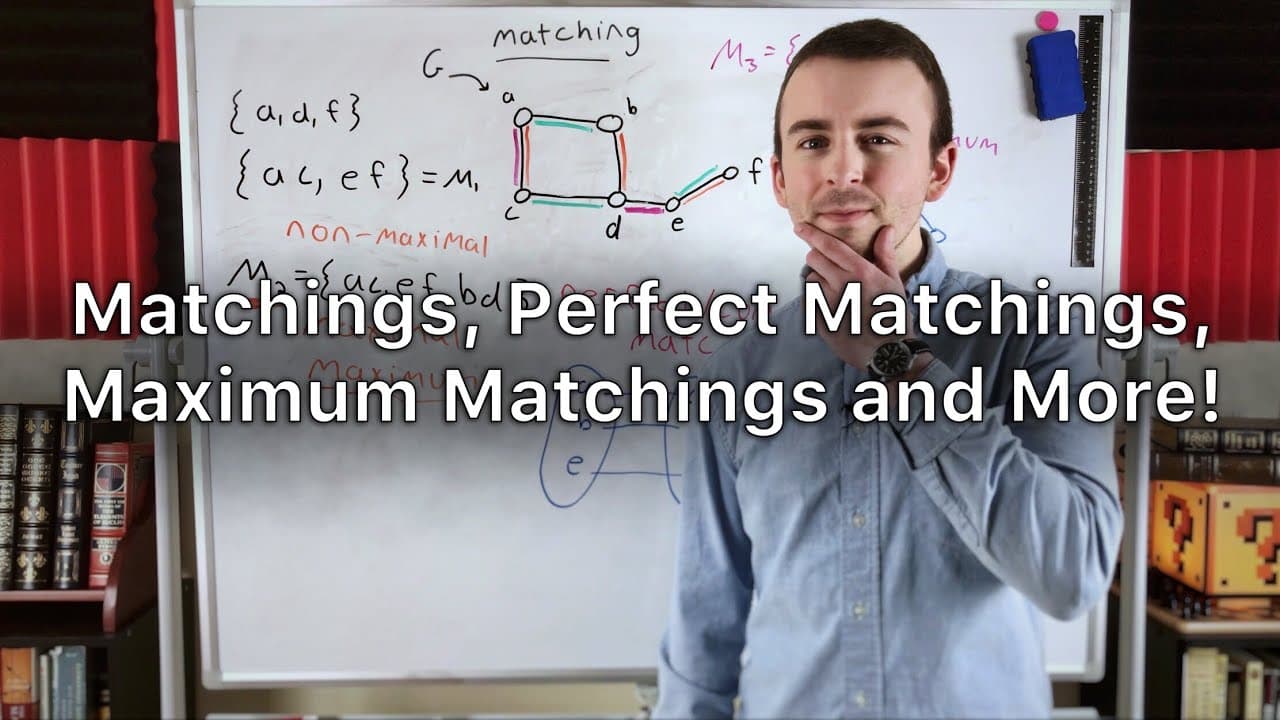
In graph theory, a matching refers to a set of edges where no two edges are adjacent. A maximal matching cannot be expanded further, while a maximum matching has the largest number of edges. A perfect matching matches every vertex with an edge, ensuring all vertices are included, although not all graphs can achieve this.
Transcript
hey everyone in today's wrath of math lesson we're going to be clarifying the definition of matching as well as some special types of matchings in graph theory this is a viewer requested video and either 23 asked about matchings complete matchings and perfect matchings in bipartite graphs for starters we're gonna ditch the bipartite graph part of t... Read More
Key Insights
- 😫 Matchings in graph theory refer to sets of edges that are not adjacent to each other.
- 📈 A non-maximal matching is a proper subset of another matching in the graph.
- 🦔 A maximum matching is a matching with the largest number of edges in the graph.
- 💯 A perfect or complete matching is a matching where every vertex in the graph is incident with one edge in the matching.
- 🦔 The subgraph induced by a matching in a graph includes the edges in the matching and their incident vertices.
- 💯 Some graphs may not have a perfect matching, especially those with an odd number of vertices.
- 🦔 A maximal matching is a matching that cannot be expanded by adding another edge.
Install to Summarize YouTube Videos and Get Transcripts
Explore YouTube Video Summarizer or Get YouTube Transcript Extractor
Questions & Answers
Q: What is a matching in graph theory?
A matching in graph theory refers to a set of edges in a graph where no two edges are adjacent to each other.
Q: What is the difference between a maximal matching and a maximum matching?
A maximal matching is a matching that cannot be expanded by adding another edge, while a maximum matching is a matching with the largest number of edges in the graph.
Q: What is a perfect or complete matching?
A perfect or complete matching is a matching where every vertex in the graph is incident with one edge in the matching, meaning it matches every vertex in the graph.
Q: Can every graph have a perfect matching?
Not every graph can have a perfect matching. A graph needs to have an even number of vertices to have a chance at having a perfect matching, but it's not guaranteed.
Key Insights:
- Matchings in graph theory refer to sets of edges that are not adjacent to each other.
- A non-maximal matching is a proper subset of another matching in the graph.
- A maximum matching is a matching with the largest number of edges in the graph.
- A perfect or complete matching is a matching where every vertex in the graph is incident with one edge in the matching.
- The subgraph induced by a matching in a graph includes the edges in the matching and their incident vertices.
- Some graphs may not have a perfect matching, especially those with an odd number of vertices.
- A maximal matching is a matching that cannot be expanded by adding another edge.
- Not every maximal matching is a maximum matching, as a maximum matching has the largest number of edges in the graph.
Summary & Key Takeaways
-
Matchings in graph theory refer to sets of edges that are not adjacent to each other.
-
A maximal matching is a matching that cannot be expanded by adding another edge, while a maximum matching is a matching with the largest number of edges in the graph.
-
A perfect or complete matching is a matching where every vertex in the graph is incident with one edge in the matching.
Read in Other Languages (beta)
Share This Summary 📚
Summarize YouTube Videos and Get Video Transcripts with 1-Click
Try YouTube Summary with ChatGPT & Claude or YouTube Transcript Generator
Explore More Summaries from Wrath of Math 📚


Summarize YouTube Videos and Get Video Transcripts with 1-Click
Try YouTube Summary with ChatGPT & Claude or YouTube Transcript Generator