1 Hour Simple Japanese Listening - Money in Japan (ENG SUB) #10
TL;DR
Explores Japanese money, cashless payments, and gambling culture.
Transcript
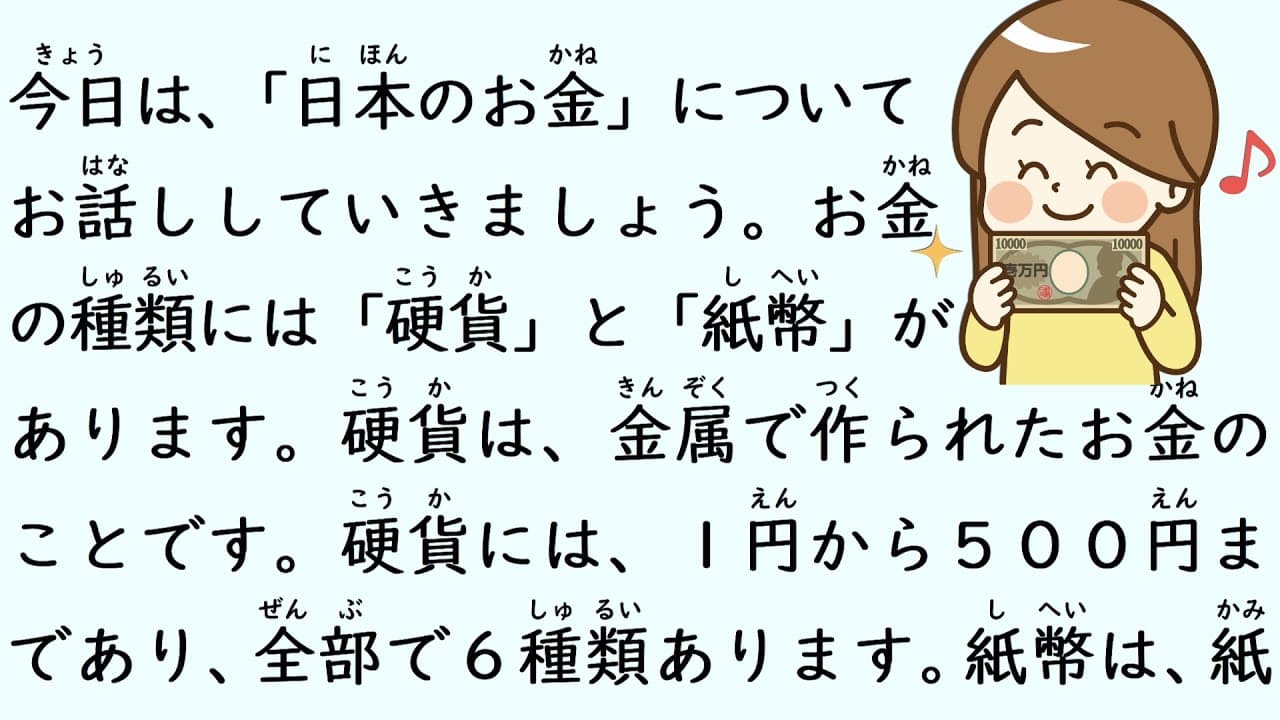
Today, let's talk about "Money in Japan". First, there are two types of money: "coins" and "bills". Coins are money made of metal. There are six types of coins in total, ranging from 1 yen to 500 yen. Bills are money made of paper. Currently, there are four types of bills. Japanese money... Read More
Key Insights
- Japanese currency consists of coins and bills, with advanced anti-counterfeiting technology that makes counterfeiting rare.
- Cashless payments in Japan include credit cards, electronic money, and smartphone payments, offering convenience and speed.
- Credit cards require a screening process and offer benefits like points, while electronic money allows quick transactions without a PIN.
- Smartphone payments eliminate the need for carrying cards, integrating payment options directly into mobile apps.
- Cashless payments reduce the need to carry cash, minimize theft risk, and provide an automatic transaction record for easy money management.
- Cultural practices like allowances and New Year's gift money teach Japanese children money management and saving habits.
- Full-time employment provides stability and benefits in Japan, while part-time jobs offer flexibility but less security.
- Gambling forms like pachinko, horse racing, and lotteries are popular in Japan, with pachinko being a unique blend of skill and luck.
Install to Summarize YouTube Videos and Get Transcripts
Explore YouTube Video Summarizer or Get YouTube Transcript Extractor
Questions & Answers
Q: What are the types of cashless payments in Japan?
The video describes three main types of cashless payments in Japan: credit cards, electronic money, and smartphone payments. Credit cards allow deferred payments with benefits like points. Electronic money involves charging money onto a card with an IC chip for quick transactions. Smartphone payments use apps to facilitate easy transactions without carrying physical cards.
Q: How does Japanese currency prevent counterfeiting?
Japanese currency employs advanced anti-counterfeiting technology, making it very difficult to counterfeit. The money features extremely fine patterns that are hard to replicate. As a result, counterfeit money is rarely seen in daily life in Japan, and the country's anti-counterfeiting measures are highly regarded worldwide.
Q: What is the role of allowances and New Year's gift money in Japan?
Allowances and New Year's gift money play significant roles in teaching children money management in Japan. Allowances are regularly given by parents to children to help them learn budgeting and saving. New Year's gift money, or 'otoshidama,' is a cultural tradition where children receive money during the New Year, often used for savings or purchasing desired items.
Q: What are the advantages of cashless payments?
Cashless payments offer several advantages, including the convenience of not carrying cash, reducing the risk of theft or loss. They enable quick transactions and keep an automatic record of payments, aiding in financial management. Additionally, cashless payments often come with rewards or points, adding further value to their use.
Q: How does one become a full-time employee in Japan?
To become a full-time employee in Japan, individuals must apply for job openings and pass a series of screenings, including interviews. Full-time employment in Japan is characterized by stability, with employees often working at the same company from hiring until retirement, protected by laws that make firing rare.
Q: What is pachinko, and how is it related to gambling?
Pachinko is a popular form of gambling in Japan involving metal balls shot into a machine. Players aim to win more balls, which can be exchanged for prizes. Although pachinko balls cannot be exchanged directly for money, prizes can be exchanged for cash at nearby exchange centers, making it a unique gambling method.
Q: What are the legal forms of gambling in Japan?
Legal forms of gambling in Japan include horse racing, boat racing, keirin (bicycle racing), and lotteries. These activities are regulated and widely accepted, offering various ways for individuals to engage in gambling. In contrast, pachinko operates in a legal gray area but remains extremely popular.
Q: Why do people buy lottery tickets despite low odds of winning?
People buy lottery tickets for the entertainment value and the dream of winning large sums with a small investment. The excitement of potentially winning and the fun of choosing numbers or sharing the experience with friends and family contribute to the lottery's appeal, despite the low probability of winning significant prizes.
Summary & Key Takeaways
-
The video discusses the structure of Japanese money, highlighting the security features that make counterfeiting difficult and the rarity of encountering fake currency in Japan.
-
Cashless payment methods such as credit cards, electronic money, and smartphone payments are increasingly popular in Japan, each offering unique advantages and conveniences.
-
The video also covers cultural aspects like allowances and New Year's gift money, as well as various ways to earn money, including full-time and part-time employment, and explores the gambling culture in Japan.
Read in Other Languages (beta)
Share This Summary 📚
Summarize YouTube Videos and Get Video Transcripts with 1-Click
Try YouTube Summary with ChatGPT & Claude or YouTube Transcript Generator
Explore More Summaries from Japanese Listening Shower 📚

Summarize YouTube Videos and Get Video Transcripts with 1-Click
Try YouTube Summary with ChatGPT & Claude or YouTube Transcript Generator