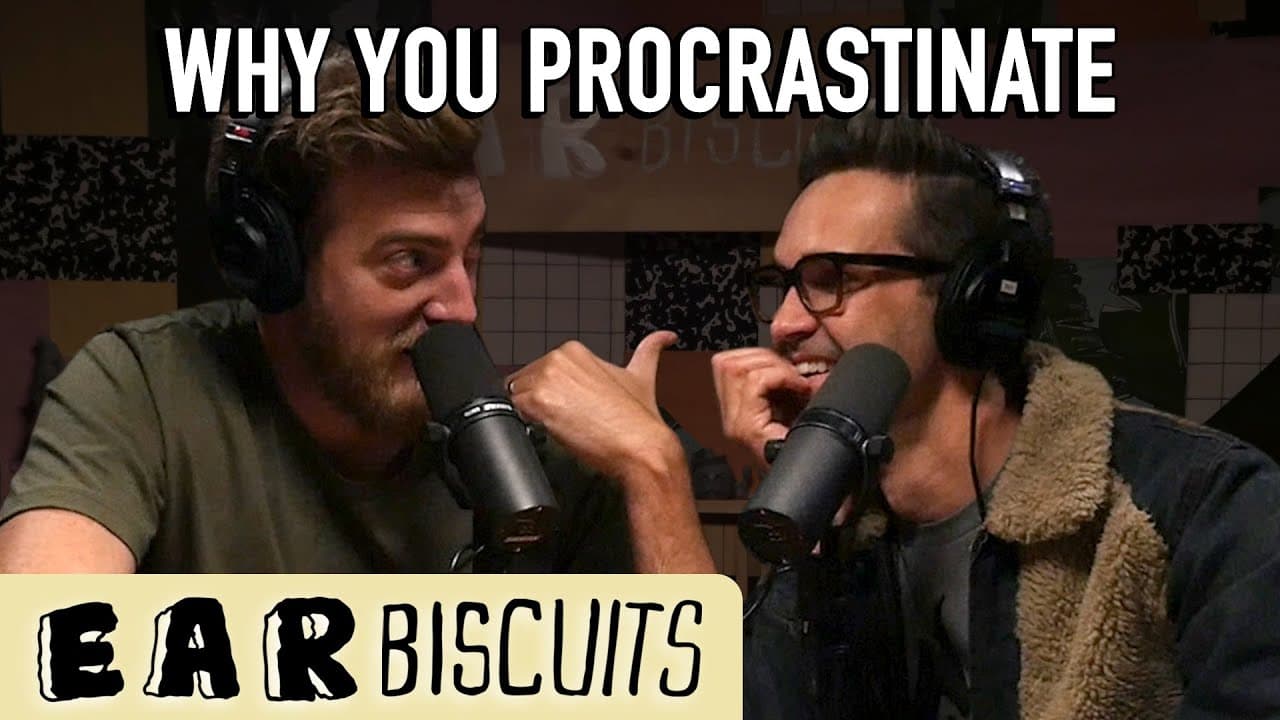
Why You Procrastinate (Rabbit Hole)
TL;DR
Rhett and Link discuss determinism, free will, and the implications for human experience.
Transcript
welcome to ear biscuits I'm Rhett and I'm Linc man I'm glad you're listening because this week at the round table of dim lighting we're talking at each other and going down a rabbit hole where's it gonna take us we don't know we've got an envelope depends on what the rabbit decided when he dug it with a topic of discussion maybe a question I don't ... Read More
Key Insights
- 🥶 The podcast explores the tension between determinism and free will, suggesting that individual choice may heavily depend on a combination of personal history, genetics, and environment.
- 🤨 Personal anecdotes illustrate how experiences, such as Rhett's concussion, influence current choices and raise questions about the nature of decision-making.
- 😨 Procrastination is examined through their perspectives, highlighting how distractions and fear of failure contribute to their tendencies to postpone tasks.
- ❓ Humor arises amidst their discussions on parenting, reflecting an authentic portrayal of the challenges of fatherhood and their competitive natures.
- 🥺 The conversation touches on societal implications of transparency, suggesting that revealing underlying thoughts could lead to both greater understanding and potential conflict.
- 🧘 The podcast emphasizes the importance of honesty in relationships, positing that radical honesty may enhance connections and prepare society for future communication paradigms.
- 🤨 They acknowledge that while the notion of fully transparent thoughts is daunting, it raises essential questions about morality, character, and societal structure.
Install to Summarize YouTube Videos and Get Transcripts
Explore YouTube Video Summarizer or Get YouTube Transcript Extractor
Questions & Answers
Q: How do Rhett and Link define determinism in their conversation?
Rhett and Link explore determinism as the idea that every decision or action we take is influenced by prior causes, such as genetics and environmental factors. They question if what they consider free will might be an illusion created by our brains narrating choices that have already been made subconsciously.
Q: What role does personal experience play in their views on free will?
Their personal experiences, particularly Rhett's concussion and memory loss, serve as pivotal examples illustrating how past events shape present actions and decisions. They argue that these experiences might imply that our responses are more influenced by determinism than they initially presumed, complicating the notion of free will.
Q: What are some humorous elements present in their discussion about parenting?
The conversation features light-hearted banter about their competitiveness in a father-son basketball contest, with comedic reflections on their personal shortcomings. Rhett hilariously discusses his frustration with his son’s performance, adding to the dynamic of unabashedly sharing personal stories as a form of relatable humor.
Q: How do they express their thoughts on procrastination?
Rhett and Link share insights on their procrastination habits, with Rhett detailing his tendency to avoid tasks due to a fear of failure. They reflect on how distractions and the desire for immediate gratification often lead them to procrastinate, despite a genuine interest in completing their work.
Q: What implications do they see for society regarding transparency of thoughts?
They speculate that if everyone's thoughts were transparent, it could potentially lead to societal shifts in trust and relationships. However, they acknowledge the risks, as it could also reveal uncomfortable truths that might disrupt interpersonal dynamics and lead to conflicts.
Q: How do they juxtapose their beliefs on personal privacy with societal trends?
Rhett and Link emphasize that while they appreciate the importance of privacy, they also recognize that with advancements in technology, personal privacy is becoming increasingly compromised. They suggest that this trend will continue, pushing society toward a future where thoughts can be more openly exchanged.
Q: What conclusion do they reach about loving relationships and honesty?
They conclude that greater honesty within loving relationships can foster understanding and growth. They emphasize that approaching relationships with radical honesty might help prepare humanity for the eventual communication of thoughts without the fear of judgment or repercussions.
Q: How do Rhett and Link feel about their podcast discussions potentially affecting their audience?
They acknowledge that delving into complex and sometimes uncomfortable subjects might make their audience uneasy, but they affirm the value of exploring these topics as a means to provoke thought and foster deeper conversations about life and human experience.
Summary & Key Takeaways
-
Rhett and Link engage in a philosophical discussion about determinism, questioning whether their choices are predetermined or a product of free will, leading to deep reflections on their interactions and experiences.
-
They explore personal anecdotes, including Rhett's concussion and subsequent memory loss, to illustrate how past experiences influence current decisions, raising questions about the nature of choice and autonomy in life.
-
The conversation shifts to the concept of procrastination, examining personal tendencies and societal influences, ultimately reflecting on how distractions impact productivity and the pursuit of meaning in life.
Read in Other Languages (beta)
Share This Summary 📚
Summarize YouTube Videos and Get Video Transcripts with 1-Click
Try YouTube Summary with ChatGPT & Claude or YouTube Transcript Generator
Explore More Summaries from Ear Biscuits 📚


Summarize YouTube Videos and Get Video Transcripts with 1-Click
Try YouTube Summary with ChatGPT & Claude or YouTube Transcript Generator