3.2.8 Introduction to Logistical Regression - Video 5: Thresholding
TL;DR
The threshold value for logistic regression model predictions determines how we classify outcomes as good or poor care based on probabilities.
Transcript
We saw in the previous video that the outcome of a logistic regression model is a probability. Often, we want to make an actual prediction. Should we predict 1 for poor care, or should we predict 0 for good care? We can convert the probabilities to predictions using what's called a threshold value, t. If the probability of poor care is greater than... Read More
Key Insights
- ❎ The threshold value determines the trade-off between false positives and false negatives in logistic regression model predictions.
- 🔡 Selecting a higher threshold value prioritizes detecting the worst cases of care, while a lower value detects a broader range of poor care cases.
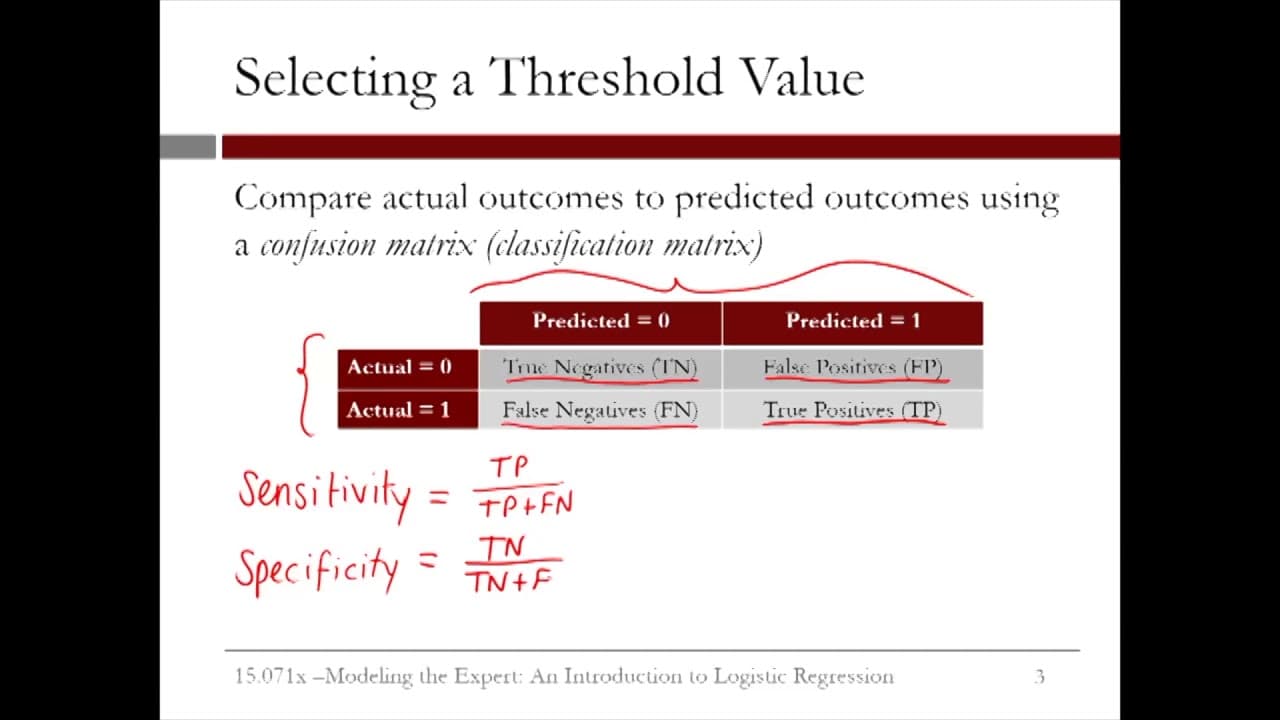
- 😨 Sensitivity measures the percentage of correctly classified poor care cases, while specificity measures the percentage of correctly classified good care cases.
- 🐕🦺 Sensitivity decreases and specificity increases as the threshold value increases, and vice versa.
- ❓ The selection of the threshold value should consider the specific context and priorities of decision-makers.
- ❓ The confusion matrix or classification matrix provides a quantitative comparison of actual outcomes and predicted outcomes.
- 💻 R can be used to compute confusion matrices and outcome measures such as sensitivity and specificity for different threshold values.
Install to Summarize YouTube Videos and Get Transcripts
Explore YouTube Video Summarizer or Get YouTube Transcript Extractor
Questions & Answers
Q: How does the threshold value impact the predictions made by a logistic regression model?
The threshold value determines whether a prediction is classified as good or poor care. If the probability of poor care is greater than the threshold, poor care is predicted. Otherwise, good care is predicted.
Q: What are the two types of errors that can occur in logistic regression model predictions?
The two types of errors are false positives and false negatives. False positives occur when we predict poor care, but the actual outcome is good care. False negatives occur when we predict good care, but the actual outcome is poor care.
Q: How does the choice of threshold value affect the occurrence of false positives and false negatives?
A higher threshold value leads to fewer predictions of poor care, resulting in more false negatives. Conversely, a lower threshold value leads to more predictions of poor care and more false positives.
Q: How can decision-makers influence the selection of the threshold value?
Decision-makers can express a preference for one type of error over the other, which can guide the selection of the threshold value. If there is no preference, a threshold of 0.5, predicting the most likely outcome, can be used.
Summary & Key Takeaways
-
Logistic regression models provide probabilities, and the threshold value helps convert these probabilities to predictions of good or poor care.
-
The threshold value is selected based on which types of errors, false positives or false negatives, are preferred.
-
A higher threshold value increases specificity but decreases sensitivity, while a lower threshold value increases sensitivity but decreases specificity.
Read in Other Languages (beta)
Share This Summary 📚
Summarize YouTube Videos and Get Video Transcripts with 1-Click
Try YouTube Summary with ChatGPT & Claude or YouTube Transcript Generator
Explore More Summaries from MIT OpenCourseWare 📚



Summarize YouTube Videos and Get Video Transcripts with 1-Click
Try YouTube Summary with ChatGPT & Claude or YouTube Transcript Generator