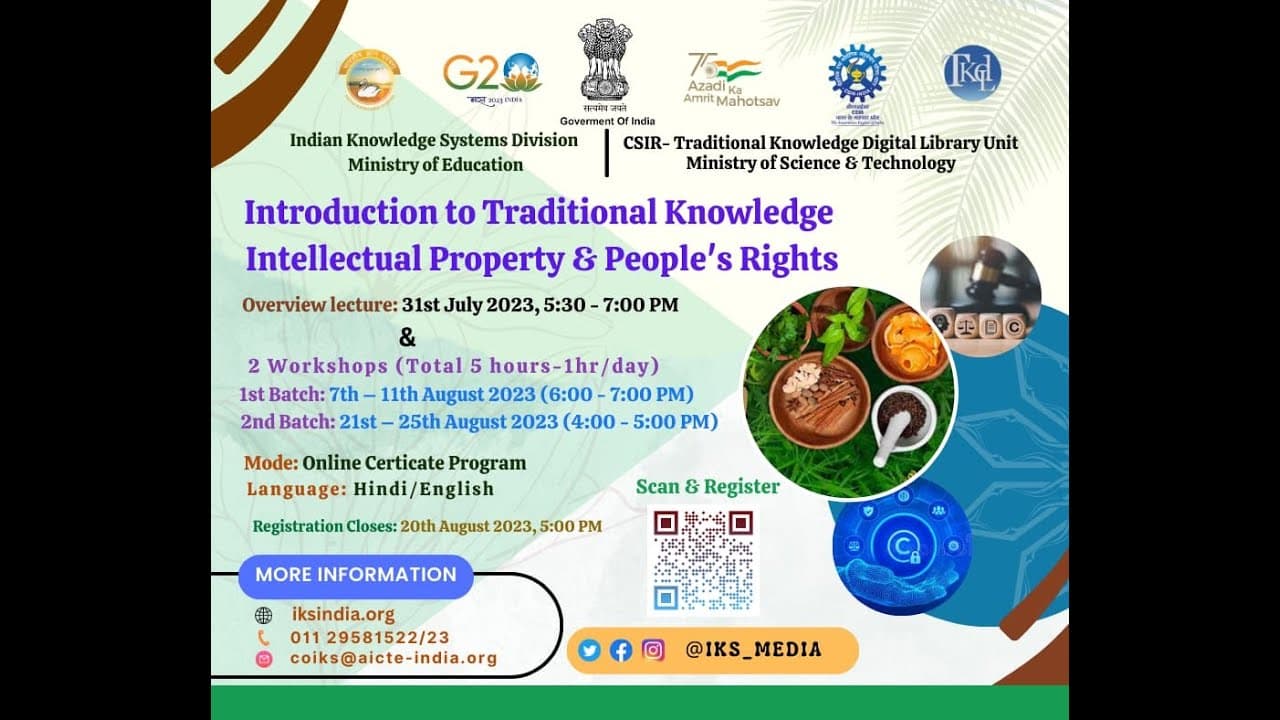
An Introduction to Traditional Knowledge Systems Intellectual Property & People's Rights.
TL;DR
A workshop on traditional knowledge's role in innovation and intellectual property.
Transcript
so first we will start with a prayer and then you know you I will announce you know what we are going to talk today and then I will hand over the uh this went to Anila who will explain about the test channel that who's going to do that I will explain them okay so then I will invite you you give a brief of you know how the session is going t... Read More
Key Insights
- The workshop spanned five days, covering traditional knowledge, intellectual property types, and protective measures, emphasizing the ethical handling of traditional knowledge.
- Traditional knowledge can inspire innovations, contributing significantly to achieving sustainable development goals across various sectors, including culture, agriculture, and health.
- Examples from Indonesia, Turkey, and India highlight how traditional practices can address poverty, hunger, and health, illustrating their global relevance.
- Chess, originating from India, exemplifies how traditional games can gain international recognition and contribute to global education and understanding.
- The discovery of quinine and artemisinin showcases how traditional medicinal knowledge can lead to significant medical advancements, impacting global health.
- Oral traditional knowledge, like the creation of artificial glaciers in the Himalayas, demonstrates innovative solutions to environmental challenges.
- The workshop emphasized the importance of preserving traditional knowledge for future innovation and its integration into modern intellectual property frameworks.
- Participants were encouraged to apply the insights gained to inspire colleagues and promote further learning in the upcoming workshop sessions.
Install to Summarize YouTube Videos and Get Transcripts
Explore YouTube Video Summarizer or Get YouTube Transcript Extractor
Questions & Answers
Q: What was the main focus of the workshop?
The workshop primarily focused on the role of traditional knowledge in inspiring innovations and its significance in achieving sustainable development goals. It provided an overview of various intellectual property types and discussed ethical considerations in handling traditional knowledge. The aim was to highlight the global relevance and potential of traditional knowledge for innovation.
Q: How does traditional knowledge contribute to sustainable development?
Traditional knowledge contributes to sustainable development by providing innovative solutions to various challenges. For example, traditional agricultural practices can improve food security, while traditional medicines offer health benefits. Additionally, cultural practices can promote social cohesion and economic development. The workshop highlighted these contributions through case studies from different countries.
Q: What are some examples of traditional knowledge inspiring modern innovations?
Examples include the development of quinine and artemisinin for treating malaria, inspired by traditional medicinal practices in South America and China. The creation of artificial glaciers in the Himalayas, based on oral traditional knowledge, addresses water scarcity issues. Additionally, the international recognition of chess, originating from India, showcases the global impact of traditional games.
Q: What ethical considerations are important in handling traditional knowledge?
Ethical considerations include respecting the cultural heritage and rights of indigenous communities, ensuring fair compensation for their contributions, and preventing exploitation or misappropriation of their knowledge. The workshop emphasized the importance of ethical handling to preserve traditional knowledge and foster trust between communities and researchers.
Q: How can traditional knowledge be integrated into modern intellectual property frameworks?
Integration can be achieved by recognizing traditional knowledge as a valuable intellectual asset and developing legal frameworks that protect it from exploitation. This includes granting rights to indigenous communities, creating databases to document traditional practices, and ensuring that innovations based on traditional knowledge provide benefits to the original knowledge holders.
Q: What role does traditional knowledge play in cultural preservation?
Traditional knowledge plays a crucial role in cultural preservation by maintaining cultural identity and heritage. It encompasses practices, beliefs, and skills passed down through generations, contributing to the social fabric and continuity of communities. Preserving traditional knowledge ensures that cultural diversity is maintained and respected in a rapidly changing world.
Q: What challenges exist in preserving traditional knowledge?
Challenges include the risk of knowledge loss due to globalization, cultural assimilation, and lack of documentation. Intellectual property laws may not adequately protect traditional knowledge, leading to misappropriation. Additionally, there may be conflicts between traditional practices and modern development goals, requiring sensitive balancing and negotiation.
Q: How can workshops like this one promote the preservation and use of traditional knowledge?
Workshops raise awareness about the importance of traditional knowledge and its potential for innovation. They provide a platform for sharing best practices, case studies, and strategies for integrating traditional knowledge into modern frameworks. By fostering dialogue among stakeholders, workshops encourage collaboration and inspire participants to apply insights in their own contexts, promoting preservation and sustainable use.
Summary & Key Takeaways
-
The workshop focused on the significance of traditional knowledge in inspiring innovations and achieving sustainable development goals. It covered various intellectual property types and ethical considerations in handling traditional knowledge, highlighting its global relevance and potential for innovation.
-
Case studies from different countries illustrated how traditional practices contribute to poverty alleviation, food security, and health improvement. Notable examples included the economic impact of traditional textiles in Indonesia and the health benefits of traditional medicines in India and China.
-
Participants were encouraged to explore the potential of traditional knowledge in their own contexts, with a focus on preserving and integrating it into modern intellectual property frameworks. The workshop concluded with an assessment to reinforce learning and inspire further exploration.
Read in Other Languages (beta)
Share This Summary 📚
Summarize YouTube Videos and Get Video Transcripts with 1-Click
Try YouTube Summary with ChatGPT & Claude or YouTube Transcript Generator