Averages | Exam Marks & Average Income | Aptitude | Part- 16 | Bharath Kumar
TL;DR
The session covers solving average-related mathematical problems through various examples.
Transcript
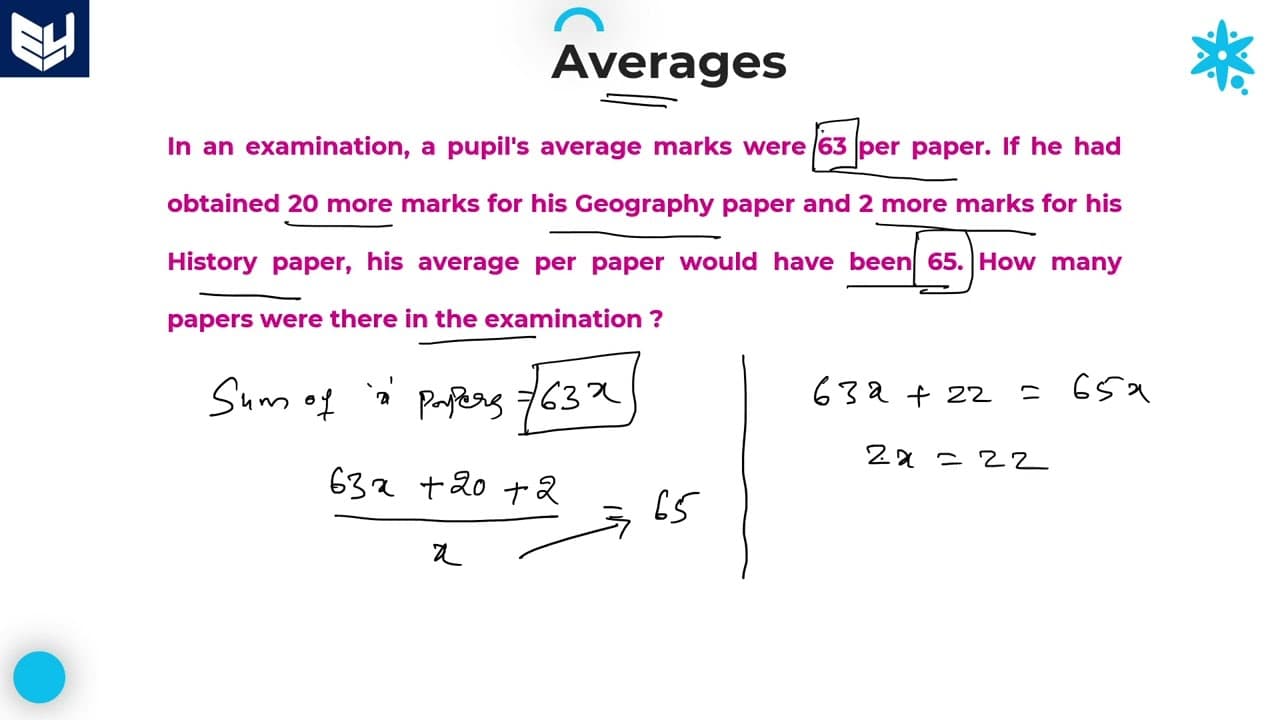
hi everyone welcome to the session in this session we are going to discussing about some more problems related to averages let's see the first question in this session see here in an examination a people's average marks were 63 per paper here the average of all the people is given as 63 if he had scored if he had scored 20 more marks for his geogra... Read More
Key Insights
- 🍹 Understanding the relationship between averages and sums is crucial in solving average-related problems effectively.
- 😫 The session demonstrates the importance of knowing how to set up equations from average data to find missing variables such as the number of items.
- #️⃣ Averages of series of numbers can often be calculated quicker by recognizing patterns in the numbers rather than summing them individually.
- #️⃣ The concept of reversing digits in two-digit numbers highlights the symmetry in mathematics, showcasing how properties of numbers can simplify calculations.
- ❓ The role of savings in calculating total income emphasizes the importance of considering all financial aspects when analyzing personal finance.
- 👻 Recognizing that all numbers in certain series have equal gaps allows for efficient average calculations without exhaustive addition.
- 🛟 The session serves as a reminder that fundamental mathematical principles can be applied creatively to simplify problem-solving strategies.
Install to Summarize YouTube Videos and Get Transcripts
Explore YouTube Video Summarizer or Get YouTube Transcript Extractor
Questions & Answers
Q: What is the first problem discussed in the session?
The first problem explores how to compute the number of examination papers based on an individual's average score of 63 and hypothetical changes in marks. The solution involves setting up a linear equation based on the average formula, ultimately determining that there are 11 papers in total.
Q: How does the average monthly income get calculated in the session?
To determine the monthly average income, the total annual expenditure of 1510 and annual savings of 290 are added together to yield 1800. This total is divided by 12 (the number of months), resulting in a monthly average income of 150 rupees, emphasizing the link between income, expenditure, and savings.
Q: What shortcut is suggested for finding the average of two-digit numbers in the session?
The session suggests a shortcut for finding the average of two-digit numbers that remain the same when their digits are interchanged. Instead of manually adding the numbers, one can take the average of the first number (11) and last number (99), yielding 55, which also represents the middle number of the sequence.
Q: What key mathematical concept is reinforced through the examples?
The examples reinforce the concept that averages can be computed through various methods, including direct calculation and linear equations, encouraging students to seek shortcuts rather than sticking to time-consuming processes.
Summary & Key Takeaways
-
The session begins with a problem related to average scores, illustrating how to compute the number of papers based on marks and averages given.
-
It progresses to another example about calculating a man's average monthly income from his expenditures and savings, emphasizing the relationship between income, expenditure, and savings.
-
The final problem demonstrates finding the average of two-digit numbers that remain unchanged when their digits are reversed, showing shortcuts in calculation.
Read in Other Languages (beta)
Share This Summary 📚
Summarize YouTube Videos and Get Video Transcripts with 1-Click
Try YouTube Summary with ChatGPT & Claude or YouTube Transcript Generator