What Is Generative AI and How Does It Work?
TL;DR
Generative AI is a type of artificial intelligence that creates new content—such as text, images, and audio—based on learned patterns from existing data. It leverages machine learning techniques, including supervised, unsupervised, and deep learning methods, to generate novel outputs. Understanding generative AI's capabilities is essential for its application in various fields, including code generation and natural language processing.
Transcript
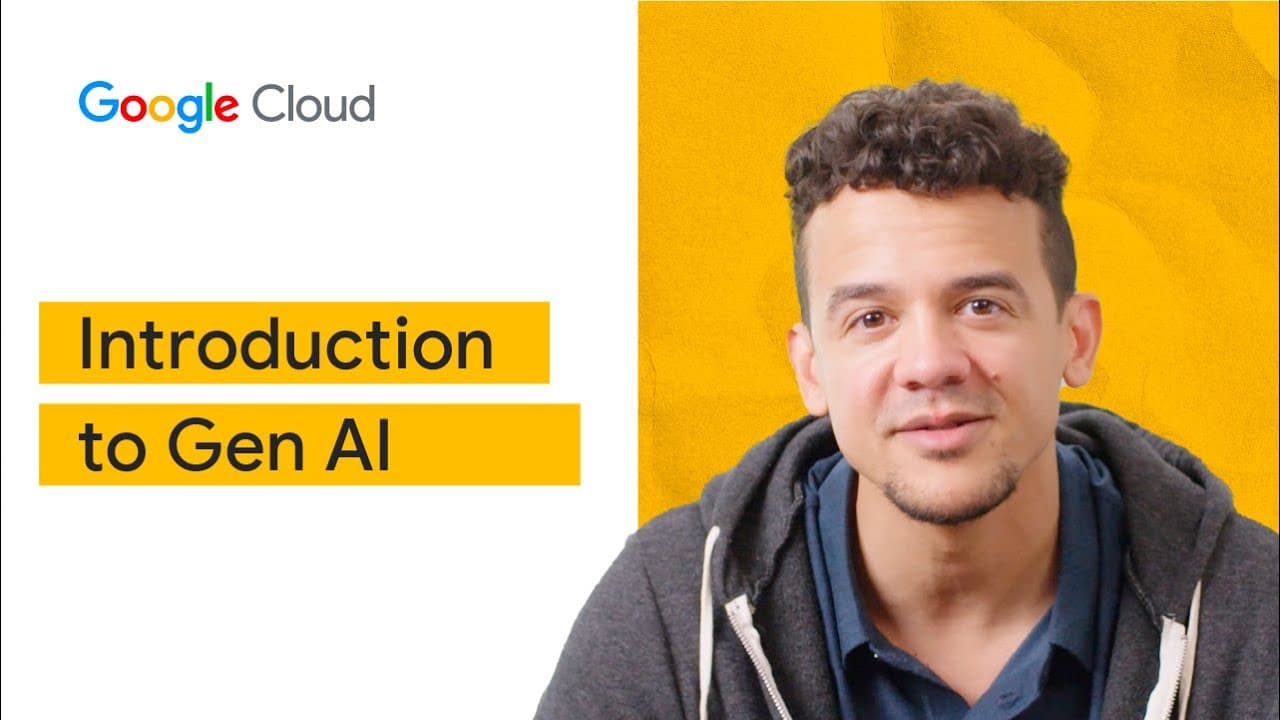
hi and welcome to introduction to generative AI don't know what that is then you're in the perfect place I'm Roger Martinez and I am a developer relations engineer at Google cloud and it's my job to help developers learn to use Google cloud in this course I'll teach you four things how to Define generative AI explain how generative AI Works describ... Read More
Key Insights
- 🛰️ Generative AI is a transformative field of artificial intelligence, enabling the creation of novel content from learned data patterns.
- 🎰 Understanding AI, machine learning, and deep learning is foundational for grasping the intricacies of generative AI capabilities.
- ⚾ Generative models can be categorized into types based mainly on their learning methods: supervised, unsupervised, and semi-supervised.
- 🪛 Deep learning techniques enhance generative AI's ability to understand and generate complex data structures, driving innovation in various applications.
- ❓ Hallucinations, a common issue in generative models, underscore the importance of quality training data to improve output reliability and coherence.
- 👤 Users leverage prompts to dictate the outputs of generative AI, making effective prompt design essential for practical applications.
- 😑 Foundation models represent a significant advancement in generative AI, offering pre-built capabilities adaptable to multiple tasks across industries.
Install to Summarize YouTube Videos and Get Transcripts
Explore YouTube Video Summarizer or Get YouTube Transcript Extractor
Questions & Answers
Q: What is generative AI and how does it differ from traditional AI?
Generative AI is a type of artificial intelligence that creates new content based on trained data. Unlike traditional AI, which may classify or categorize data, generative AI learns patterns from existing content to generate original outputs such as text, images, and audio, allowing for more creative applications.
Q: Can you explain the difference between supervised and unsupervised machine learning models?
Supervised machine learning models use labeled data to learn the relationship between input and output, enabling predictions. In contrast, unsupervised models analyze unlabeled data to discover inherent structures, grouping similar data points without predefined labels, focusing on exploratory analysis rather than predictions.
Q: How does deep learning fit into the framework of generative AI?
Deep learning is a subset of machine learning utilizing artificial neural networks to process complex patterns in data. Generative AI models often rely on deep learning techniques to generate new instances of data, employing methodologies such as unsupervised and semi-supervised learning for enhanced output generation.
Q: What are some common applications of generative AI today?
Generative AI applications include content creation such as text, images, and audio generation. It’s also used in industries for sentiment analysis, fraud detection, customer service, code generation, and automation of tasks through AI agents and chatbots, significantly enhancing operational efficiency.
Q: What challenges do generative AI models face, particularly concerning hallucinations?
Hallucinations in generative AI occur when models produce nonsensical or incorrect outputs, often due to insufficient training data or poor context. This issue complicates the reliability of the generated content and can mislead users, highlighting the necessity for robust training and prompt design.
Q: How do users interact with generative AI to produce desired outputs?
Users interact with generative AI primarily through prompts, which are specific inputs that guide the model's output. Effective prompt design is crucial as it can significantly influence the quality and relevance of the generated content, making user guidance vital in achieving optimal results.
Q: What is the role of foundation models in generative AI?
Foundation models are pre-trained large AI models designed to be fine-tuned for various downstream tasks such as image recognition, sentiment analysis, and code generation. They simplify the development process by providing a versatile base that can be adapted to numerous applications across different industries.
Q: How do Google Cloud services support the development of generative AI applications?
Google Cloud offers several tools to streamline generative AI development, including Vertex AI Studio for customizing models, Vertex AI Agent Builder for non-coders to build chatbots and digital assistants, and the Gemini model, which supports multimodal tasks involving text, images, and audio, making AI accessible and versatile.
Summary & Key Takeaways
-
Generative AI leverages artificial intelligence to create content such as text, audio, images, and synthetic data based on learned patterns from existing data.
-
The course outlines the differences between general AI, machine learning, and deep learning, emphasizing how supervised and unsupervised learning contribute to generative models.
-
Practical applications of generative AI are explored, including code generation, natural language processing, and its relevance in various industries like healthcare and finance.
Read in Other Languages (beta)
Share This Summary 📚
Summarize YouTube Videos and Get Video Transcripts with 1-Click
Try YouTube Summary with ChatGPT & Claude or YouTube Transcript Generator
Explore More Summaries from Google Cloud 📚


Summarize YouTube Videos and Get Video Transcripts with 1-Click
Try YouTube Summary with ChatGPT & Claude or YouTube Transcript Generator