Game of Theories: The Keynesians
TL;DR
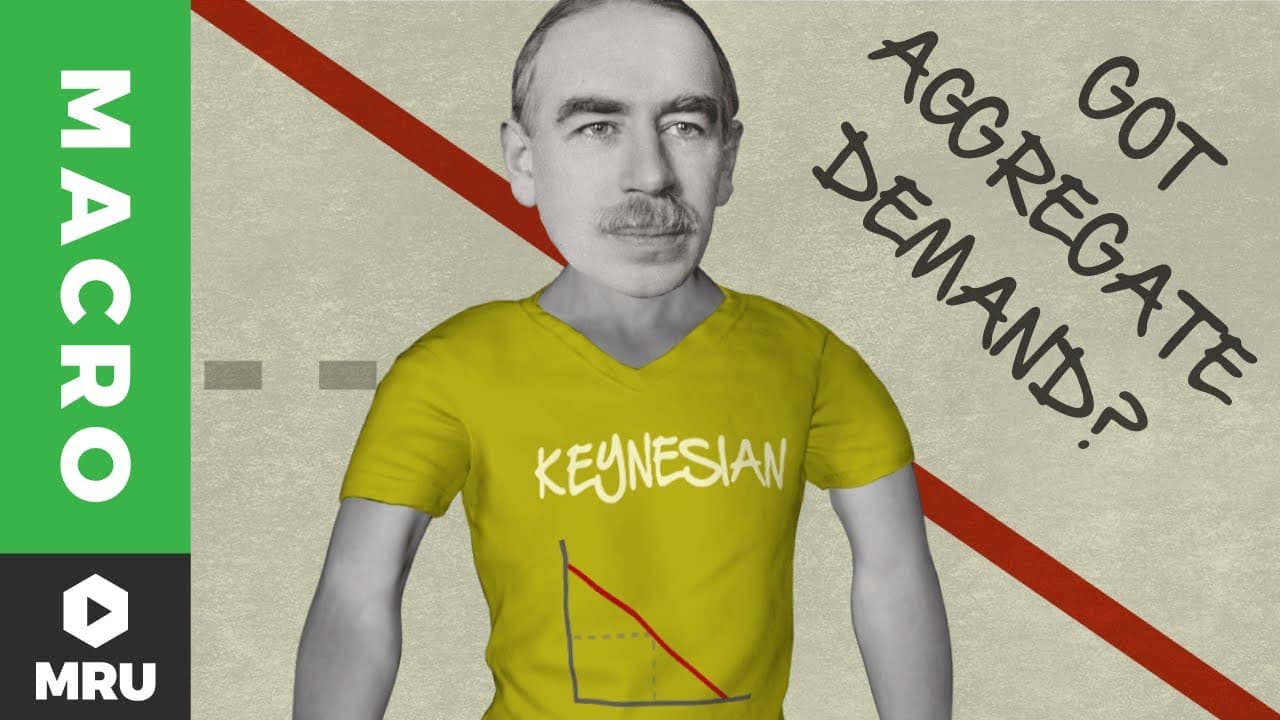
Keynesian economics emphasizes aggregate demand to address business cycles.
Transcript
♪ [music] ♪ - [Tyler] Business cycles and recessions are some of the worst things that can happen to economies. They mean lower output and higher unemployment, and more human misery. Now, in macroeconomics, the causes of business cycles -- that's a contentious topic, and it involves at least four major schools of thought: the Keynesians, the monito... Read More
Key Insights
- Keynesian economics focuses on aggregate demand, which includes consumption, investment, government spending, and net exports, as the main driver of economic activity.
- Nominal wages are considered 'sticky' in Keynesian theory, meaning they do not adjust quickly to changes in demand, leading to unemployment during downturns.
- The Great Depression is a key example of a downturn that Keynesian economics seeks to explain, highlighting the collapse in consumer spending and investment.
- Keynesians advocate for activist monetary and fiscal policies, such as expanding the money supply and increasing government spending during recessions.
- Critics argue that Keynesian economics does not always explain the initial causes of a fall in aggregate demand, sometimes masking deeper economic issues.
- Monetary policy is often seen as sufficient to stabilize nominal expenditures, potentially making Keynesian fiscal interventions unnecessary.
- The Keynesian approach has limitations, such as predicting either high unemployment or high inflation, but not both simultaneously, as seen in the 1970s stagflation.
- Public-choice critiques suggest that Keynesian policies may lead to persistent deficits and debt, as governments may not balance budgets during economic booms.
Install to Summarize YouTube Videos and Get Transcripts
Explore YouTube Video Summarizer or Get YouTube Transcript Extractor
Questions & Answers
Q: What is the central idea of Keynesian economics?
The central idea of Keynesian economics is the concept of aggregate demand, which includes the total spending in an economy from consumption, investment, government spending, and net exports. Keynesians believe that fluctuations in aggregate demand are the primary cause of business cycles, and managing this demand can stabilize the economy.
Q: Why are wages considered 'sticky' in Keynesian theory?
Wages are considered 'sticky' in Keynesian theory because they do not adjust quickly to changes in demand. This stickiness can result from long-term contracts, minimum wage laws, or concerns about worker morale. As a result, when aggregate demand falls, wages do not decrease rapidly, leading to unemployment instead of wage cuts.
Q: How did the Great Depression illustrate Keynesian economic principles?
The Great Depression illustrated Keynesian economic principles by showing how a collapse in aggregate demand, due to bank failures and a reduction in the money supply, led to high unemployment and economic stagnation. Keynesians argue that increased government spending and monetary expansion could have mitigated these effects by boosting demand.
Q: What are the recommended Keynesian policy responses to a recession?
Keynesian policy responses to a recession include expanding the money supply to maintain nominal expenditures, lowering interest rates, and increasing government deficit spending to boost aggregate demand. These measures aim to reduce unemployment and stimulate economic activity during downturns.
Q: What are some criticisms of Keynesian economics?
Criticisms of Keynesian economics include its inability to always explain the initial fall in aggregate demand, potential masking of deeper economic issues, reliance on the government's ability to time and target fiscal interventions effectively, and the risk of creating long-term deficits due to persistent fiscal expansion.
Q: How does Keynesian economics view the role of government during economic downturns?
Keynesian economics views the government as a crucial actor during economic downturns, advocating for increased public spending and monetary expansion to stimulate aggregate demand. The government is expected to counteract reduced private sector spending by borrowing and investing in public works and other programs to create jobs and boost economic activity.
Q: What is the public-choice critique of Keynesian economics?
The public-choice critique of Keynesian economics argues that governments may not follow the Keynesian prescription of balancing budgets during good times. Instead, they might maintain deficits consistently, leading to excessive debt accumulation and potential fiscal crises. This critique highlights the challenge of implementing Keynesian policies effectively in practice.
Q: How do Keynesians explain stagflation, and what challenges does it pose to their theory?
Keynesians struggle to explain stagflation, a period of high inflation and high unemployment, as their theory predicts either one or the other but not both simultaneously. The occurrence of stagflation in the 1970s challenged Keynesian assumptions and led some economists to explore alternative explanations, such as supply-side factors and external shocks.
Summary & Key Takeaways
-
Keynesian economics, named after John Maynard Keynes, emphasizes the importance of aggregate demand in understanding business cycles and recessions. It suggests that sticky wages prevent markets from clearing, leading to unemployment when demand falls.
-
Keynesians favor activist monetary and fiscal policies, advocating for increased government spending and monetary expansion to maintain aggregate demand and reduce unemployment during economic downturns.
-
Critiques of Keynesian economics include its potential failure to address underlying economic issues, reliance on government intervention timing, and the risk of creating long-term deficits due to persistent fiscal policies.
Read in Other Languages (beta)
Share This Summary 📚
Summarize YouTube Videos and Get Video Transcripts with 1-Click
Try YouTube Summary with ChatGPT & Claude or YouTube Transcript Generator
Explore More Summaries from Marginal Revolution University 📚

Summarize YouTube Videos and Get Video Transcripts with 1-Click
Try YouTube Summary with ChatGPT & Claude or YouTube Transcript Generator