Competing orders, nematicity, and phase transitions in magic angle graphene. ▸ Pablo Jarillo-Herrero
TL;DR
Exploration of phase transitions and nematicity in magic angle graphene.
Transcript
welcome everybody to the second day of our return of intertwined conference um uh without further ado we'll we have pablo uh yairo herrera as our first speaker he's going to tell us about competing orders mimeticity and phase transitions and twisted by layer graph the magic angle graphing that's twisting away in front of our... Read More
Key Insights
- Magic angle graphene demonstrates unique phase transitions due to its flat band condition at specific twist angles, leading to correlated insulating states and superconductivity.
- Twisted bilayer graphene exhibits a range of electronic behaviors, including superconductivity and insulating phases, when the twist angle approaches the magic angle of approximately 1.1 degrees.
- The interplay of various condensed matter communities has enriched the study of correlated moiré structures, combining insights from 2D materials, cuprates, and topological physics.
- Phase diagrams of magic angle graphene reveal complex behaviors, including superconducting domes and regions of nematicity, influenced by charge density and temperature.
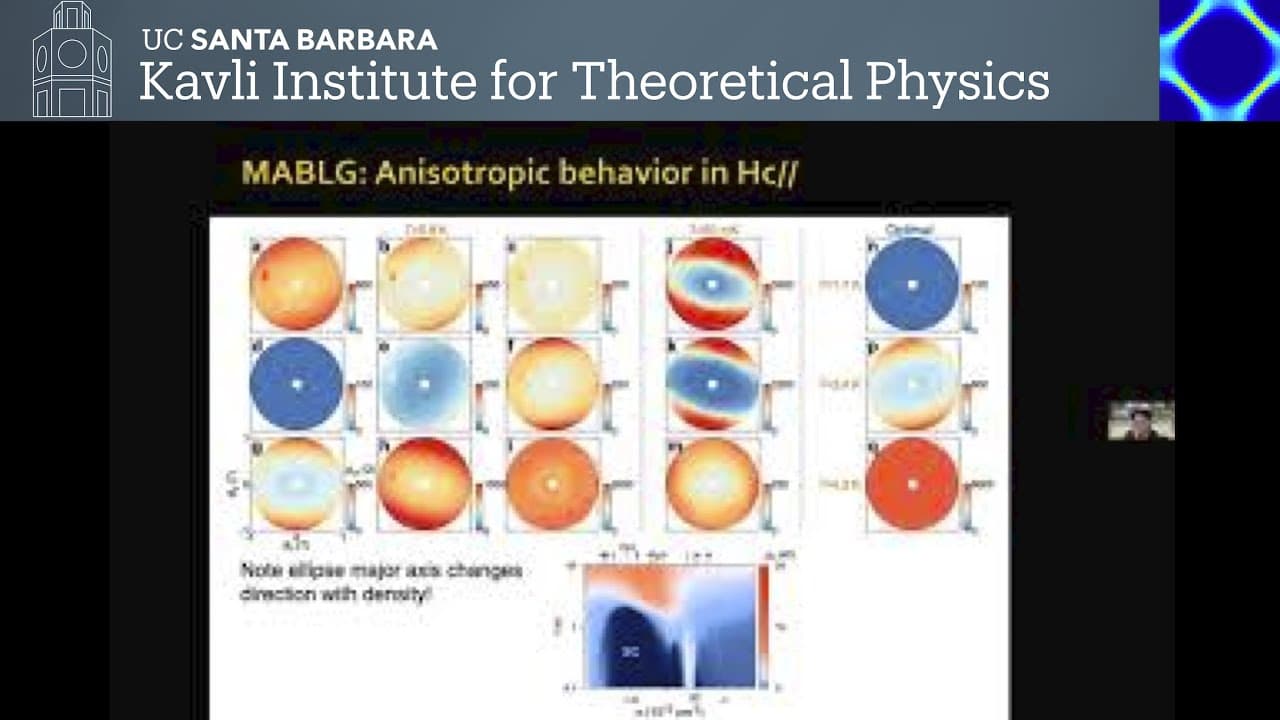
- Nematicity in magic angle graphene is observed both in the normal and superconducting states, suggesting a breaking of lattice rotational symmetry.
- The presence of competing orders in the phase diagram, such as nematicity and superconductivity, highlights the complex interactions and potential suppression of superconductivity.
- Recent experiments have shown a cascade of phase transitions and Dirac revivals in magic angle graphene, attributed to flavor symmetry breaking at high temperatures.
- The study of magic angle graphene is sensitive to precise twist angles and disorder, making it a challenging yet rewarding area of research with implications for understanding high-temperature superconductivity.
Install to Summarize YouTube Videos and Get Transcripts
Explore YouTube Video Summarizer or Get YouTube Transcript Extractor
Questions & Answers
Q: What is the significance of the magic angle in graphene?
The magic angle in graphene is significant because it marks the twist angle at which the electronic structure of bilayer graphene exhibits a flat band condition. This condition leads to a range of correlated electronic behaviors, including superconductivity and insulating phases. The magic angle is approximately 1.1 degrees, and its discovery has opened new avenues for research in condensed matter physics, particularly in the study of correlated materials and high-temperature superconductivity.
Q: How does nematicity manifest in magic angle graphene?
Nematicity in magic angle graphene manifests as a breaking of lattice rotational symmetry, observed in both the normal and superconducting states. This phenomenon is characterized by anisotropy in the electronic properties, such as resistivity, which indicates that the system chooses a preferred direction. Nematicity is associated with competing orders in the phase diagram and can influence superconductivity by potentially suppressing the superconducting transition temperature (Tc).
Q: What are the implications of competing orders in magic angle graphene?
Competing orders in magic angle graphene have significant implications for understanding the material's electronic behaviors. These orders, such as nematicity and superconductivity, interact in complex ways, potentially leading to the suppression of superconductivity. The presence of competing orders is reminiscent of behaviors observed in other correlated materials, like cuprates, and highlights the intricate balance of interactions that govern the phase diagram of magic angle graphene.
Q: What challenges are associated with studying magic angle graphene?
Studying magic angle graphene presents several challenges, primarily due to its sensitivity to precise twist angles and disorder. Small variations in the twist angle can significantly alter the electronic properties, making it difficult to achieve consistent results. Additionally, the presence of disorder, such as twist angle disorder and chemical potential disorder, can complicate the interpretation of experimental data. Despite these challenges, the potential insights into high-temperature superconductivity make it a rewarding area of research.
Q: How does the phase diagram of magic angle graphene evolve with doping?
The phase diagram of magic angle graphene evolves with doping, showing a complex interplay of phases such as correlated insulators, superconducting domes, and regions of nematicity. As the charge density changes, the system transitions between these phases, with the superconducting domes often exhibiting depletion near certain doping levels. The evolution of the phase diagram with doping provides insights into the competing orders and the underlying physics of magic angle graphene.
Q: What is the role of flavor symmetry breaking in magic angle graphene?
Flavor symmetry breaking plays a crucial role in the phase transitions observed in magic angle graphene. At high temperatures, the system undergoes a cascade of phase transitions, characterized by the spontaneous polarization of one flavor while others remain near charge neutrality. This flavor symmetry breaking leads to Dirac revivals and influences the electronic properties, setting the stage for the correlated insulating and superconducting phases observed at lower temperatures.
Q: How does the electronic structure of twisted bilayer graphene differ from single-layer graphene?
The electronic structure of twisted bilayer graphene differs from single-layer graphene due to the formation of moiré patterns when two graphene sheets are stacked with a small twist angle. This results in the emergence of flat bands at the magic angle, where the bandwidth is minimized, leading to unique electronic properties such as correlated insulating states and superconductivity. The twist angle introduces a new degree of freedom, significantly altering the electronic landscape compared to single-layer graphene.
Q: What experimental techniques are used to study magic angle graphene?
Experimental techniques used to study magic angle graphene include transport measurements, scanning tunneling microscopy (STM), and compressibility measurements. Transport measurements provide insights into the phase diagram and electronic properties, while STM allows for the visualization of electronic structures and local density of states. Compressibility measurements, such as inverse compressibility, help identify phase transitions and Dirac revivals. These techniques, combined with theoretical modeling, enhance the understanding of magic angle graphene's complex behaviors.
Summary & Key Takeaways
-
Magic angle graphene, characterized by its unique flat band condition at specific twist angles, exhibits a range of electronic behaviors including superconductivity and insulating phases. These phenomena arise from the interplay of various condensed matter communities, enriching the study of correlated moiré structures.
-
Phase diagrams of magic angle graphene reveal complex behaviors influenced by charge density and temperature, including superconducting domes and regions of nematicity. Nematicity, observed in both the normal and superconducting states, suggests a breaking of lattice rotational symmetry.
-
Recent experiments have identified a cascade of phase transitions and Dirac revivals in magic angle graphene, attributed to flavor symmetry breaking at high temperatures. The study is sensitive to precise twist angles and disorder, posing challenges for understanding high-temperature superconductivity.
Read in Other Languages (beta)
Share This Summary 📚
Summarize YouTube Videos and Get Video Transcripts with 1-Click
Try YouTube Summary with ChatGPT & Claude or YouTube Transcript Generator