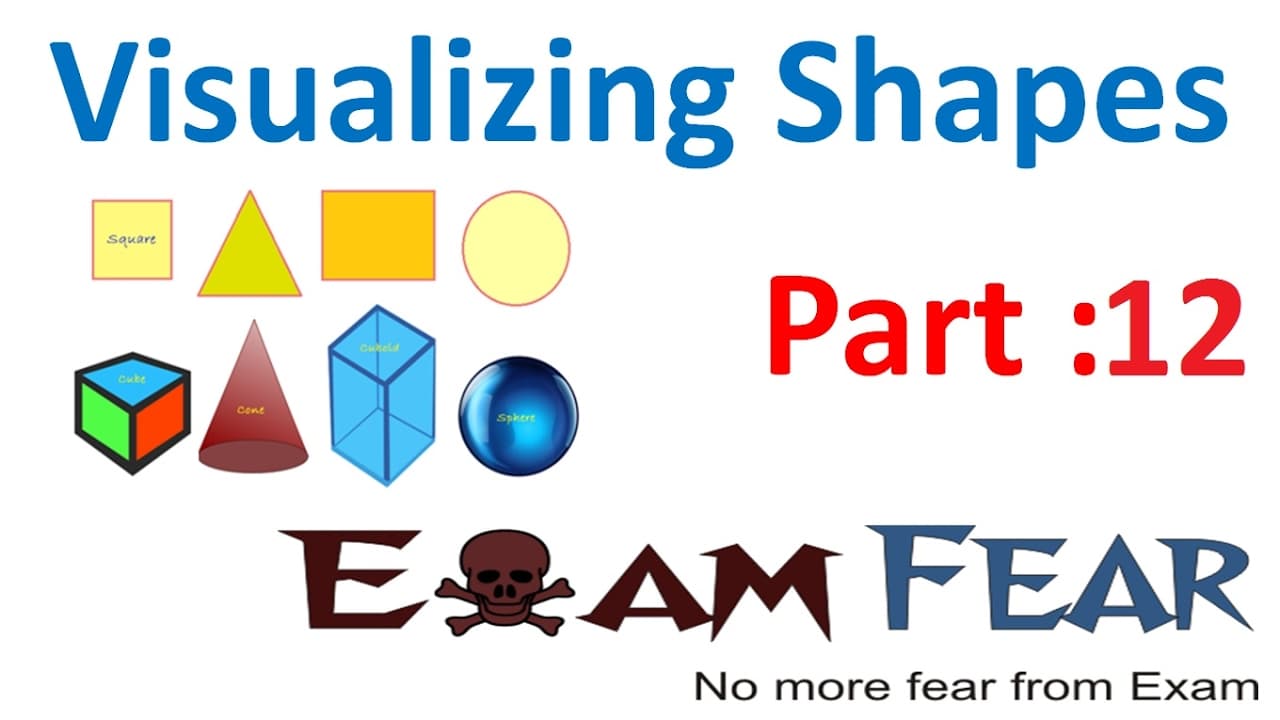
Maths Visualizing Shapes part 12 (Eulers Formula) CBSE Class 8 Mathematics VIII
TL;DR
Euler's formula states that for any polyhedron, the number of faces plus the number of vertices minus the number of edges equals 2.
Transcript
hello friends this video on visualizing shapes part 12 is brought to you by exam 4 calm no more fear from exam so now that we have learned about the faces edges and vertices of various polyhedrons it is important to learn about Euler's formula this is interesting so Euler's formula says that for any polyhedron with M faces e edges and V vertices th... Read More
Key Insights
- ❓ Euler's formula is a fundamental relation that applies to all polyhedrons.
- 🌞 The formula ensures that for any polyhedron, the sum of faces and vertices minus edges will always equal 2.
- 📐 The examples of a cuboid, triangular pyramid, and hexagonal prism confirm the validity of Euler's formula for various polyhedrons.
- 😀 The number of faces, edges, and vertices can be used to determine if an object is a polyhedron.
- 💨 Euler's formula provides a simple and efficient way to classify polyhedrons.
- 🔨 Euler's formula is a valuable tool in mathematics and geometry.
- 💠 The formula can be applied to various three-dimensional shapes beyond the examples given.
Install to Summarize YouTube Videos and Get Transcripts
Explore YouTube Video Summarizer or Get YouTube Transcript Extractor
Questions & Answers
Q: What is Euler's formula?
Euler's formula states that for any polyhedron, the number of faces plus the number of vertices minus the number of edges equals 2. It is a fundamental relation that holds true for all polyhedrons.
Q: How is Euler's formula used to determine if an object is a polyhedron?
To determine if an object is a polyhedron, you can count the number of faces, edges, and vertices. Then, apply Euler's formula (F + V - E = 2). If the equation holds true, the object is a polyhedron.
Q: What are the properties of a cuboid?
A cuboid has six faces, twelve edges, and eight vertices. When applying Euler's formula (F + V - E = 2), the equation holds true for a cuboid, confirming it is a polyhedron.
Q: What are the characteristics of a triangular pyramid?
A triangular pyramid has four faces, six edges, and four vertices. When applying Euler's formula (F + V - E = 2), the equation holds true for a triangular pyramid, confirming it is a polyhedron.
Summary & Key Takeaways
-
Euler's formula states that for any polyhedron, the equation F + V - E = 2 will always hold true.
-
A cuboid has 6 faces, 12 edges, and 8 vertices, and when applying Euler's formula, the equation holds true, proving it is a polyhedron.
-
A triangular pyramid has 4 faces, 6 edges, and 4 vertices, and when applying Euler's formula, the equation holds true, proving it is a polyhedron.
-
A hexagonal prism has 8 faces, 18 edges, and 12 vertices, and when applying Euler's formula, the equation holds true, proving it is a polyhedron.
Read in Other Languages (beta)
Share This Summary 📚
Summarize YouTube Videos and Get Video Transcripts with 1-Click
Try YouTube Summary with ChatGPT & Claude or YouTube Transcript Generator
Explore More Summaries from LearnoHub - Class 11, 12 📚


Summarize YouTube Videos and Get Video Transcripts with 1-Click
Try YouTube Summary with ChatGPT & Claude or YouTube Transcript Generator