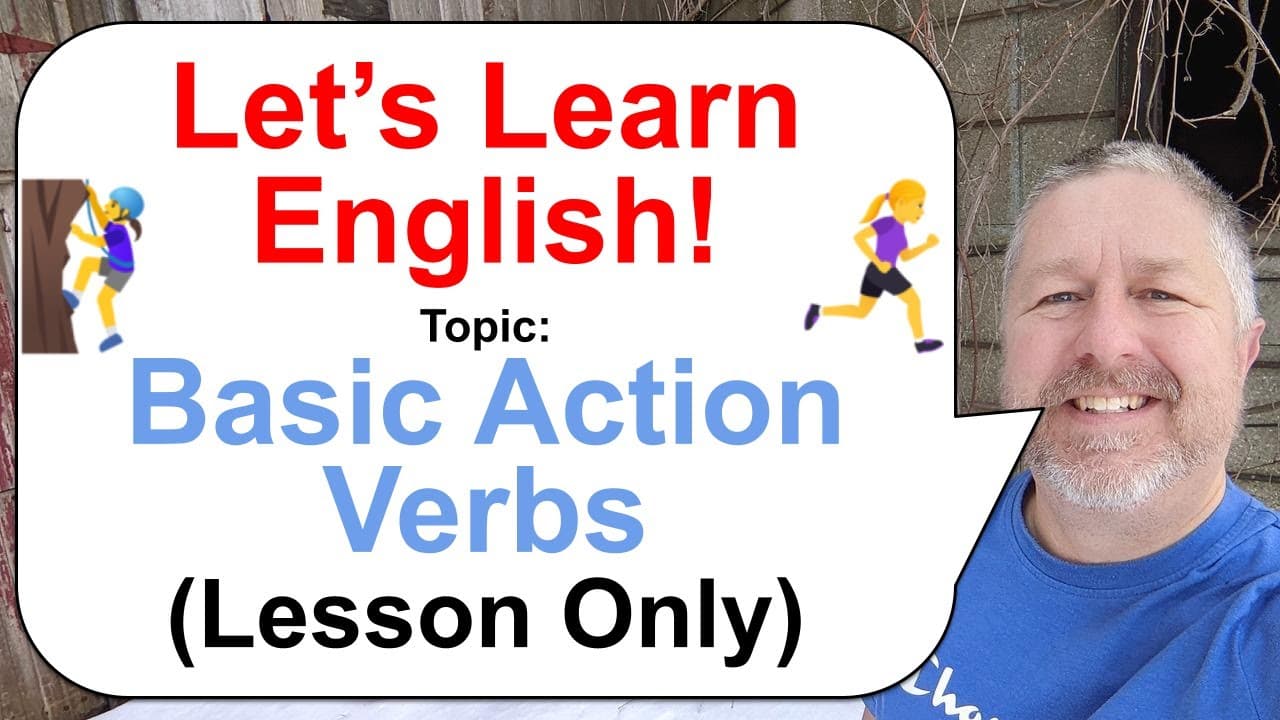
Let's Learn English! Topic: Basic Action Verbs! 🏃♀️😢🧗 (Lesson Only)
TL;DR
Basic action verbs in English for all levels, with examples and variations explained.
Transcript
Well hello and welcome to this English lesson about action verbs and you'll notice it says part one. I'm excited to do this lesson about some of the basic action verbs in English. But if you are an intermediate or advanced learner don't leave. I will make sure to talk about other verbs every time I talk about a basic action verb. So if I teach the ... Read More
Key Insights
- 🏛️ Action verbs serve as the building blocks of language proficiency.
- 😅 Verbs like "eat," "sleep," and "cook" illustrate basic human actions in English.
- 👰♀️ Learning verbs with variations such as "ride," "drive," and "sit" enhances vocabulary depth.
- 🦮 Action verbs guide communication in various contexts like sports, emotions, and daily routines.
- 😄 Understanding verbs like "fall," "cry," and "laugh" enriches expression of feelings and experiences.
- 🤔 Mastery of verbs like "play," "think," and "learn" fosters cognitive and creative development.
- 😚 Verbs like "turn on/off," "open/close," and "leave" contribute to functional language skills.
Install to Summarize YouTube Videos and Get Transcripts
Explore YouTube Video Summarizer or Get YouTube Transcript Extractor
Questions & Answers
Q: How does the lesson on action verbs cater to different English learning levels?
The lesson covers basic action verbs while also introducing variations and examples suitable for intermediate or advanced learners.
Q: Can you explain the difference between "fight" as arguing and "fight" as physical conflict?
When using "fight" for arguing, it refers to a disagreement using words. "Fight" for physical conflict indicates hitting or punching.
Q: Why is it essential to learn verbs like "turn on/off" and "open/close" in English?
Understanding these verbs is crucial for daily tasks like operating electronic devices or handling objects with moving parts.
Q: How does the lesson emphasize the importance of learning through actions?
By focusing on verbs related to everyday activities, the lesson encourages active engagement to improve English language skills.
Summary & Key Takeaways
-
Lesson covers basic action verbs like cook, eat, catch, throw, sleep, read, write, listen, speak, walk, run, climb, fall, laugh, learn, ride, drive, sit, stand, fight, cry, play, think, turn on/off, open/close, leave, look, lose, win, meet, give, jump.
-
Each verb is explained with its usage in sentences and variations.
-
Suitable for beginners with additional insights for intermediate and advanced learners.
Read in Other Languages (beta)
Share This Summary 📚
Summarize YouTube Videos and Get Video Transcripts with 1-Click
Try YouTube Summary with ChatGPT & Claude or YouTube Transcript Generator
Explore More Summaries from Learn English with Bob the Canadian 📚


Summarize YouTube Videos and Get Video Transcripts with 1-Click
Try YouTube Summary with ChatGPT & Claude or YouTube Transcript Generator