1.2.5 Fixed-length Encodings
TL;DR
Fixed-length encodings use the same distance from the root in binary trees and support random access. Different encodings like binary-coded decimal and ASCII have different entropy values. Number representations can use binary or hexadecimal notation.
Transcript
If the symbols we are trying to encode occur with equal probability (or if we have no a priori reason to believe otherwise), then we'll use a fixed-length encoding, where all leaves in the encoding's binary tree are the same distance from the root. Fixed-length encodings have the advantage of supporting random access, where we can figure out the Nt... Read More
Key Insights
- 🍃 Fixed-length encodings support random access and have the advantage of all leaves being equidistant from the root.
- #️⃣ Entropy in encodings is determined by the number of equally-probable outcomes, affecting the efficiency of the encoding.
- 👨💻 Different encodings like binary-coded decimal and ASCII have different entropy values.
- 😒 Number representations can use binary or hexadecimal notation, with binary being based on a base-2 system and hexadecimal using a radix-16 system.
- 🫦 Hexadecimal representations provide a more convenient notation for transcribing and recovering original bit strings.
Install to Summarize YouTube Videos and Get Transcripts
Explore YouTube Video Summarizer or Get YouTube Transcript Extractor
Questions & Answers
Q: What is the advantage of using fixed-length encoding?
Fixed-length encoding allows for random access because all leaves in the encoding's binary tree are the same distance from the root. This means the Nth symbol of a message can be determined by skipping over the required number of bits.
Q: How is entropy related to encodings?
Entropy represents the average amount of information needed to encode a symbol. Fixed-length encodings, like binary-coded decimal or ASCII, have different entropy values based on the number of possible choices or symbols they can represent.
Q: What is the difference between binary and hexadecimal representations?
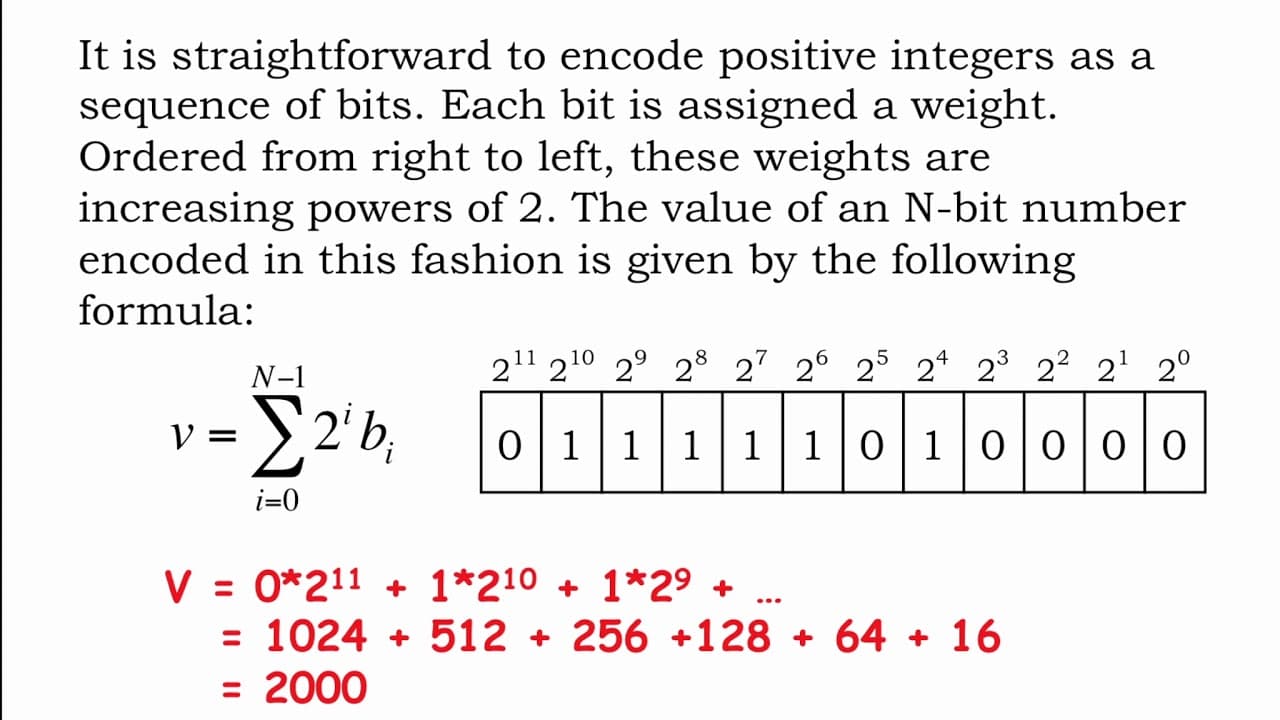
Binary representations use a base-2 system, with each binary digit having a corresponding weight. Hexadecimal representations use a radix-16 system, where each group of 4 binary digits is represented by a single hex digit.
Q: How can binary numbers be converted to hexadecimal representation?
To convert a binary number to hexadecimal, group the binary digits into sets of 4 from the least-significant bit. Then use a table mapping each 4-bit pattern to the corresponding hex digit.
Summary & Key Takeaways
-
Fixed-length encoding uses a binary tree where all leaves are equidistant from the root, allowing for random access.
-
Different encodings, such as binary-coded decimal and ASCII, have varying entropy values, determined by the number of possible choices.
-
Number representations can use binary or hexadecimal notation, with binary being based on a base-2 representation and hexadecimal using a radix-16 system.
Read in Other Languages (beta)
Share This Summary 📚
Summarize YouTube Videos and Get Video Transcripts with 1-Click
Try YouTube Summary with ChatGPT & Claude or YouTube Transcript Generator
Explore More Summaries from MIT OpenCourseWare 📚



Summarize YouTube Videos and Get Video Transcripts with 1-Click
Try YouTube Summary with ChatGPT & Claude or YouTube Transcript Generator