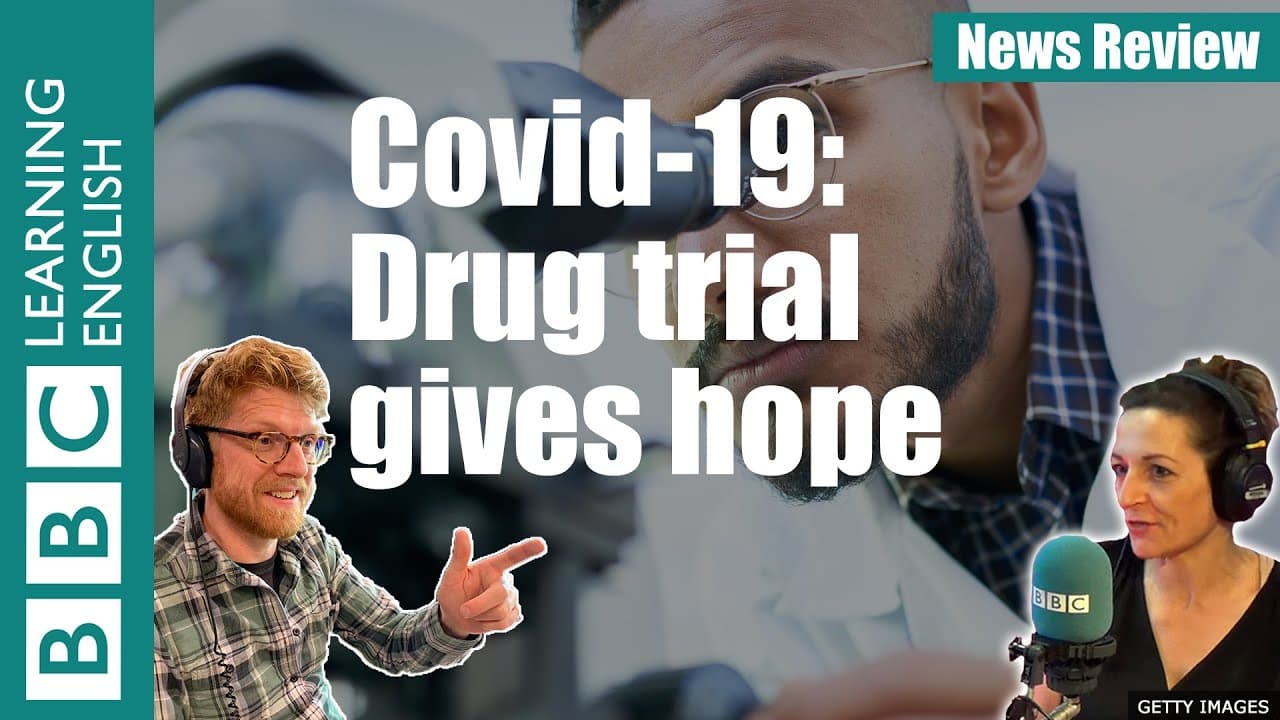
Covid-19: Drug trial gives hope: BBC News Review
TL;DR
Remdesivir shows potential in reducing Covid-19 symptoms.
Transcript
hi everyone welcome to News Review I'm nail in my home studio of course we are in lockdown because of the corona virus outbreak but with me well on the other side of London is Catherine hi Catherine what story have you got for us today well the race is on to find a treatment for corona virus and scientists in the United States think they might be o... Read More
Key Insights
- Remdesivir, initially developed for Ebola, is being trialed to treat Covid-19, showing a reduction in symptom duration from 15 to 11 days.
- The trial involved over a thousand participants but the impact on mortality rates remains uncertain due to lack of independent review.
- The term 'clear-cut' is used to describe something obvious or easy to understand, applicable in both positive and negative contexts.
- The expression 'opening the door' refers to creating possibilities, often for positive outcomes, like university education leading to job opportunities.
- Showing promise indicates likely future success, as seen in the trial results of Remdesivir, though definitive conclusions are premature.
- The vocabulary 'clear-cut', 'opening the door', and 'show promise' are key phrases to discuss developments and opportunities in medical trials.
- The trial's lack of independent validation means the effectiveness of Remdesivir cannot be fully confirmed yet, urging cautious optimism.
- Vocabulary like 'show potential' is synonymous with 'show promise', indicating a positive outlook based on current evidence.
Install to Summarize YouTube Videos and Get Transcripts
Explore YouTube Video Summarizer or Get YouTube Transcript Extractor
Questions & Answers
Q: What is Remdesivir and what was it originally developed for?
Remdesivir is an antiviral medication that was originally developed as a treatment for Ebola. It is currently being trialed to assess its effectiveness in treating Covid-19, specifically in reducing the duration of symptoms experienced by patients.
Q: What were the findings of the Remdesivir trial mentioned in the video?
The trial suggested that Remdesivir could reduce the duration of Covid-19 symptoms from an average of 15 days to 11 days. However, the trial's impact on reducing mortality rates is still uncertain, and the results have not been independently reviewed or published, raising concerns about the conclusiveness of the findings.
Q: What does the term 'clear-cut' mean in the context of the video?
In the context of the video, 'clear-cut' is used to describe something that is obvious or easy to understand, with no room for doubt or argument. It can be used in both positive and negative contexts, such as describing a penalty in sports or a treatment's effectiveness.
Q: How is the phrase 'opening the door' used in the video?
The phrase 'opening the door' is used to describe the creation of possibilities or opportunities. In the video, it refers to the potential for Remdesivir to lead to effective Covid-19 treatments, similar to how education can open doors to job opportunities.
Q: What does 'show promise' mean in the context of the Remdesivir trial?
In the context of the Remdesivir trial, 'show promise' means that the initial results indicate a likelihood of success or positive outcomes in the future. It suggests that the drug may be effective in treating Covid-19, although further validation and testing are needed to confirm its efficacy.
Q: Why is there caution around the Remdesivir trial results?
There is caution around the Remdesivir trial results because the data has not been independently reviewed or published. This lack of validation means that the effectiveness and usefulness of the drug cannot be fully confirmed, necessitating a cautious approach to interpreting the findings.
Q: How does the video suggest using the vocabulary 'clear-cut', 'opening the door', and 'show promise'?
The video suggests using these vocabulary terms to describe developments and opportunities in medical research. 'Clear-cut' refers to something obvious, 'opening the door' to creating possibilities, and 'show promise' to indicating likely success, all of which are relevant in discussing the potential of medical trials like those for Remdesivir.
Q: What is the significance of the trial's lack of independent review?
The lack of independent review of the trial means that the results cannot be fully trusted or considered conclusive. Independent validation is crucial for confirming the reliability and effectiveness of medical treatments, and without it, the findings remain speculative, urging caution in interpreting the results.
Summary & Key Takeaways
-
Remdesivir, an antiviral drug originally developed for Ebola, is being tested for its effectiveness in treating Covid-19, showing a reduction in symptoms duration.
-
The trial's results are promising but not conclusive, as the data has not been independently reviewed, leaving questions about its impact on mortality.
-
The discussion introduces vocabulary such as 'clear-cut', 'opening the door', and 'show promise', which are useful for describing developments in medical research.
Read in Other Languages (beta)
Share This Summary 📚
Summarize YouTube Videos and Get Video Transcripts with 1-Click
Try YouTube Summary with ChatGPT & Claude or YouTube Transcript Generator
Explore More Summaries from BBC Learning English 📚

Summarize YouTube Videos and Get Video Transcripts with 1-Click
Try YouTube Summary with ChatGPT & Claude or YouTube Transcript Generator