2020 Conference on Firms, Trade and Development - Felipe Brugues
TL;DR
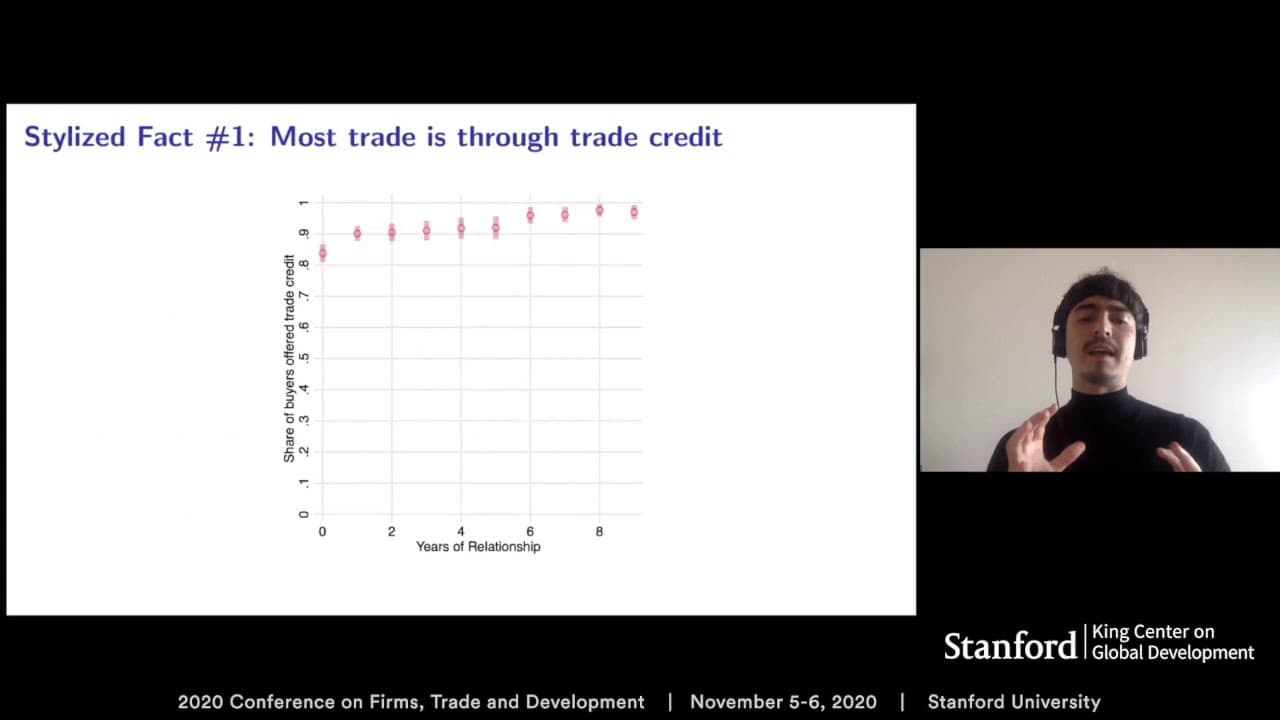
This analysis examines the market power and weak contract enforcement in supply chains in developing economies, highlighting the inefficiencies and potential benefits of long-term relationships and best practice policies.
Transcript
our next session uh will be um a paper by uh felipe uh for those of you who might not know felipe is a phd student who's on the job market this year um so our format will be the same as we've done so far uh somewhere around halfway through uh felipe's first 50 minutes uh he'll take a little pause welcome people to ask questions out loud and um if y... Read More
Key Insights
- ✊ Concentrated sectors in developing economy supply chains give sellers significant market power.
- 👔 Weak contract enforcement requires trading partners to rely on sources other than formal courts for agreements.
- 🤳 Self-enforced relational contracts are common solutions, but their efficiency and effectiveness are variable.
- 🥺 Long-term relationships become more efficient over time, but individual reforms may lead to welfare losses.
Install to Summarize YouTube Videos and Get Transcripts
Explore YouTube Video Summarizer or Get YouTube Transcript Extractor
Questions & Answers
Q: How do intermediaries in developing economy supply chains exercise market power?
Intermediaries in these supply chains extract as much surplus as possible from buyers. They may use strategies like price discrimination, quantity discounts, and dynamic pricing to maximize profits.
Q: What is the role of self-enforced relational contracts in addressing contracting frictions?
Self-enforced relational contracts are common solutions to weak contract enforcement. They limit the extraction of surplus by sellers and incentivize buyers to repay their debts. However, their efficiency and effectiveness vary and depend on market dynamics.
Q: How does the study measure efficiency in supply chain relationships?
The study measures efficiency through the comparison of actual trade levels to the first-best equilibrium that maximizes joint surplus. It finds that relationships tend towards full efficiency as they age.
Q: What are the potential welfare gains of best practice policies in supply chains?
Best practice policies, such as improving contract enforcement and reducing market power, can generate welfare gains when implemented simultaneously. However, focusing on individual reforms may lead to welfare losses compared to the second-best equilibrium.
Summary & Key Takeaways
-
Developing economy supply chains often have highly concentrated sectors with significant market power and weak contract enforcement.
-
The paper investigates the efficiency and effectiveness of self-enforced relational contracts and compares them to best practice institutions, using data from Ecuador.
-
The study finds that long-term relationships become more efficient over time, but pushing for individual reforms (such as better contract enforcement or reducing market power) can lead to welfare losses compared to the second best equilibrium.
-
However, simultaneous reforms addressing both frictions can potentially generate welfare gains.
Read in Other Languages (beta)
Share This Summary 📚
Summarize YouTube Videos and Get Video Transcripts with 1-Click
Try YouTube Summary with ChatGPT & Claude or YouTube Transcript Generator
Explore More Summaries from Stanford Institute for Economic Policy Research (SIEPR) 📚




Summarize YouTube Videos and Get Video Transcripts with 1-Click
Try YouTube Summary with ChatGPT & Claude or YouTube Transcript Generator