Solubility vs Concentration - Basic Introduction, Saturated Unsaturated and Supersaturated Solutions
TL;DR
Solubility is the maximum amount of solute that can be dissolved per liter of solution at a given temperature, while concentration tells you the amount of solute dissolved per liter of solution.
Transcript
in this video i want to give you a basic introduction into solubility now what is the difference between solubility and concentration now both of these things are similar in that they share the same units units of concentration could be molarity which is moles per liter in this video we're going to use grams per liter it could be molality normality... Read More
Key Insights
- 🇦🇪 Solubility and concentration share the same units, but solubility is specific to a given temperature.
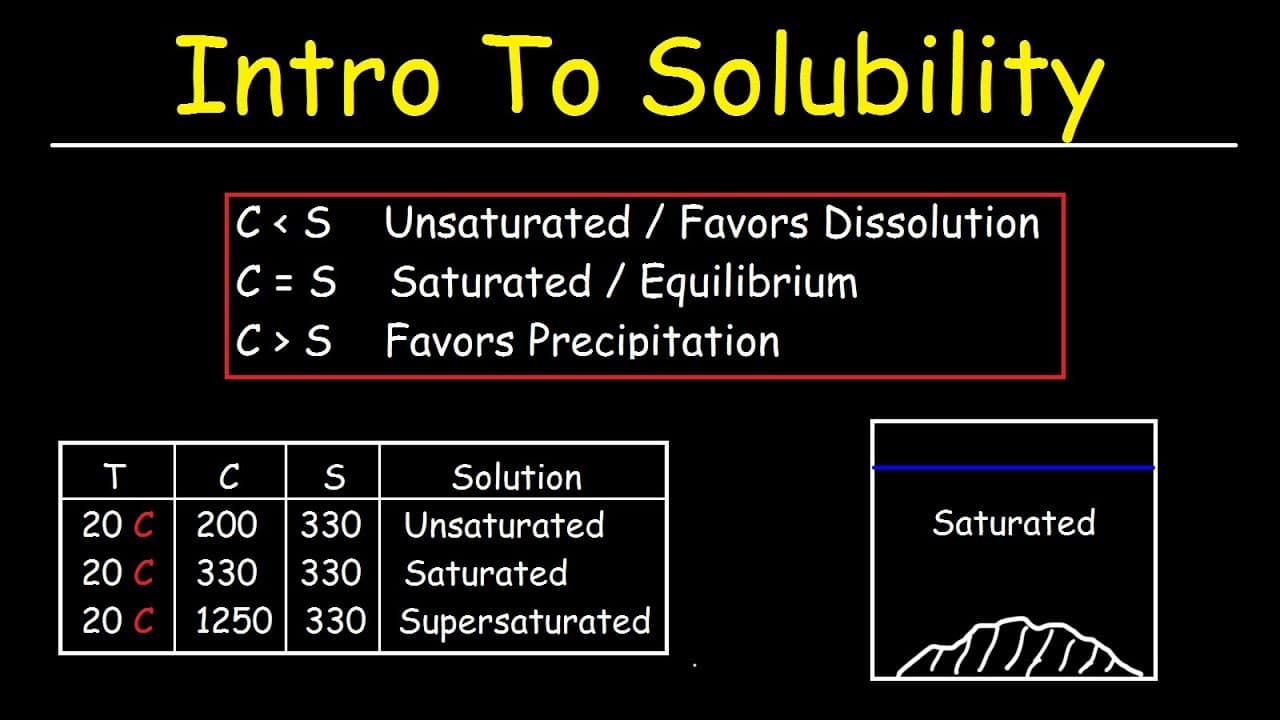
- 😘 An unsaturated solution has a concentration lower than the solubility, a saturated solution has a concentration equal to the solubility, and a supersaturated solution has a concentration higher than the solubility.
- 💆 Concentration can be measured in various units, such as molarity or mass percent.
- ❓ Solubility determines the maximum amount of solute that can be dissolved per liter of solution at a given temperature.
- ❓ A supersaturated solution is unstable and may crystallize or precipitate out of the solution.
- 🤨 Raising the temperature can increase solubility, while lowering the temperature can decrease solubility.
- ❓ Solubility can vary for different substances and temperatures.
Install to Summarize YouTube Videos and Get Transcripts
Explore YouTube Video Summarizer or Get YouTube Transcript Extractor
Questions & Answers
Q: What is the difference between solubility and concentration?
Solubility refers to the maximum amount of solute that can be dissolved per liter of solution at a given temperature, while concentration measures the amount of solute dissolved per liter of solution.
Q: Can solubility be measured in different units?
Yes, solubility can be measured in different units, such as grams per liter or moles per liter, depending on the specific substance and temperature.
Q: What happens when the concentration exceeds the solubility?
When the concentration exceeds the solubility, a supersaturated solution is formed. This solution is unstable and may crystallize or precipitate out of the solution.
Q: How can a supersaturated solution be created?
A supersaturated solution can be created by dissolving a large amount of solute at a higher temperature and then cooling the solution slowly, allowing it to retain the higher concentration.
Summary & Key Takeaways
-
Solubility and concentration both describe the amount of solute in a solution, but solubility is the maximum amount that can be dissolved at a given temperature.
-
Concentration can be measured in various units, such as molarity or mass percent, while solubility is specific to a particular temperature.
-
An unsaturated solution has a concentration lower than the solubility, a saturated solution has a concentration equal to the solubility, and a supersaturated solution has a concentration higher than the solubility.
Read in Other Languages (beta)
Share This Summary 📚
Summarize YouTube Videos and Get Video Transcripts with 1-Click
Try YouTube Summary with ChatGPT & Claude or YouTube Transcript Generator
Explore More Summaries from The Organic Chemistry Tutor 📚




Summarize YouTube Videos and Get Video Transcripts with 1-Click
Try YouTube Summary with ChatGPT & Claude or YouTube Transcript Generator