Comparatives: The Grammar Gameshow Episode 15
TL;DR
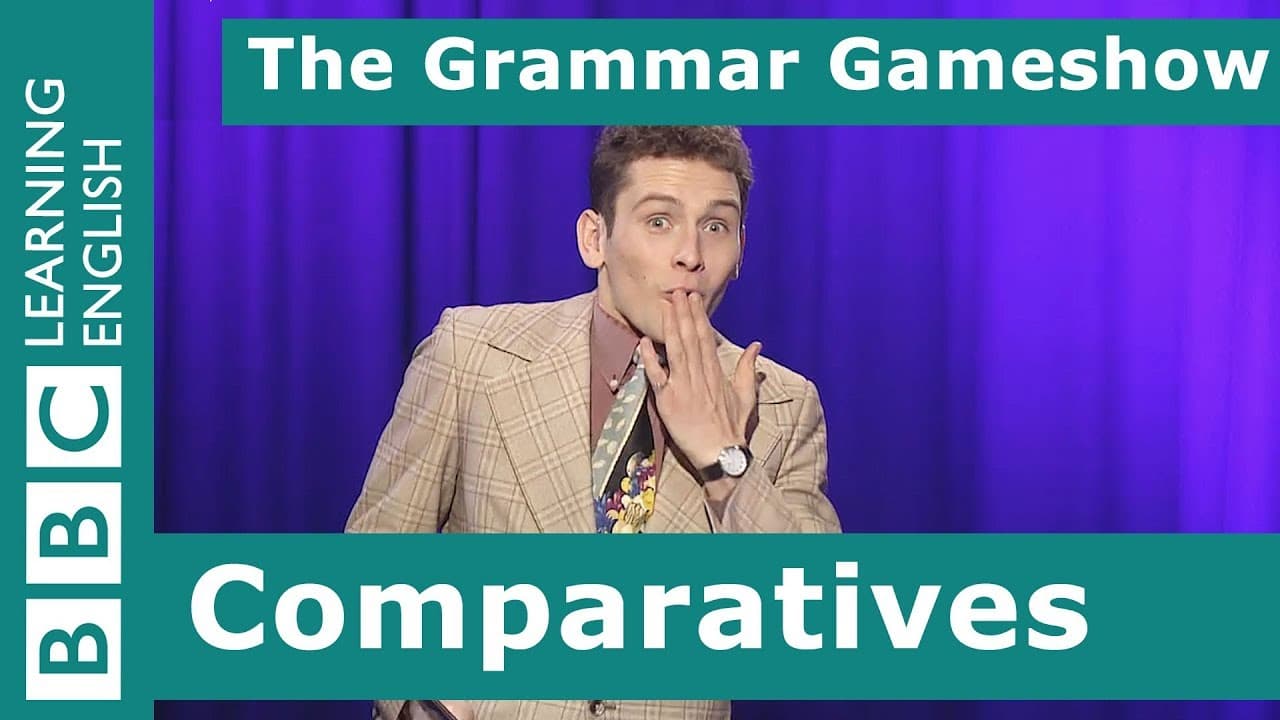
Selene and June compete in a comparative grammar showdown.
Transcript
Hello, and welcome to today’s Grammar Gameshow! I’m your host, Will! This is my game show. There are many like it, but this one is mine. And of course let’s not forget Leslie, our all-knowing voice in the sky. Hello, everyone! Tonight, we’re going to ask you three questions about… Comparatives! Those useful words and expressions for measuring one t... Read More
Key Insights
- The Grammar Gameshow is a light-hearted quiz focused on teaching English grammar, specifically comparatives, through competitive gameplay.
- Comparatives are used to measure one thing against another, often formed by modifying adjectives with 'ER', 'more', or irregular forms.
- The show uses humor and playful banter to engage contestants and viewers, creating an entertaining learning environment.
- Contestants Selene and June navigate through various rounds, applying comparative rules to win points and prizes.
- The host, Will, uses puns and wordplay, often referencing the personal lives of contestants, particularly Selene's heartbreak.
- Leslie, the voice in the sky, provides authoritative explanations on grammar rules, ensuring educational value amidst the comedic elements.
- The episode emphasizes understanding the degree of difference conveyed by comparatives, using expressions like 'much', 'a bit', and 'as... as...'.
- The show concludes with Selene winning, despite her emotional turmoil, highlighting the unpredictable nature of the game.
Install to Summarize YouTube Videos and Get Transcripts
Explore YouTube Video Summarizer or Get YouTube Transcript Extractor
Questions & Answers
Q: What is the main focus of this Grammar Gameshow episode?
The main focus of this Grammar Gameshow episode is on teaching and testing knowledge of comparatives in English grammar. Contestants compete in various rounds to demonstrate their understanding of how to form and use comparatives, while the host and Leslie provide comedic and educational commentary.
Q: How are comparatives formed according to the episode?
Comparatives are formed by modifying adjectives. For one-syllable adjectives, 'ER' is added. For two-syllable adjectives, 'ER' or 'more' can be used. If the adjective ends in 'E', only 'R' is added. For adjectives ending in a single vowel followed by a consonant, the consonant is doubled before adding 'ER'. Adjectives ending in 'Y' have the 'Y' replaced with 'I' before adding 'ER'.
Q: What role does Leslie play in the show?
Leslie serves as the all-knowing voice in the sky, providing authoritative explanations on grammar rules. Leslie ensures that educational content remains clear and accurate amidst the show's humor and competitive elements. Leslie's input is crucial for reinforcing the learning objectives of the episode.
Q: What comedic elements are present in the show?
The show incorporates humor through the host Will's puns, wordplay, and playful banter with contestants. The personal lives of contestants, particularly Selene's heartbreak, are referenced for comedic effect. The show's format, with nonsensical points and unusual prizes, also adds to the comedic atmosphere.
Q: How does the show engage its audience?
The show engages its audience by combining humor with educational content. The competitive format encourages viewers to play along, while the host's comedic style and Leslie's informative input maintain interest. The unpredictable outcomes and light-hearted approach make learning grammar enjoyable and accessible.
Q: What is the significance of the final round in the episode?
The final round emphasizes understanding the degree of difference conveyed by comparatives. Contestants must identify whether the difference is big, small, or nonexistent, using expressions like 'much', 'a bit', and 'as... as...'. This round reinforces the nuanced use of comparatives in communication, highlighting their importance in expressing precise differences.
Q: Why does Selene win the episode despite her emotional challenges?
Selene wins the episode because, despite her emotional challenges, she effectively applies the rules of comparatives to earn points. The show's format allows for unpredictable outcomes, and Selene's victory demonstrates that knowledge and application of grammar rules can triumph over personal difficulties, aligning with the show's educational objectives.
Q: What educational value does the Grammar Gameshow provide?
The Grammar Gameshow provides educational value by teaching English grammar, specifically comparatives, in an engaging and entertaining format. Through competitive gameplay, humor, and clear explanations from Leslie, the show makes grammar accessible and enjoyable, encouraging viewers to learn and apply language rules in a fun context.
Summary & Key Takeaways
-
The Grammar Gameshow episode focuses on comparatives, with contestants Selene and June competing in a series of grammar challenges. The host, Will, adds humor and puns, while Leslie provides educational insights. Despite Selene's heartbreak, she emerges victorious, showcasing the entertaining yet educational format of the show.
-
Comparatives are central to this episode, with rules explained by Leslie. Contestants modify adjectives to form comparatives, learning to express differences in size and degree. The show blends humor with learning, making grammar accessible and enjoyable for viewers.
-
The episode highlights the use of comparatives in English grammar, with contestants applying rules to win points. The humorous dynamic between Will, Selene, and June, alongside Leslie's informative input, creates a unique educational experience. The episode ends with Selene winning, despite her emotional challenges.
Read in Other Languages (beta)
Share This Summary 📚
Summarize YouTube Videos and Get Video Transcripts with 1-Click
Try YouTube Summary with ChatGPT & Claude or YouTube Transcript Generator
Explore More Summaries from BBC Learning English 📚

Summarize YouTube Videos and Get Video Transcripts with 1-Click
Try YouTube Summary with ChatGPT & Claude or YouTube Transcript Generator