How to Calculate Your Daily Macros for Fitness Goals?
TL;DR
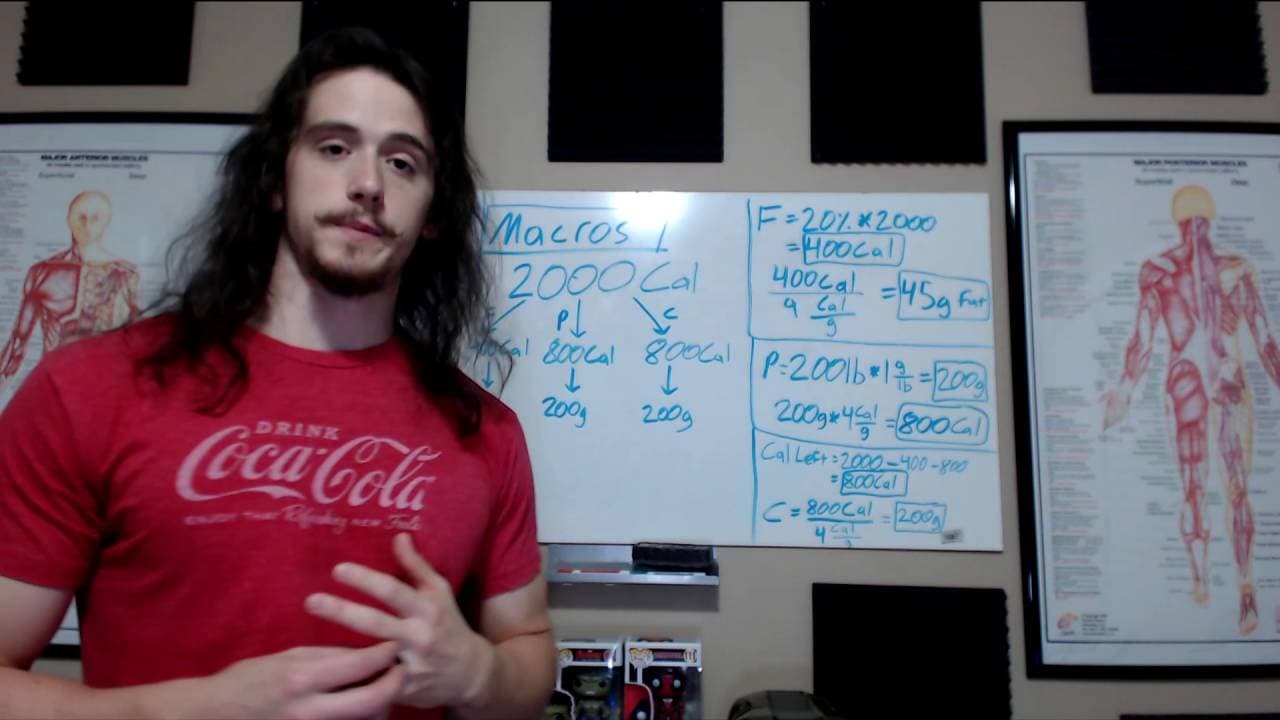
To calculate your daily macros, aim for 20-30% of calories from fat, protein intake of 1 gram per pound of body weight for muscle gain, and fill the remainder with carbs. For example, a 200-pound person consuming 2000 calories should have about 45 grams of fat, 200 grams of protein, and 200 grams of carbs. Customize these ratios based on personal preferences and fitness objectives.
Transcript
do you finally want to know how to calculate how many macros you've needed a stick around what's up guys Ryan here with Charlie training in the past several videos I've told you that I'm going to tell you how to calculate your macros and I'm finally going to do that in this video but I had to cover the other videos first because that was the inform... Read More
Key Insights
- 🥅 Adherence to a diet is crucial for success in reaching fitness goals.
- 💪 Protein intake varies based on muscle-building needs or general fitness goals.
- ❓ Carbs make up the remaining calories in macro distribution.
- 🌱 Customized macro calculations are essential for individualized nutrition plans.
- 🥅 Understanding how to calculate macros can help optimize nutrition for fitness goals.
- 😋 Personalized macro calculations consider factors like food preferences and dietary needs.
- ❓ Seeking professional assistance for macro calculations is an option for those unsure of how to do it themselves.
Install to Summarize YouTube Videos and Get Transcripts
Explore YouTube Video Summarizer or Get YouTube Transcript Extractor
Questions & Answers
Q: How do you determine the percentage of calories from fat in your macros?
The percentage of calories from fat in your macros is determined by personal preference, food choices, and adherence to a diet plan. If you prefer fatty foods, you may go with a higher percentage, while those who prefer lower-fat options may choose a lower percentage.
Q: What is the recommended protein intake for muscle building and general fitness?
For muscle building, a common recommendation is 1 gram of protein per pound of body weight. However, for general fitness without specific muscle-building goals, protein intake can be lower, around 0.5 grams per pound of body weight.
Q: How are carbs calculated in macro distribution?
Carbs are calculated based on the remaining calories after accounting for fat and protein. Once fat and protein macros are set, the remaining calories are allocated to carbs, with each gram of carbs providing 4 calories.
Q: How can personalized macro calculations help in achieving fitness goals?
Personalized macro calculations take into account individual preferences, needs, and goals, ensuring optimal nutrition for muscle building, weight loss, or general fitness.
Summary & Key Takeaways
-
Understanding macro percentages: 20-30% from fat, protein based on muscle goals, carbs make up the rest.
-
Example calculation for a 200-pound person aiming for 20% fat, 200g protein, and 200g carbs at 2000 calories.
-
Customized macro calculations are based on personal preferences, needs, and goals.
Read in Other Languages (beta)
Share This Summary 📚
Summarize YouTube Videos and Get Video Transcripts with 1-Click
Try YouTube Summary with ChatGPT & Claude or YouTube Transcript Generator
Explore More Summaries from Ryan Treadaway 📚

Summarize YouTube Videos and Get Video Transcripts with 1-Click
Try YouTube Summary with ChatGPT & Claude or YouTube Transcript Generator