What Are Hypercube Shadows and Their Symmetries?
TL;DR
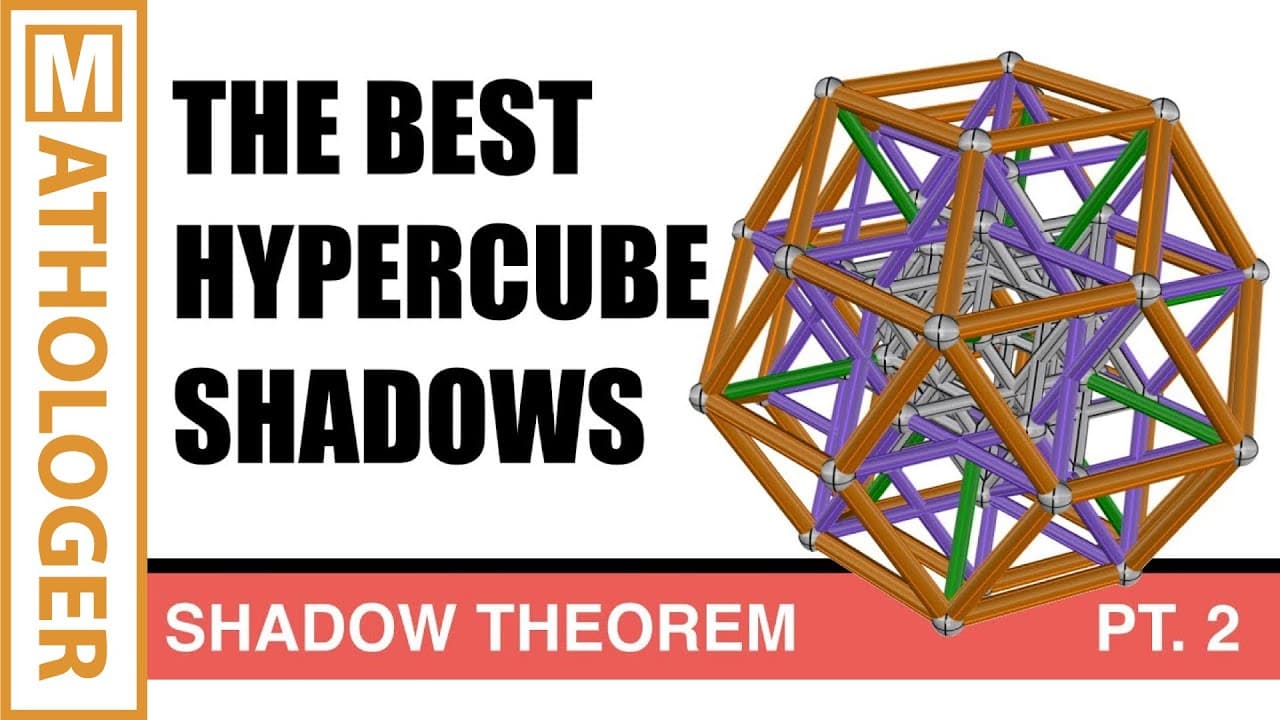
Hypercube shadows reveal intricate symmetries and shapes in higher dimensions, such as the rhombic triacontahedron from 6D unit hypercubes. By projecting these shapes into lower dimensions, we can explore their properties, demonstrating equal lengths and areas amid fascinating geometric structures. These shadows encapsulate the fundamental characteristics of our 3D world through their unique shadow theorem.
Transcript
I'm assuming you've all just watched part 1 of this video and that you know all about the shadow theorem in three dimensions. It turns out that our shadow theorem has counterparts for hypercubes living in abstract four- and higher-dimensional spaces. The maximal 2d and 3d shadows of these abstract hypercubes turn out to be fantastic bundles of real... Read More
Key Insights
- 👾 Shadows in higher-dimensional spaces capture symmetries and shape characteristics of objects in our 3D world.
- 👻 Manipulating dimensions and coordinates allows for the derivation of shadows and reveals fascinating shapes.
- 💠 The rhombic triacontahedron is a well-known symmetrical shape obtained from 6D unit hypercubes.
- ✋ Shadows of higher-dimensional objects can exhibit rotational and mirror symmetries.
- 🧊 The rhombic triacontahedron contains regular solids like cubes, dodecahedrons, tetrahedrons, octahedrons, and icosahedrons.
- ✋ Shadows can maintain equal lengths and areas in higher dimensions, demonstrating unique properties of higher-dimensional shapes.
- 💠 Higher-dimensional shapes, including their shadows, can be analyzed and understood through mathematical formulas and equations.
Install to Summarize YouTube Videos and Get Transcripts
Explore YouTube Video Summarizer or Get YouTube Transcript Extractor
Questions & Answers
Q: How are shadows in higher-dimensional spaces related to symmetries in our 3D world?
Shadows of higher-dimensional shapes capture the symmetries found in our 3D world, representing the essence of objects in a reduced form.
Q: How are 3D shadows derived from higher-dimensional objects?
By manipulating the coordinates and dimensions, the shadows of higher-dimensional objects can be projected onto three dimensions, revealing fascinating shapes such as the rhombic triacontahedron.
Q: Are there any other shapes besides the cube that have the same shadow property in 2D?
Yes, any shape with four-fold symmetry, such as a regular octagon, would exhibit the same shadow property in 2D.
Q: Can shapes with the same shadow property be found in higher dimensions?
Yes, besides the cube, there are other shapes with the same shadow property in higher dimensions, although they may be more challenging to find.
Summary & Key Takeaways
-
Shadows in higher-dimensional spaces represent symmetries of objects in our 3D world.
-
By casting shadows and manipulating dimensions, various shapes and their maximal shadows can be derived.
-
The rhombic triacontahedron is a particularly impressive and symmetrical shape that can be derived from 6D unit hypercubes.
Read in Other Languages (beta)
Share This Summary 📚
Summarize YouTube Videos and Get Video Transcripts with 1-Click
Try YouTube Summary with ChatGPT & Claude or YouTube Transcript Generator
Explore More Summaries from Mathologer 📚


Summarize YouTube Videos and Get Video Transcripts with 1-Click
Try YouTube Summary with ChatGPT & Claude or YouTube Transcript Generator