Shear Failure in Soil, Frictional Cohesive Strength
TL;DR
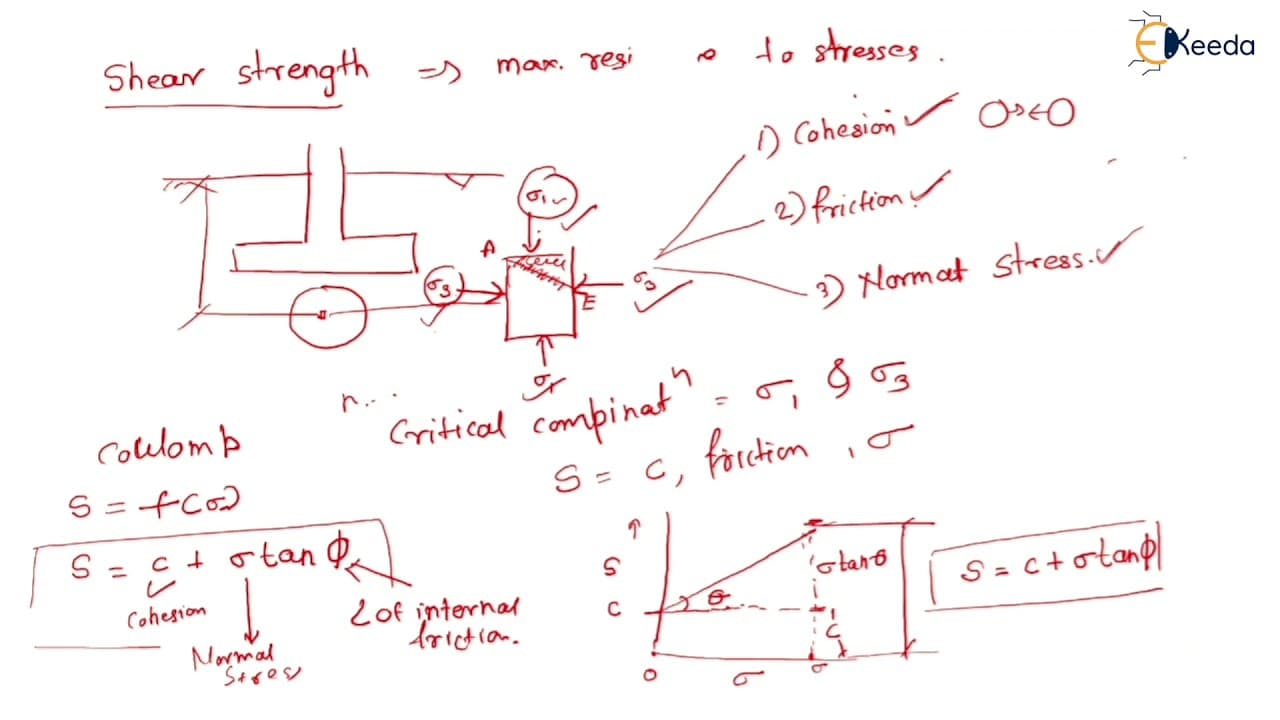
This video discusses shear failure in soil and the role of cohesion and friction in determining the shear strength of the soil.
Transcript
hello everyone in this video we are going to discuss shear failure in soil and frictional cohesive strength of the soil from the chapter shear strength shear strength of the soil shear strength it is maximum resistance to shear stresses acting on it just before the failure so when we apply the stress which is more than the shear strength then the s... Read More
Key Insights
- 📶 Shear failure in soil occurs when the applied stresses exceed the shear strength of the soil.
- 📶 The shear strength of soil is influenced by cohesion, friction, and normal stress.
- 😑 Coulomb's equation provides an expression for shear strength in terms of cohesion, normal stress, and the angle of internal friction.
- 💦 The Mohr-Coulomb equation modifies Coulomb's equation to account for factors like water content and drainage conditions.
- 🖤 Soil can be classified as cohesion-less (frictional) or purely cohesive, depending on the presence of cohesion or lack thereof.
- 📶 Cohesion-less soil derives its shear strength from intergranular friction, while cohesive soil relies on cohesive forces.
Install to Summarize YouTube Videos and Get Transcripts
Explore YouTube Video Summarizer or Get YouTube Transcript Extractor
Questions & Answers
Q: What is shear strength in soil?
Shear strength in soil refers to the maximum resistance to shear stresses before failure occurs. It is the ability of the soil to withstand the forces that can cause it to deform and collapse.
Q: How is shear failure of soil caused?
Shear failure in soil occurs when the stresses applied to the soil exceed its shear strength. This causes the soil particles to slip or slide along a specific plane, leading to a collapse or deformation of the soil structure.
Q: What factors contribute to the shear strength of soil?
The shear strength of soil is influenced by cohesion, which is the force of attraction between soil particles, and friction between the particles. Additionally, the normal stress or compressive stress on the soil also contributes to its shear strength.
Q: What is the difference between coarse-grained and fine-grained soil?
Coarse-grained soil, such as gravel and sand, has larger particle sizes and relies on intergranular friction for shear strength. Fine-grained soil, like silt and clay, has smaller particle sizes and exhibits prominent cohesive forces, leading to cohesive strength.
Summary & Key Takeaways
-
Shear strength of soil is the maximum resistance to shear stresses acting on it just before failure.
-
Shear failure occurs due to the relative movement of soil particles and is influenced by major and minor principle stresses.
-
The shear strength of the soil is dependent on cohesion, friction, and normal stress, which contribute to the soil's resistance to shear failure.
Read in Other Languages (beta)
Share This Summary 📚
Summarize YouTube Videos and Get Video Transcripts with 1-Click
Try YouTube Summary with ChatGPT & Claude or YouTube Transcript Generator
Explore More Summaries from Ekeeda 📚






Summarize YouTube Videos and Get Video Transcripts with 1-Click
Try YouTube Summary with ChatGPT & Claude or YouTube Transcript Generator