34.5 Worked Example - Particle Hits Pivoted Ring
TL;DR
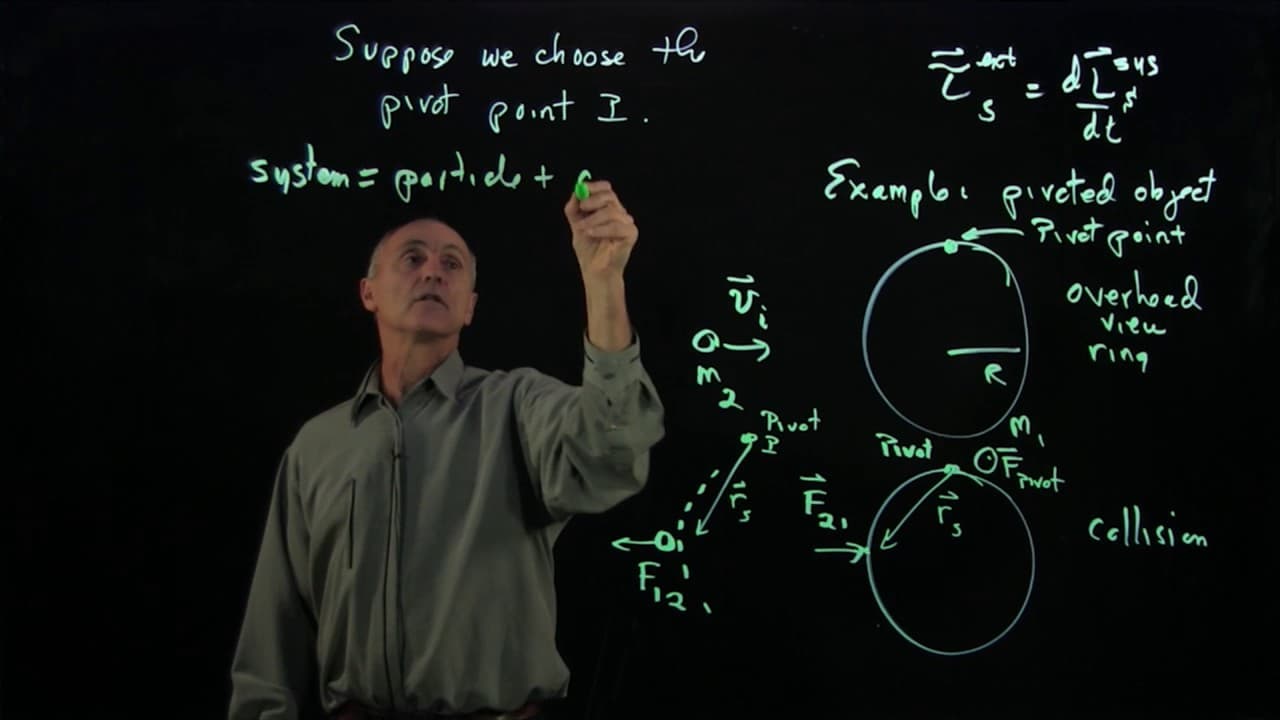
The angular momentum of a system changes when an external torque is applied, as demonstrated by the example of a collision between a pivoted object and a particle.
Transcript
Let's consider examples of our principle that the external torque about a point, s, causes the angular momentum of a system to change about s. We've examined central force problems in which we chose the point s to be the central point in which there was no torque. Now, as examples, let's look at a case where we have a pivoted object. So I could tak... Read More
Key Insights
- 📐 External torque causes the angular momentum of a system to change.
- 😥 The choice of pivot point affects the presence of torque on the system.
- 😋 Internal torques in a system cancel out when considering both the particle and the ring as the system.
- 🪐 The initial and final angular momenta of a system are equal when there is no net external torque on the system.
- 🦾 The angular momentum of a system can be calculated using the mass, velocity, and moment arm of the objects involved.
- 😋 The parallel axis theorem is used to calculate the angular momentum of the ring about its center of mass.
- 📐 The final angular momentum of the system is a combination of the individual angular momenta of the objects in the system.
Install to Summarize YouTube Videos and Get Transcripts
Explore YouTube Video Summarizer or Get YouTube Transcript Extractor
Questions & Answers
Q: How does the choice of pivot point affect whether there is torque on the system?
The pivot force has no torque about the pivot point, but the collision force does produce a torque that causes the ring to start rotating and the object to reverse directions.
Q: What happens to the internal torques in the system?
The internal torques cancel out in pairs because they are equal and opposite forces, resulting in a net torque of zero on the system about the pivot point.
Q: How is the initial angular momentum of the system calculated?
The initial angular momentum is the product of the object's mass, initial velocity, and moment arm, which is the distance from the pivot point.
Q: How is the final angular momentum of the system calculated?
The final angular momentum consists of two components - the angular momentum of the ring about the pivot point and the angular momentum of the particle about the pivot point, both multiplied by the final angular velocity.
Summary & Key Takeaways
-
The content explores the concept of external torque and its effect on the angular momentum of a system using examples of a pivoted object and a collision between two objects.
-
The choice of the pivot point determines whether there is torque on the system, and in this case, the pivot force has no torque but the collision force does.
-
By considering the system as both the particle and the ring, the internal torques cancel out and the torque on the system about the pivot point is zero, indicating that the initial and final angular momenta are equal.
Read in Other Languages (beta)
Share This Summary 📚
Summarize YouTube Videos and Get Video Transcripts with 1-Click
Try YouTube Summary with ChatGPT & Claude or YouTube Transcript Generator
Explore More Summaries from MIT OpenCourseWare 📚


Summarize YouTube Videos and Get Video Transcripts with 1-Click
Try YouTube Summary with ChatGPT & Claude or YouTube Transcript Generator