What Is Protactinium and How Is It Used in Dating Sediments?
TL;DR
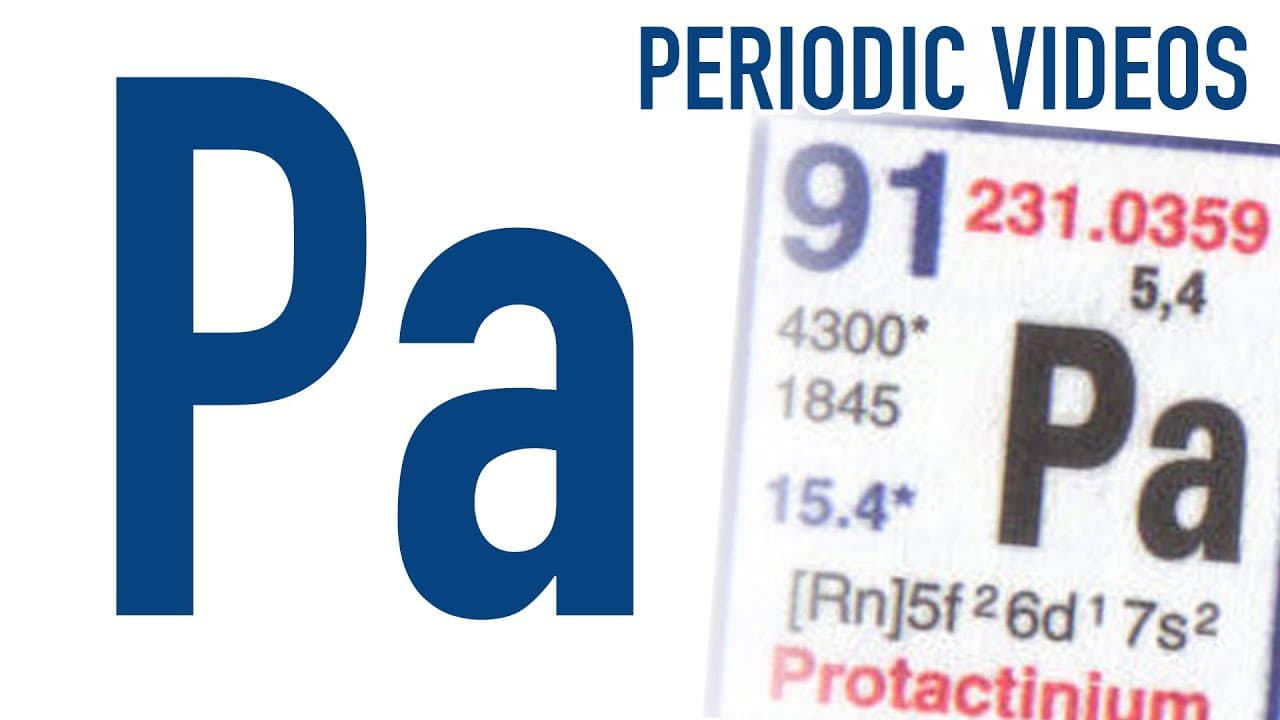
Protactinium is a rare radioactive element first discovered in 1918, challenging to isolate due to its scarcity and chemical similarities to tantalum. It is primarily used in dating ocean sediments by measuring the ratio of protactinium to thorium isotopes, helping to determine the age of the sediment layers.
Transcript
it is one of the few elements that is more or less totally useless protactinium is an element which is actually much more interesting than I expected the first interesting fact is that it is one of the elements whose existence was predicted by melif you've probably all heard how melif predicted the existence of gallium and Scandium because there we... Read More
Key Insights
- ❓ Protactinium, discovered in 1918, poses challenges in isolation due to its radioactivity and scarcity.
- 🙈 Its unique chemistry and similarity to tantalum aided in its isolation from uranium ores.
- 😒 Protactinium's application in dating sediment ages highlights its practical use despite its rarity.
- 🫀 The element's atomic weight of 231 differs from the predicted value of 235 by Mendeleev.
- 🧑🤝🧑 Despite cost-inefficiencies in production, protactinium is utilized in dating sediments, showcasing its practical applications.
- 😒 Protactinium's use in dating sediments provides insights into the age of oceanic sediments and geological history.
- 🛟 The discovery of protactinium isotopes and their half-lives contribute to understanding its radioactivity.
Install to Summarize YouTube Videos and Get Transcripts
Explore YouTube Video Summarizer or Get YouTube Transcript Extractor
Questions & Answers
Q: How was protactinium initially named, and why was it later shortened?
Protactinium was originally named Proto actinium due to its decay to actinium but later shortened to protactinium for ease of pronunciation.
Q: What challenges did scientists face in isolating protactinium from other radioactive elements?
Isolating protactinium was difficult due to its presence in uranium ores alongside other radioactive elements like radium and polonium.
Q: What unique property of protactinium makes it valuable for dating sediment ages?
The ratio of protactinium isotopes to thorium isotopes in sediment helps determine the age of oceanic sediments.
Q: Why did scientists attempt to produce a large amount of protactinium in the UK despite cost inefficiencies?
The production of protactinium in large quantities was attempted for applications like dating sediment despite the high cost of production.
Summary & Key Takeaways
-
Protactinium, a rare element, was discovered in 1918 and named Proto actinium before being shortened to protactinium due to its radioactivity.
-
Its discovery was challenging due to its small quantities and similarity in chemistry to tantalum, isolated by Lisa Meitner and Otto Hahn.
-
Protactinium's use in dating sediment ages showcases its unique applications despite its scarcity.
Read in Other Languages (beta)
Share This Summary 📚
Summarize YouTube Videos and Get Video Transcripts with 1-Click
Try YouTube Summary with ChatGPT & Claude or YouTube Transcript Generator
Explore More Summaries from Periodic Videos 📚





Summarize YouTube Videos and Get Video Transcripts with 1-Click
Try YouTube Summary with ChatGPT & Claude or YouTube Transcript Generator