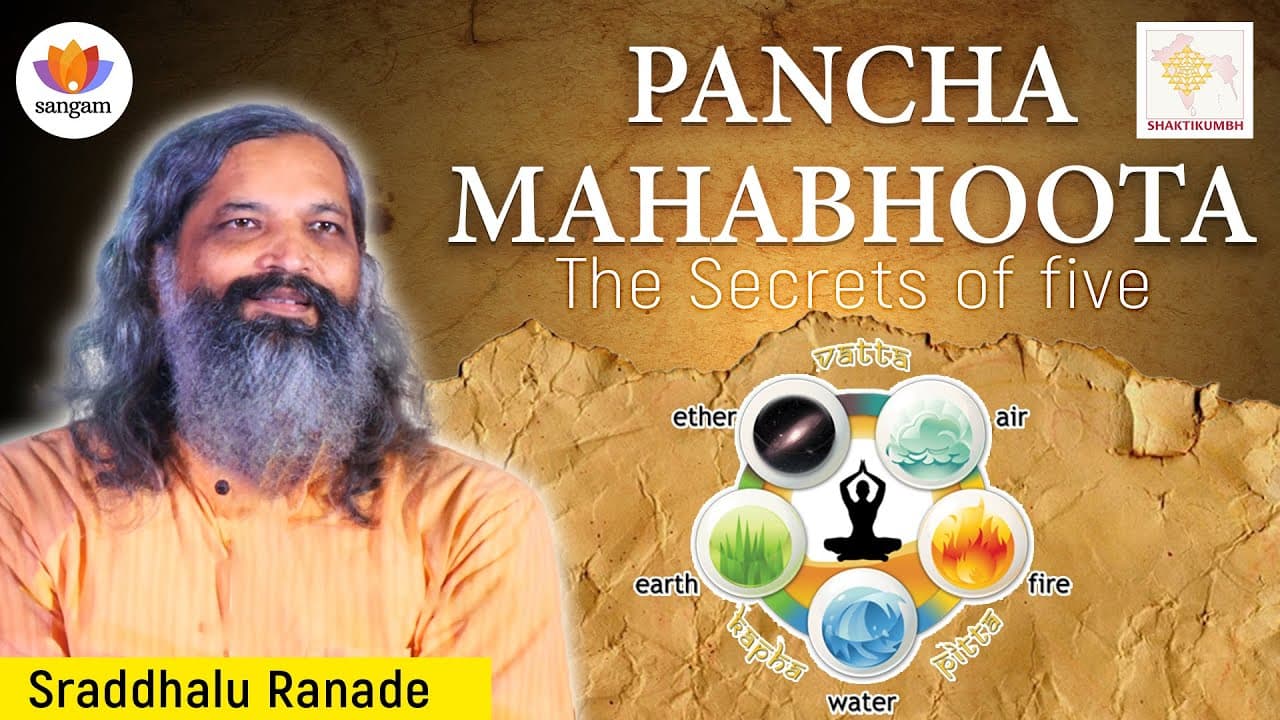
PanchaMahaBhoota – The Secrets of Five Elements | Sraddhalu Ranade | #sangamtalks
TL;DR
Explores the Panchmahabhoota and consciousness with scientific and spiritual insights.
Transcript
But that same 1 sunset that is happening right now is seen differently from different angles, from different positions on the earth and is never repeated ever. It's almost as if each 1 of us experiencing the universe at each moment is uniquely experiencing it, never to be ever repeated. Such is the enormous beauty and diversity and richness... Read More
Key Insights
- Ranade emphasizes the unique experience of the universe, highlighting the diverse perspectives of the divine consciousness.
- The concept of five bodies in yoga is explained, with emphasis on the supramental consciousness and bliss body.
- Numbers hold psycho-spiritual significance, with deeper origins in the mental world, according to Ranade.
- The Panchmahabhoota, or five elements, are described as essential states of self-modification of divine consciousness.
- Ranade discusses how biological senses can transcend physical limitations, revealing an underlying unity in existence.
- The five elements correspond to five senses, offering a unique perspective on perception and consciousness.
- Ranade integrates scientific inquiry with spiritual insights, offering a comprehensive understanding of consciousness.
- The five elements are crucial to the manifestation of the universe, illustrating the creative power of divine consciousness.
Install to Summarize YouTube Videos and Get Transcripts
Explore YouTube Video Summarizer or Get YouTube Transcript Extractor
Questions & Answers
Q: What is the significance of the Panchmahabhoota?
The Panchmahabhoota, or five elements, represent essential states of self-modification of the divine consciousness. They are crucial for the manifestation of the universe, illustrating the creative power of the divine. Each element corresponds to a specific sensory experience and plays a vital role in the structure of the cosmos.
Q: How do the five bodies in yoga relate to consciousness?
The five bodies in yoga represent different layers of consciousness, with the physical body dominated by the earth element and the mental body by the fire element. The supramental consciousness and bliss body are higher states that are not yet fully organized in humans, but they hold the potential for greater spiritual awareness and integration.
Q: What role do numbers play in Ranade's discourse?
Numbers are seen as having a deeper psycho-spiritual significance, with origins in the mental world. They serve as essential concepts that manifest in various forms, providing a framework for understanding the universe's structure and the divine consciousness's manifestation. Ranade explores how these numbers relate to the five elements and consciousness.
Q: How does Ranade describe the nature of divine consciousness?
Ranade describes divine consciousness as an indivisible oneness that manifests in diverse forms. It is a creative power that unfolds in the universe, with each moment offering a unique experience. The consciousness undergoes self-modification through five elemental states, leading to the appearance of distinct forms and multiplicity.
Q: What is the relationship between the five elements and the senses?
Each of the five elements corresponds to a specific sensory experience, with sound associated with ether, touch with air, vision with fire, taste with water, and smell with earth. This mapping highlights the interconnectedness of the senses and the elemental realms, providing a unique perspective on perception and consciousness.
Q: How do biological senses transcend physical limitations?
Ranade explains that biological senses possess the remarkable ability to transcend physical limitations, revealing an underlying unity in existence. This is evident in experiences where individuals can perceive without relying on traditional sensory organs, suggesting that consciousness operates through modes beyond the physical realm.
Q: What insights does Ranade offer about consciousness and creation?
Ranade offers insights into the creative process of divine consciousness, which manifests the universe through self-modification. The five elements play a crucial role, providing the framework for the appearance of forms and the continuity of consciousness. This understanding bridges scientific inquiry with spiritual insights, offering a comprehensive view of creation.
Q: How does Ranade integrate scientific inquiry with spiritual insights?
Ranade seamlessly integrates scientific inquiry with spiritual insights by exploring the interconnectedness of the universe, consciousness, and the Panchmahabhoota. He draws on philosophical reflections and yogic perspectives to provide a profound understanding of the cosmos, emphasizing the unity underlying the apparent multiplicity of existence.
Summary & Key Takeaways
-
Sraddhalu Ranade explores the intricate relationship between the universe, consciousness, and the Panchmahabhoota, revealing the spiritual and philosophical significance of these elements. He emphasizes the unique experience of divine consciousness and its manifestations.
-
Ranade delves into the concept of five bodies in yoga, explaining the supramental consciousness and the bliss body. He highlights the significance of numbers and their deeper origins in the mental world, offering insights into their psycho-spiritual importance.
-
The discourse highlights the ability of biological senses to transcend physical limitations, emphasizing the underlying unity in existence. Ranade seamlessly integrates scientific inquiry with spiritual insights, providing a profound understanding of consciousness and the universe.
Read in Other Languages (beta)
Share This Summary 📚
Summarize YouTube Videos and Get Video Transcripts with 1-Click
Try YouTube Summary with ChatGPT & Claude or YouTube Transcript Generator
Explore More Summaries from Sangam Talks 📚



Summarize YouTube Videos and Get Video Transcripts with 1-Click
Try YouTube Summary with ChatGPT & Claude or YouTube Transcript Generator