Torque Slip characteristics | Low, Medium & High slip region | Induction Motor | Lec-39
TL;DR
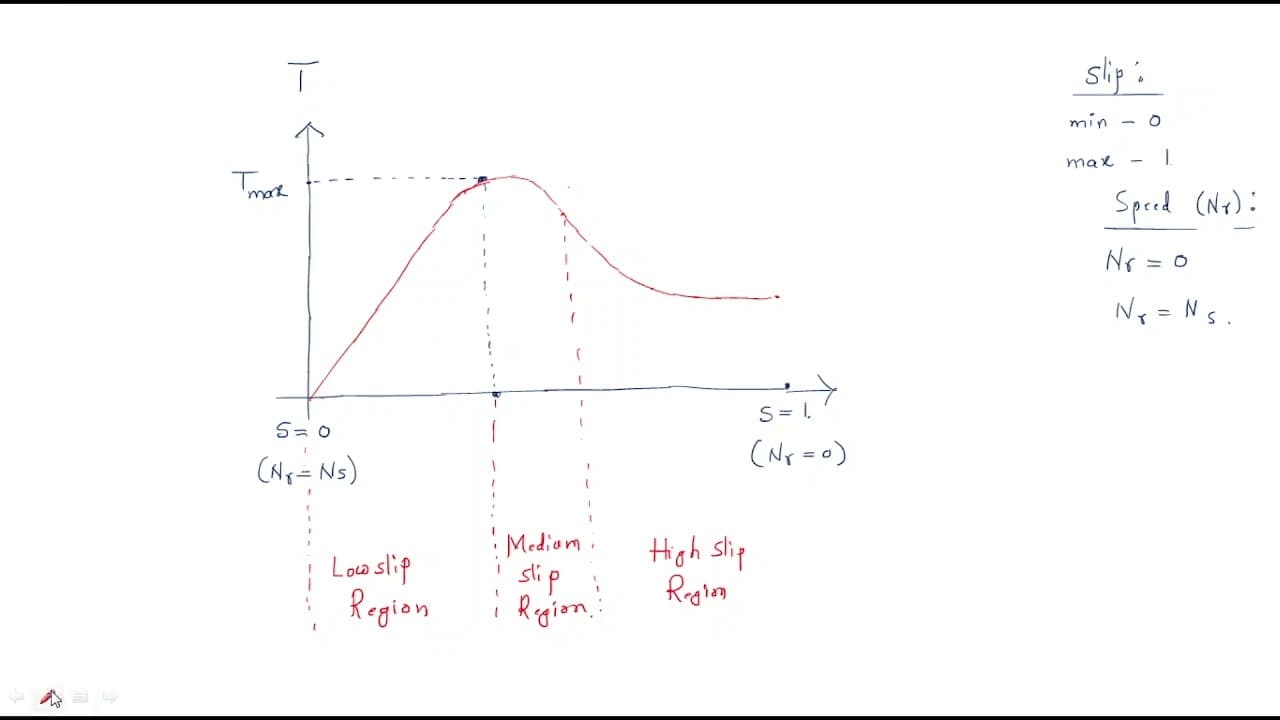
The content describes the torque-slip characteristics of three-phase induction motors across different slip regions.
Transcript
hello everyone in the last session we discussed about the dark slip characteristics in that we discussed one point that is low slip region in the low slip region we observed that the torque and slip is proportional to each other in this next we will move on to the medium medium slip region and in the medium slip region we can't we can't tell how it... Read More
Key Insights
- 💋 The relationship between torque and slip is crucial for understanding motor performance across three distinct slip regions: low, medium, and high.
- 😘 Operating within the low slip region guarantees stability and predictable performance in three-phase induction motors.
- 💋 In the high slip region, the inverse relationship between torque and slip signals potential instability and performance challenges that may arise.
- 🥳 Understanding the slip concept as the ratio of speed differences aids in grasping the operational dynamics of induction motors.
- 💋 The importance of linear vs. nonlinear relationships in torque-slip characteristics can impact design and control decisions in motor applications.
- 💋 Engineers must monitor slip levels carefully to avoid operating in unstable regions that could harm motor efficiency and functionality.
- 💋 Torque-slip characteristics diagrams serve as valuable tools for visualizing operational parameters and guiding engineering decisions.
Install to Summarize YouTube Videos and Get Transcripts
Explore YouTube Video Summarizer or Get YouTube Transcript Extractor
Questions & Answers
Q: What is the significance of the low slip region in torque-slip characteristics?
The low slip region is significant because, in this area, the torque is directly proportional to slip. This linear relationship indicates stable motor operation, where increases in slip correspond to increases in torque, providing predictable performance essential for various applications.
Q: How does slip vary with rotor speed in three-phase induction motors?
Slip is defined as the difference between synchronous speed and rotor speed expressed relative to synchronous speed. As rotor speed increases from zero to synchronous speed, the slip decreases from one to zero, demonstrating an inverse relationship between slip and rotor speed in induction motors.
Q: What happens to torque in the high slip region compared to the low slip region?
In the high slip region, torque becomes inversely proportional to slip, meaning that as slip increases, torque decreases. This behavior indicates an unstable operational region, which can lead to performance issues if the motor is not carefully monitored and controlled.
Q: Why is it important to identify stable and unstable regions in the torque-slip characteristics?
Identifying stable and unstable regions is crucial for operational efficiency. Operating in a stable region, such as the low slip region, ensures reliable motor behavior and performance, while high slip regions can result in erratic performance and potential motor damage due to unintended behaviors.
Q: How do torque and slip interact in different slip regions?
In the low slip region, torque increases linearly with slip, reflecting a stable relationship; in the medium slip region, the relationship becomes less defined, and in the high slip region, torque decreases as slip increases, representing an unstable characteristic where performance can be unpredictable.
Q: What roles do dynamic equations play in understanding torque-slip characteristics?
Dynamic equations help describe the relationship between torque and slip. The equations facilitate predicting motor behaviors under varying conditions, enabling engineers to design systems and control strategies that maintain optimal performance and stability across operations.
Summary & Key Takeaways
-
The content analyzes the behavior of torque in relation to slip in three phases: low, medium, and high slip regions, outlining their unique characteristics and equations.
-
It establishes that torque is directly proportional to slip in the low slip region, while in the high slip region, torque is inversely proportional to slip, which affects the motor's stability.
-
The speaker emphasizes the importance of operating induction motors within stable regions, specifically in low slip settings, to ensure optimal performance and efficiency.
Read in Other Languages (beta)
Share This Summary 📚
Summarize YouTube Videos and Get Video Transcripts with 1-Click
Try YouTube Summary with ChatGPT & Claude or YouTube Transcript Generator