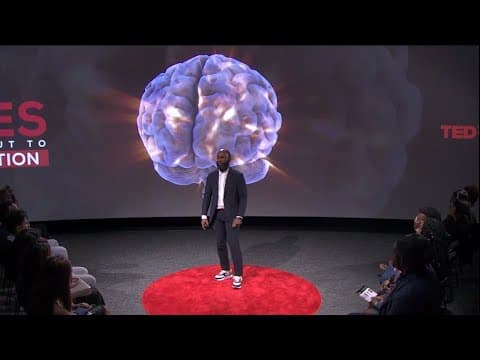
Quantum Universe | Xiaoke Wang | TEDxYouth@TongAnRoad

TL;DR
Quantum physics challenges our understanding of reality and interconnectedness.
Transcript
God doesn't throw dice I'm pretty sure when you sometimes order a teal meal you might find that there were no chapsticks nor Forks inside well you might think to yourself that's just some random bad luck but what if there's actually no Randomness and everything that is seemingly a battery actually does occur in a prettyer way sounds scary huh do pe... Read More
Key Insights
- 🫵 Quantum physics suggests that our observations fundamentally shape reality, contrasting with deterministic views of the universe.
- 🦾 Schrödinger's equation illustrates how quantum mechanics connects perception with physical phenomena, highlighting our role in influencing outcomes.
- 👶 The concept of quantum entanglement undermines classical ideas of locality, introducing a new understanding of distance and interaction.
- 🌍 Heisenberg's uncertainty principle emphasizes the inherent randomness of the quantum world, challenging traditional scientific methodologies.
- 🏛️ Advances in quantum computing promise revolutionary changes in technology, potentially surpassing classical computing capabilities.
- 🦾 The potential applications of quantum mechanics extend to fields like medicine, communications, and artificial intelligence, influencing future technological contexts.
- ❓ Philosophically, quantum physics invites discussions on interconnectedness, the nature of reality, and the existence of parallel universes.
Install to Summarize YouTube Videos and Get Transcripts
Explore YouTube Video Summarizer or Get YouTube Transcript Extractor
Questions & Answers
Q: What is quantum entanglement, and why is it significant?
Quantum entanglement refers to a phenomenon where two or more particles become interconnected, such that the state of one particle instantly influences the state of another, no matter the distance separating them. This concept is significant because it challenges the classical understanding of locality and suggests that particles can have instantaneous connections, reshaping our grasp of space and time.
Q: How does Schrödinger's equation relate to our perception of reality?
Schrödinger's equation describes how the quantum state of a physical system evolves over time. This equation illustrates that our observations aren't mere passive reflections of reality but rather active influences that shape the outcomes of quantum events, emphasizing the idea that perception plays a crucial role in defining reality.
Q: What is the relevance of quantum mechanics to everyday life?
Quantum mechanics isn't just theoretical; it influences many technologies we use daily, such as lasers, semiconductors, and even medical imaging devices. These technologies, grounded in quantum phenomena, have transformed our world, demonstrating that understanding quantum physics can lead to innovations that directly affect our lives.
Q: What are some implications of the uncertainty principle introduced by Heisenberg?
Heisenberg's uncertainty principle posits that certain pairs of physical properties, like position and momentum, cannot both be precisely measured at the same time. This principle implies that randomness and probability are foundational to quantum systems, suggesting that the universe operates under a framework of uncertainty rather than strict determinism, affecting scientific approaches across disciplines.
Q: How might quantum computing change the technological landscape?
Quantum computing leverages the principles of superposition and entanglement to process information in fundamentally different ways than classical computers. This could lead to breakthroughs in solving complex problems, optimizing algorithms, and advancing fields like cryptography, drug discovery, and artificial intelligence, potentially transforming industries and research capabilities.
Q: What philosophical questions arise from quantum physics?
Quantum physics raises profound philosophical inquiries about the nature of reality, free will, and existence. It challenges our notions of cause and effect, determinism, and interconnectedness, prompting us to rethink our understanding of consciousness, perception, and the very fabric of the universe, as well as our place within it.
Summary & Key Takeaways
-
The speech explores the intersection of quantum physics with everyday life, emphasizing how our perceptions shape reality and influence outcomes, as illustrated by Schrödinger's equation and uncertainty principle.
-
Concepts like quantum entanglement and parallel realities challenge traditional views of determinism, suggesting that the universe is full of endless possibilities and interconnected phenomena.
-
The significance of quantum physics extends beyond theoretical exploration; it is vital for advancements in technology, especially quantum computing, which promises to revolutionize various aspects of life and scientific research.
Read in Other Languages (beta)
Share This Summary 📚
Summarize YouTube Videos and Get Video Transcripts with 1-Click
Try YouTube Summary with ChatGPT & Claude or YouTube Transcript Generator
Explore More Summaries from TEDx Talks 📚

Summarize YouTube Videos and Get Video Transcripts with 1-Click
Try YouTube Summary with ChatGPT & Claude or YouTube Transcript Generator