What Are Essential Phrasal Verbs for Education?
TL;DR
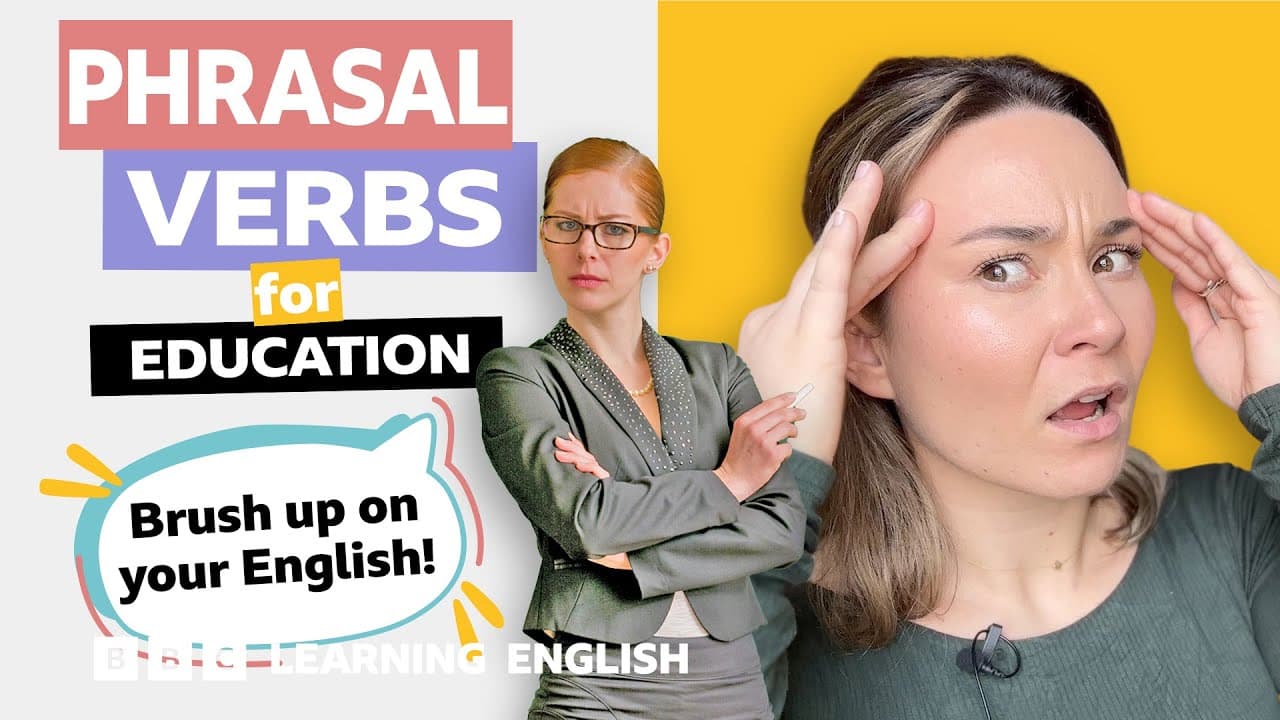
Essential phrasal verbs related to education include 'be into' for having an interest, 'take up' for starting a new activity, and 'read up on' for learning through reading. Other key verbs are 'brush up on' to improve skills, 'work on' for dedicating effort to tasks, and 'hand in' for submitting work. Understanding these verbs is vital for effective communication in educational contexts.
Transcript
Did you know that I'm really into photography? Well, you should take it up as a hobby, then. Actually, I'd like to take up a beginner's photography course first so that I can read up on it. Yeah. That might help you to brush up on the skills you already have too. Hello! This is Georgie from BBC Learning English and in this video, We are learning so... Read More
Key Insights
- Phrasal verbs are crucial in mastering English, especially those related to education and learning.
- 'Be into' signifies having an interest, while 'take up' means starting a new activity or hobby.
- 'Read up on' involves learning through reading, often used for gaining theoretical knowledge.
- 'Brush up on' means improving existing skills that may have become rusty over time.
- 'Work on' refers to dedicating effort and concentration to a task or project.
- 'Fall behind' indicates slower progress compared to others in a similar activity.
- 'Catch up' involves extra effort to reach the same level as others after falling behind.
- 'Hand in' is used when submitting completed work or projects to the relevant authority.
Install to Summarize YouTube Videos and Get Transcripts
Explore YouTube Video Summarizer or Get YouTube Transcript Extractor
Questions & Answers
Q: What does 'be into' mean in the context of phrasal verbs?
'Be into' is a phrasal verb that means having an interest in something. It is used to express enthusiasm or passion for a particular activity or subject. In the video, Georgie uses it to explain how someone might be interested in photography or languages, showcasing its application in everyday conversations.
Q: How is 'take up' used in educational contexts?
'Take up' is a phrasal verb used to indicate starting a new activity or hobby. In educational contexts, it can refer to enrolling in a course or beginning a new subject of study. The video illustrates this with examples, showing how someone might take up a photography course to learn more about the subject.
Q: What is the significance of 'read up on' in learning?
'Read up on' is a phrasal verb that means learning about something through reading. It is significant in learning as it involves gaining theoretical knowledge, which can be crucial before engaging in practical activities. The video highlights its importance by suggesting that reading up on photography can help understand its theoretical aspects.
Q: Why is 'brush up on' important for learners?
'Brush up on' is a phrasal verb that means improving skills that may have become rusty. It is important for learners as it emphasizes the need to refresh and update existing knowledge or abilities. The video suggests that brushing up on skills like listening can be beneficial for language learners, ensuring they maintain proficiency.
Q: How does 'work on' relate to educational tasks?
'Work on' is a phrasal verb that refers to putting effort and concentration into completing a task or project. In educational settings, it is often used to describe the process of diligently working on assignments, projects, or studying for exams. The video uses it to illustrate how learners can focus on improving their skills or completing their educational responsibilities.
Q: What challenges might arise from 'falling behind' in studies?
'Falling behind' is a phrasal verb that indicates slower progress compared to others. In studies, it can lead to challenges such as increased workload, stress, and difficulty catching up with peers. The video addresses this by suggesting that learners may need to spend extra time and effort to catch up, highlighting the importance of staying on track with educational tasks.
Q: How can learners 'catch up' after falling behind?
'Catch up' is a phrasal verb that involves spending extra time and effort to reach the same level as others after falling behind. Learners can catch up by prioritizing tasks, seeking help from peers or teachers, and dedicating additional study time. The video emphasizes that catching up requires commitment and perseverance to regain lost ground in educational pursuits.
Q: What does 'hand in' mean in the context of assignments?
'Hand in' is a phrasal verb used to describe the act of submitting completed work or assignments to the relevant authority, such as a teacher or professor. It signifies the completion of a task and the transition of responsibility from the student to the evaluator. The video uses it to explain the process of finalizing and submitting projects within educational environments.
Summary & Key Takeaways
-
This video by Georgie from BBC Learning English focuses on phrasal verbs related to education. It explains the meanings and uses of various verbs like 'be into', 'take up', 'read up on', and 'brush up on'. These verbs are essential for learners to understand and use in educational contexts.
-
The video provides examples of how to use phrasal verbs in sentences, highlighting their importance in improving English skills. It encourages viewers to practice by writing sentences using the learned verbs and offers additional resources like worksheets for further practice.
-
Georgie emphasizes the significance of phrasal verbs in English learning, particularly in educational settings. The video also suggests checking out other episodes and resources to enhance understanding and application of phrasal verbs, making it a valuable tool for English learners.
Read in Other Languages (beta)
Share This Summary 📚
Summarize YouTube Videos and Get Video Transcripts with 1-Click
Try YouTube Summary with ChatGPT & Claude or YouTube Transcript Generator
Explore More Summaries from BBC Learning English 📚
Summarize YouTube Videos and Get Video Transcripts with 1-Click
Try YouTube Summary with ChatGPT & Claude or YouTube Transcript Generator