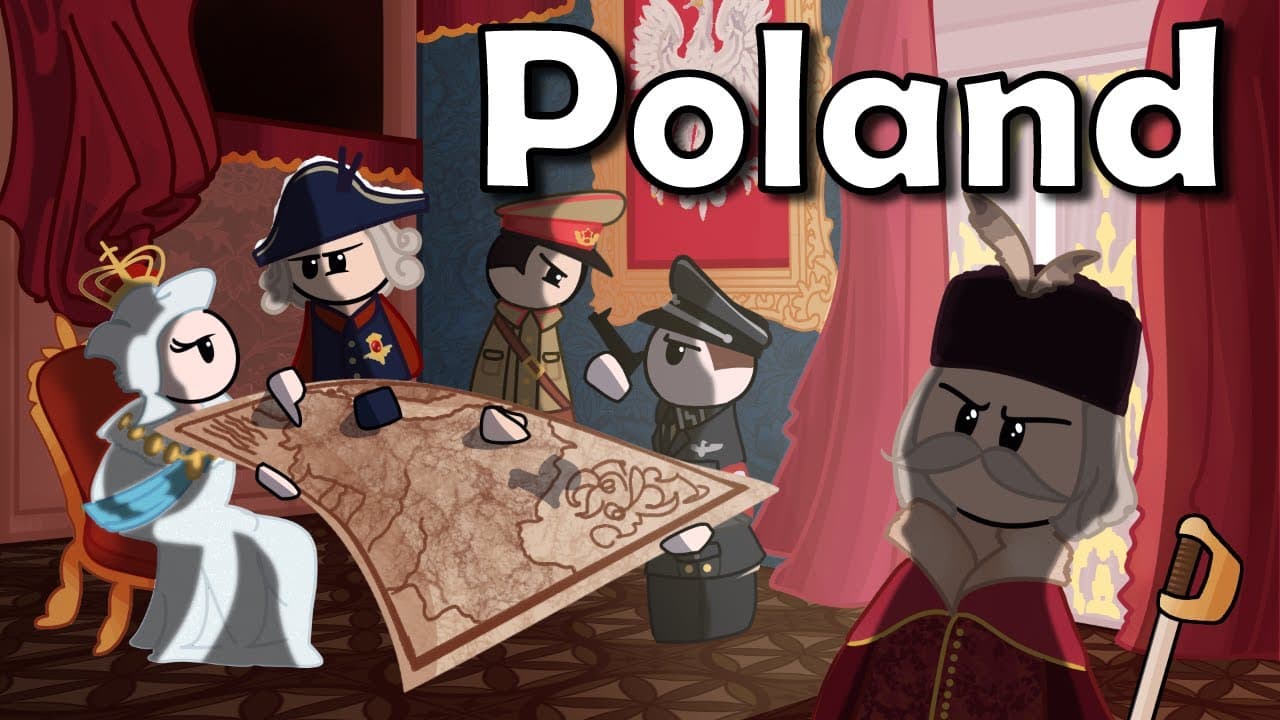
The Complete History of Poland | Compilation
TL;DR
A comprehensive overview of Poland's history from its origins to modern times.
Transcript
if you live in Central or Eastern Europe you probably grew up hearing the folk tale of the Three Brothers Le Czech and Rose the three legendary Patriarchs of the Slavic peoples while out on a hunting trip the brothers had a disagreement as brothers do on which prey to follow leading them to split up Czech the eldest of the brothers followed his pre... Read More
Key Insights
- The legend of the Three Brothers explains the founding of Poland, with Lech following a white eagle to establish the nation.
- Poland's early history was marked by the Piast dynasty, which saw the adoption of Christianity and the establishment of a feudal society.
- The Polish-Lithuanian Commonwealth became a major European power, known for its military prowess and cultural influence.
- Poland faced numerous partitions by neighboring powers, ultimately disappearing from maps for over a century.
- During World War II, Poland suffered immense losses and was occupied by both Nazi Germany and the Soviet Union.
- Post-war Poland was under Soviet influence, leading to economic struggles and political repression during the Communist era.
- The Solidarity movement in the 1980s played a pivotal role in Poland's transition from communism to democracy.
- Poland's integration into NATO and the European Union marked a significant shift towards Western alignment and economic growth.
Install to Summarize YouTube Videos and Get Transcripts
Explore YouTube Video Summarizer or Get YouTube Transcript Extractor
Questions & Answers
Q: What is the legend of the Three Brothers?
The legend of the Three Brothers tells the story of Lech, Czech, and Rus, who are considered the patriarchs of the Slavic peoples. During a hunting trip, they parted ways due to a disagreement. Lech followed a white eagle and founded Poland, which is symbolized by the eagle on the Polish flag.
Q: How did the Piast dynasty influence early Polish history?
The Piast dynasty played a crucial role in shaping early Polish history. It marked the transition from paganism to Christianity with the baptism of Mieszko I in 966. The dynasty also established a feudal society, which included the development of a structured nobility and the construction of castles, securing Poland's borders.
Q: What was the significance of the Polish-Lithuanian Commonwealth?
The Polish-Lithuanian Commonwealth was a major European power, known for its military strength, particularly the winged hussars. It was a center of culture and commerce, with a unique political system that included elected kings. The Commonwealth served as a bulwark against invasions, notably from the Ottoman Empire.
Q: How did Poland disappear from the map during the partitions?
Poland was partitioned by its powerful neighbors—Russia, Prussia, and Austria—during the late 18th century. These partitions divided Polish territories among the three empires, erasing Poland from the map for over a century. This period was marked by the suppression of Polish culture and autonomy.
Q: What challenges did Poland face during World War II?
During World War II, Poland was invaded by Nazi Germany and the Soviet Union, leading to immense suffering. The country experienced significant civilian and military casualties, and the Jewish population faced the horrors of the Holocaust. Despite these challenges, Polish resistance movements continued to fight against the occupiers.
Q: How did the Solidarity movement impact Poland's political landscape?
The Solidarity movement, led by Lech Wałęsa, was instrumental in challenging the Communist regime in Poland during the 1980s. It began as a workers' union but quickly grew into a political force advocating for democratic reforms. The movement's efforts led to the eventual collapse of communism in Poland and the establishment of a democratic government.
Q: What were the outcomes of Poland's integration into NATO and the EU?
Poland's integration into NATO in 1999 and the European Union in 2004 marked a significant shift towards Western alignment. These memberships facilitated economic growth, political stability, and security cooperation. Poland's economy benefited from EU investments and trade opportunities, contributing to its status as a success story among former Eastern Bloc countries.
Q: How did Poland's borders change after World War II?
After World War II, Poland's borders were significantly altered. The Soviet Union annexed the eastern territories, while Poland gained lands from Germany, including Silesia, Pomerania, and Prussia. This led to large-scale ethnic redistributions, with millions of Poles and Germans being forcibly relocated to reflect the new borders.
Summary & Key Takeaways
-
Poland's history is rooted in Slavic legends and the establishment of the Piast dynasty, which laid the foundation for a Christian and feudal society. The Polish-Lithuanian Commonwealth emerged as a significant European power, known for its military and cultural influence.
-
The partitions of Poland by neighboring powers led to its disappearance from the map for over a century. During World War II, Poland endured severe hardships under Nazi and Soviet occupations, resulting in significant loss of life and cultural devastation.
-
Post-war Poland was characterized by Soviet influence, economic struggles, and political repression. However, the Solidarity movement in the 1980s catalyzed Poland's transition to democracy, leading to its integration into NATO and the European Union, fostering economic growth and Western alignment.
Read in Other Languages (beta)
Share This Summary 📚
Summarize YouTube Videos and Get Video Transcripts with 1-Click
Try YouTube Summary with ChatGPT & Claude or YouTube Transcript Generator
Explore More Summaries from Suibhne 📚
Summarize YouTube Videos and Get Video Transcripts with 1-Click
Try YouTube Summary with ChatGPT & Claude or YouTube Transcript Generator