Synchronous Motor | Reactive power & power factor | Synchronous Machines | Lec-41
TL;DR
This session discusses maximum torque in synchronous motors, including its implications on stability and reactive power.
Transcript
hello everyone in this session we will con discuss about the maximum torque or breakdown torque and pull out dark Sterling dark all are the same meaning itself the torque will reach the maximum value or breakdown breakdown means at that region the motor will break down occur water will stop breakdown means pull out pull out means it will out from t... Read More
Key Insights
- 🧑🦼 Maximum torque serves as a critical threshold for synchronous motors, delineating stable and unstable operational regions.
- 🥺 Loss of synchronism in motors can lead to significant performance repercussions, emphasizing the importance of torque limits in design.
- ✊ Reactive power management is influenced heavily by excitation conditions, affecting how synchronous motors operate.
- ✊ The relationship between excitation and reactive power indicates that careful monitoring is essential for optimal motor efficiency.
- ✊ Normal excitation results in no net reactive power absorption or delivery, maintaining system balance during operation.
- 🧑🦼 The stability of synchronous motors is closely tied to their ability to maintain synchronous speed, directly influencing their torque capabilities.
- ✊ Power factor distinctions between synchronous motors and alternators highlight the unique operational characteristics of synchronous machines.
Install to Summarize YouTube Videos and Get Transcripts
Explore YouTube Video Summarizer or Get YouTube Transcript Extractor
Questions & Answers
Q: What is maximum torque in synchronous motors, and why is it important?
Maximum torque, often referred to as breakdown torque, signifies the upper limit a synchronous motor can handle without losing synchronism. This point is critical because exceeding it can destabilize the motor, leading to operational failure. Understanding this torque helps engineers design safe and efficient motor systems capable of performing within certain thresholds.
Q: How does reactive power relate to excitation in synchronous motors?
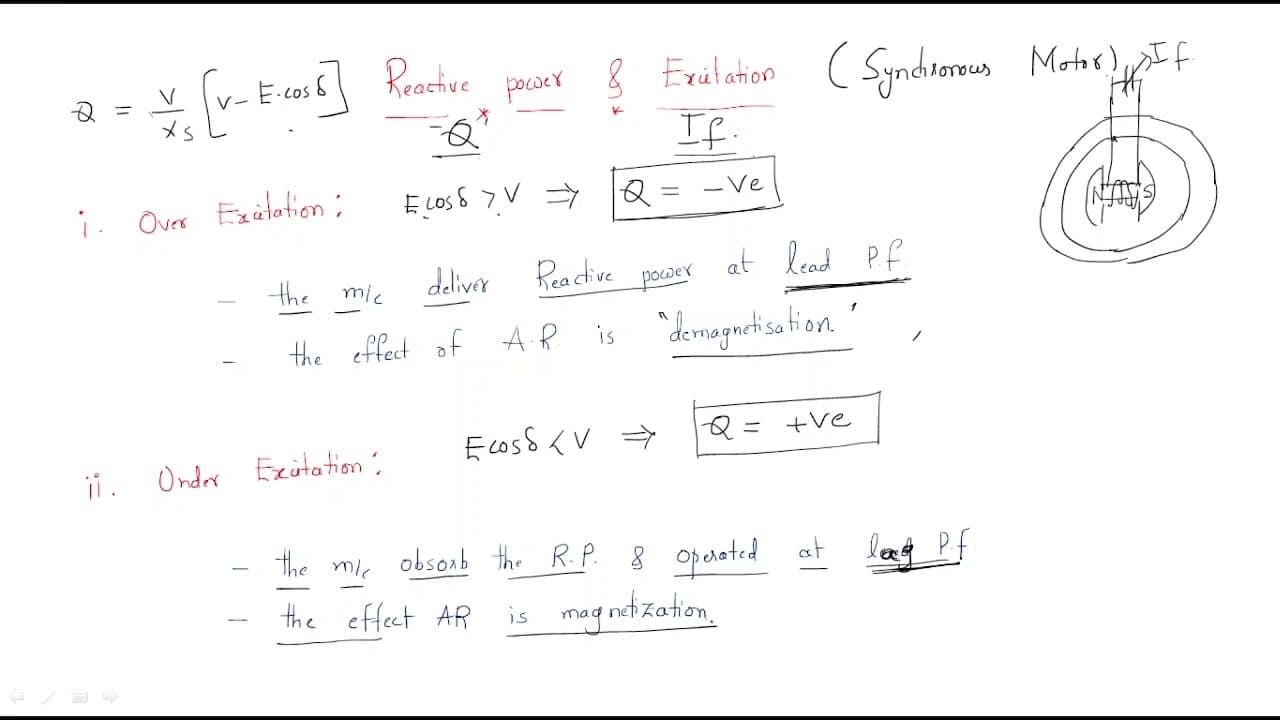
Reactive power and motor excitation are interconnected concepts. Reactive power signifies power not used to perform work but necessary for maintaining voltage levels in the system. Excitation affects how much reactive power a synchronous motor delivers or absorbs. In over-excited states, motors can supply reactive power, while under-excited states indicate absorption, influencing overall efficiency.
Q: What happens when a synchronous motor operates above its maximum torque?
When a synchronous motor operates beyond its maximum torque, it enters an unstable region, resulting in the motor losing synchronism. This can lead to the rotor stopping, risking operational safety and damaging the motor if not managed correctly. Understanding this threshold is vital for engineers to ensure sustained performance.
Q: What is the difference between over-excitation and under-excitation in synchronous motors?
Over-excitation occurs when the motor generates more excitation voltage than terminal voltage, leading to the motor delivering reactive power at a leading power factor. Conversely, under-excitation happens when the excitation voltage is less than terminal voltage, causing the motor to absorb reactive power, typically at a lagging power factor. Each state significantly affects motor performance.
Summary & Key Takeaways
-
The maximum torque, or breakdown torque, defines the limit a synchronous motor can reach before losing synchronism, becoming unstable and ceasing rotation.
-
Reactive power and excitation are crucial in synchronous motors, influencing power factors and operational stability depending on whether the motor is over-excited or under-excited.
-
A comparison of synchronous motors and alternators showcases the behaviors of reactive power and power factors in different excitation conditions, emphasizing their interrelation in motor performance.
Read in Other Languages (beta)
Share This Summary 📚
Summarize YouTube Videos and Get Video Transcripts with 1-Click
Try YouTube Summary with ChatGPT & Claude or YouTube Transcript Generator