Calculus - Lesson 16 | Indefinite and Definite Integrals | Don't Memorise
TL;DR
Integration is the reverse process of differentiation, and by finding the antiderivative of a function, we can compute the value of its integral.
Transcript
Look at the information given on the screen. Can you tell me the value of this integral? It will be equal to this. We've seen this result in the previous video. It tells us that integration is just the reverse of differentiation. Integral of the derivative of the function f of X is just equal to the difference in the function "f of X" evaluated at ... Read More
Key Insights
- ◀️ Integration is the reverse process of differentiation, and it helps find the integral of a function.
- 🎅 The antiderivative of a function, such as capital "G" of X + C, has the property that its derivative is equal to the original function.
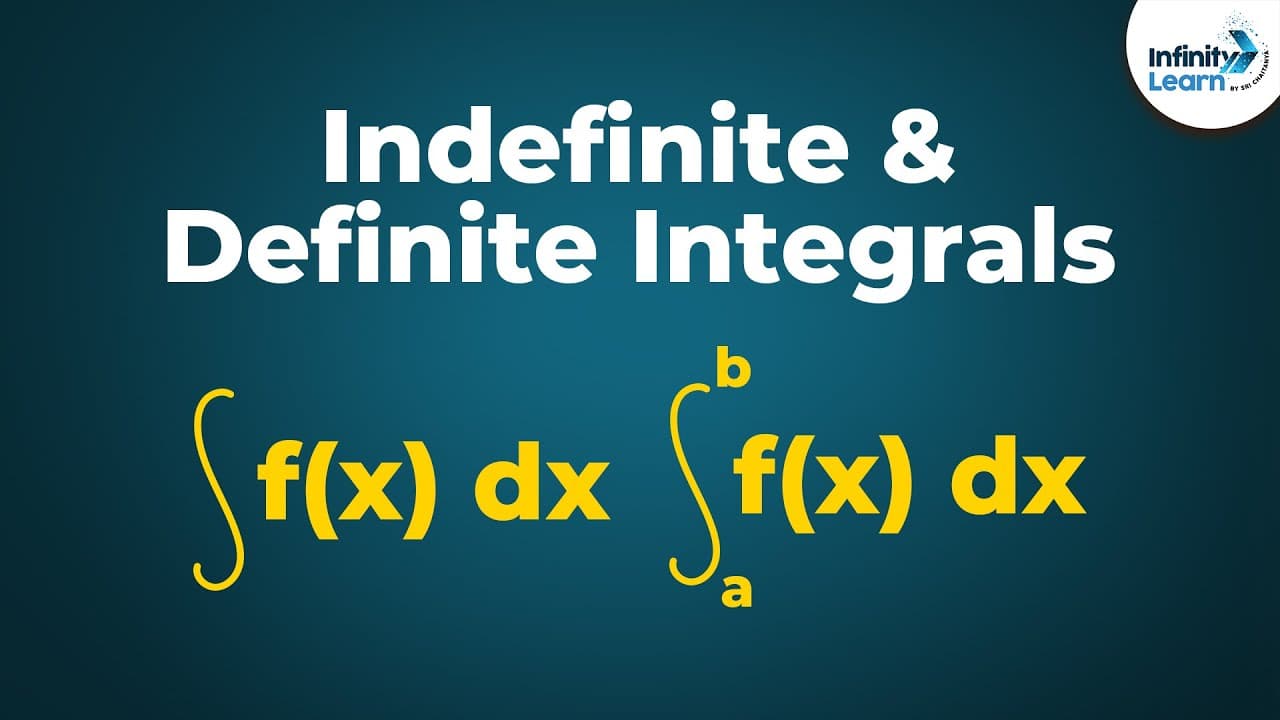
- ⛔ The definite integral represents the value of the integral of a function within specific limits of integration.
- ❓ Antiderivatives of a function, which differ by a constant, are collectively known as indefinite integrals.
Install to Summarize YouTube Videos and Get Transcripts
Explore YouTube Video Summarizer or Get YouTube Transcript Extractor
Questions & Answers
Q: What is the relationship between integration and differentiation?
Integration is the reverse process of differentiation, where integration helps find the integral of a function, while differentiation finds the rate of change of a function.
Q: How can we find the integral of a function?
To find the integral of a function, we need to find the antiderivative of the function, which is a function that, when differentiated, gives the original function.
Q: How can we determine the antiderivative of a function?
To find the antiderivative of a function, we need to find a function whose derivative is equal to the original function. This can be done through reverse engineering and manipulations, as shown in the video.
Q: What is the difference between the definite integral and indefinite integral?
The definite integral is the value of the integral of a function within specific limits of integration, while the indefinite integral represents the family of antiderivatives of the function.
Q: Can we use any antiderivative to find the value of the integral?
Yes, any antiderivative of a function can be used to find the value of its integral, as they will all yield the same result. The constant added to the antiderivative corresponds to the unknown constant of integration.
Q: What is the significance of adding a constant in the antiderivative?
Adding a constant in the antiderivative allows us to capture the infinite possibilities of antiderivatives for a given function, as any constant value added will not affect the rate of change of the function.
Summary & Key Takeaways
-
Integration is the inverse of differentiation and helps find the integral of a function.
-
The integral of a function can be found by finding the antiderivative of the function.
-
Antiderivatives of a function, such as capital "G" of X + C, can be used to evaluate definite integrals.
Read in Other Languages (beta)
Share This Summary 📚
Summarize YouTube Videos and Get Video Transcripts with 1-Click
Try YouTube Summary with ChatGPT & Claude or YouTube Transcript Generator
Explore More Summaries from Infinity Learn NEET 📚


Summarize YouTube Videos and Get Video Transcripts with 1-Click
Try YouTube Summary with ChatGPT & Claude or YouTube Transcript Generator