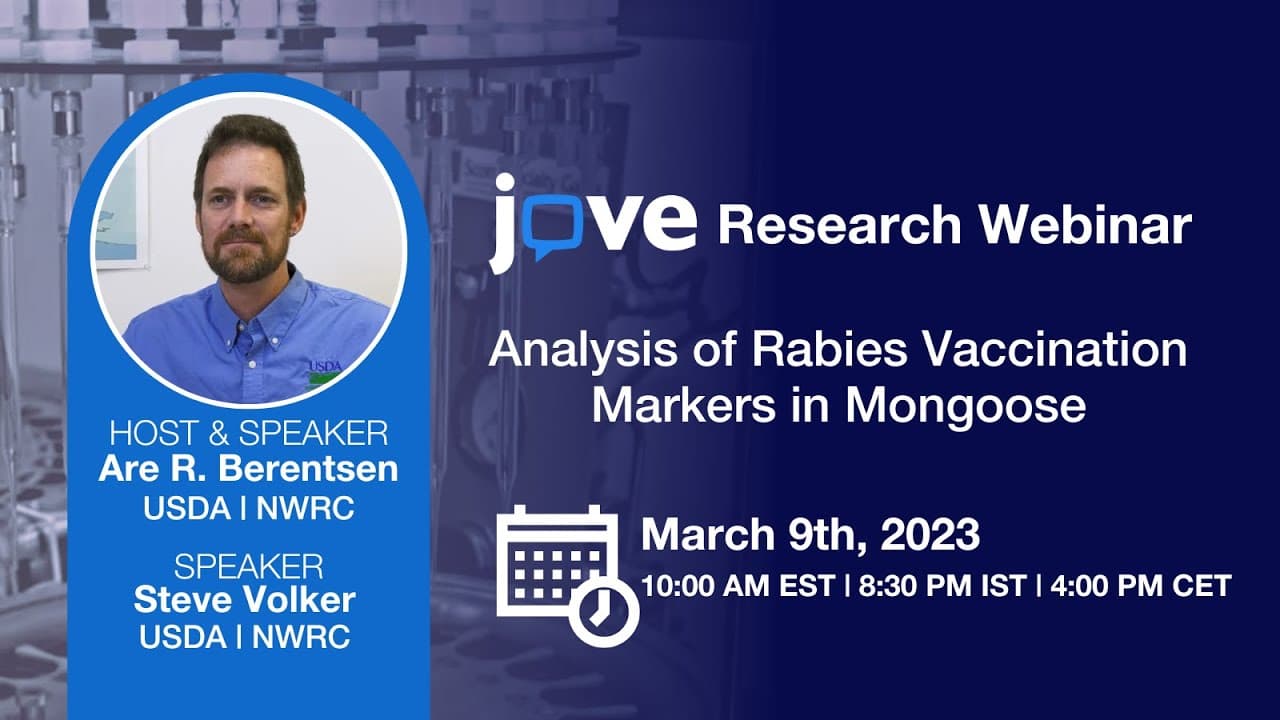
Analysis of Rabies Vaccination Markers in Mongoose
TL;DR
Webinar on rabies vaccination markers in mongoose using iophenoxic acid.
Transcript
okay so welcome welcome to our webinar everyone um so today we have um Ari Bernstein and also Steve volcker from the USDA um so they they published a video method with us in 2019. um see um so today they're going to be talking about recent updates to the um the protocol so they um they published with us on rabies vaccination markers in Mongoose so ... Read More
Key Insights
- The webinar focuses on the use of iophenoxic acids as markers for rabies vaccination in mongooses, highlighting recent updates to the methodology.
- Liquid chromatography and mass spectrometry have improved the detection of iophenoxic acids in mongoose serum, allowing for more accurate quantification.
- Field trials in Puerto Rico demonstrated high bait consumption rates using ethyl and methyl iophenoxic acids, with over 60% of sampled animals testing positive.
- Differences in detection and retention times of iophenoxic acids vary significantly between species, impacting the effectiveness of the method across different animals.
- Recent methodological updates aim to streamline the process, reducing time and costs without compromising performance.
- Challenges remain in sourcing certain iophenoxic acid congeners due to limited commercial availability, affecting the internal standard used in analyses.
- The potential for using this biomarker in other species like dogs and cats is promising, though species-specific retention times need consideration.
- Cost considerations include the synthesis of iophenoxic acid congeners and the use of phospholipid removal cartridges for sample preparation.
Install to Summarize YouTube Videos and Get Transcripts
Explore YouTube Video Summarizer or Get YouTube Transcript Extractor
Questions & Answers
Q: What are the differences in detection among species?
Detection differences among species are significant, with variations in how quickly iophenoxic acids are cleared from the body. For instance, opossums clear the acids more rapidly than mongooses, which tend to maintain a steady state level over time. These differences necessitate species-specific considerations in method application.
Q: Can this biomarker be used in dogs and cats?
The biomarker has potential for use in dogs and cats. Research indicates that iophenoxic acids have been used in the past for humans as contrasting agents and have shown long retention times in dogs. However, species-specific variability in retention times should be considered when applying this method to different animals.
Q: What is the optimum concentration of IPA in a bait?
The optimum concentration of iophenoxic acid (IPA) in a bait is species-specific. In mongoose studies, 2.8 milligrams per bait was effective, but future studies may explore reducing this to 1 milligram. The concentration also depends on the desired marking duration, with higher doses required for longer detection periods.
Q: What are the costs associated with IPA and investigations?
Costs associated with iophenoxic acid (IPA) include the synthesis of certain congeners, as only ethyl IPA is commercially available. This synthesis can be costly. Additionally, using phospholipid removal cartridges for sample preparation may increase costs, especially when processing thousands of samples.
Q: Is the half-life of IBA species-dependent?
Yes, the half-life of iophenoxic acid (IBA) is species-dependent. Different species exhibit varying retention times, with some clearing the acid more rapidly than others. This variability impacts the effectiveness of using IBA as a marker across different species and must be considered in study designs.
Q: What methodological updates have been made recently?
Recent updates to the methodology include streamlining the process to save time and costs without losing performance. Changes involve modifying the extraction procedure, such as eliminating the dry-down step and evaluating the use of phospholipid removal cartridges, which could further simplify the process.
Q: What challenges exist in sourcing IPA congeners?
Challenges in sourcing iophenoxic acid (IPA) congeners arise from the limited commercial availability of certain derivatives. While ethyl IPA is available, other congeners like methyl, propyl, butyl, and pentyl need to be specifically synthesized, which can be costly and complicates the methodology.
Q: How was the field trial in Puerto Rico conducted?
The field trial in Puerto Rico involved delivering placebo oral rabies vaccine baits with iophenoxic acid across a large area. Trials conducted in Autumn 2016 used ethyl IPA, while Spring 2017 trials used methyl IPA. Results showed over 60% of animals sampled were positive for IPA, indicating successful bait consumption.
Summary & Key Takeaways
-
The webinar presented by Ari Berentsen and Steve Volker from the USDA NWRC discussed the use of iophenoxic acids as markers for rabies vaccination in mongooses. The presentation covered updates to the methodology, including improvements in detection techniques using liquid chromatography and mass spectrometry.
-
Field trials conducted in Puerto Rico showed promising results, with high bait consumption rates detected through the presence of ethyl and methyl iophenoxic acids in mongoose serum. The method's effectiveness varies between species, requiring consideration of species-specific retention times.
-
Recent updates to the methodology aim to streamline the process, reducing time and costs. However, challenges remain in sourcing certain iophenoxic acid congeners. The potential application of this biomarker in other species like dogs and cats was also discussed.
Read in Other Languages (beta)
Share This Summary 📚
Summarize YouTube Videos and Get Video Transcripts with 1-Click
Try YouTube Summary with ChatGPT & Claude or YouTube Transcript Generator