Full adder | Combinational circuit | STLD | Lec-57
TL;DR
This video explains the full adder, its truth table, and how to derive expressions.
Transcript
hi everyone in this video I'm going to tell you about full adder in the last video I have explained you about half adder how to draw the off Adder circuit how to simplify the expressions for someone carry in the half header using K also we have seen the same method the same procedure we are going to apply for the full header what do you mean by ful... Read More
Key Insights
- 🪜 The full adder is essential for adding three binary bits, incorporating a carry input for accurate results.
- 😑 Understanding the truth table is foundational for deriving expressions that govern digital circuit behavior.
- #️⃣ K-map simplifies logical expressions, promoting efficient circuit design by minimizing the number of gates needed.
- 🪜 The full adder plays a crucial role in constructing adders capable of processing multiple bits through sequential stages.
- 😑 The expression for sum output illustrates how logical operations combine inputs to produce results based on binary addition rules.
- 🪜 Carry outputs from previous stages significantly influence the functioning of adders in arithmetic circuits.
- 🏛️ Knowledge of how to build a full adder circuit provides a fundamental understanding of more complex digital systems.
Install to Summarize YouTube Videos and Get Transcripts
Explore YouTube Video Summarizer or Get YouTube Transcript Extractor
Questions & Answers
Q: What is the primary difference between a half adder and a full adder?
The main difference is that a half adder adds only two bits without a carry input, while a full adder can add three bits by incorporating a carry input from previous additions. This makes the full adder suitable for multi-bit binary addition in digital circuits.
Q: How is the truth table for a full adder structured?
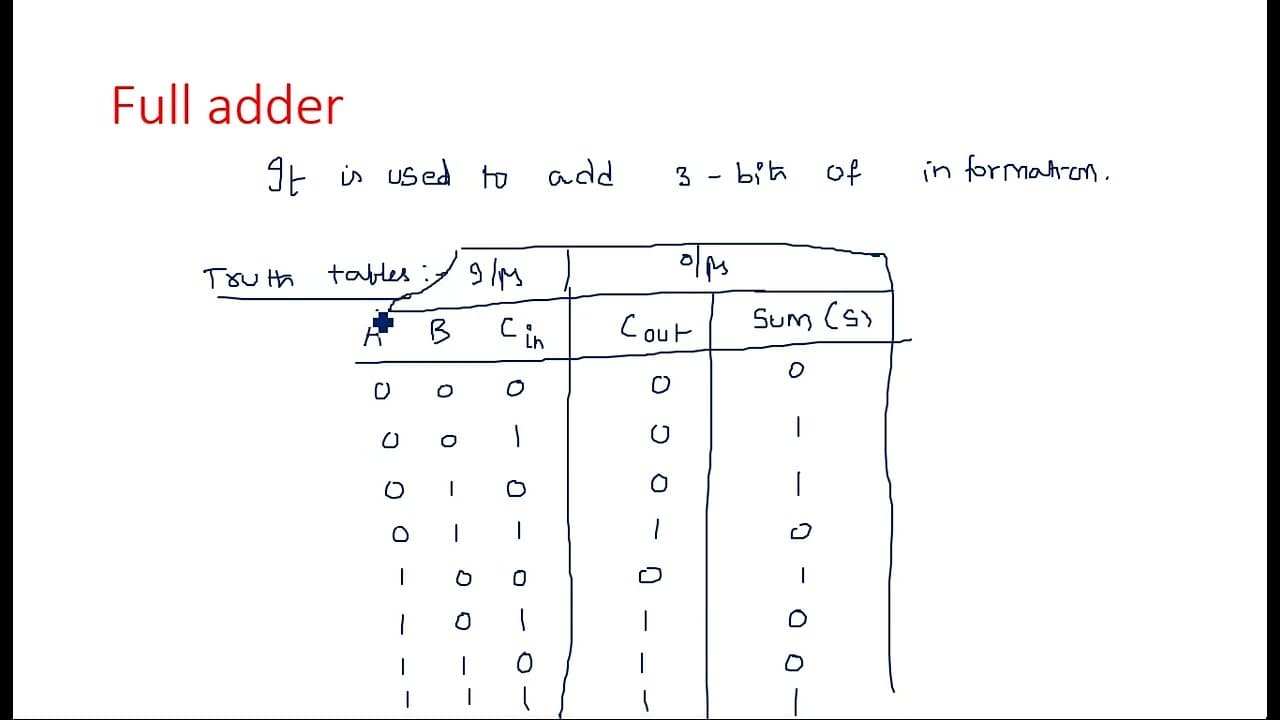
A full adder's truth table has three input variables: A, B, and Carry In (C_in). It outlines all possible combinations of these inputs to compute two outputs: Sum and Carry Out. Each row of the table results from the operation of adding the three bits, revealing how the inputs produce specific outputs through binary addition.
Q: What method is used to simplify expressions in this tutorial?
The video utilizes Karnaugh maps (K-maps) for simplifying expressions related to the sum and carry outputs. K-maps provide a visual representation to minimize Boolean expressions, allowing for the easy identification of prime implicants and subsequent formulation of simpler logic expressions for digital circuits.
Q: Could you explain the significance of the Carry In (C_in) in a full adder?
The Carry In (C_in) is critical for multi-bit addition, as it allows the full adder to account for carries generated from previous additions. When adding sequential bits, C_in enables the propagation of carry values through successive stages of addition, ensuring accurate results for aggregate binary sums.
Q: What logic gates are used in constructing a full adder circuit?
A full adder circuit generally employs XOR gates for the sum output and AND gates for the carry output. The logic circuit combines these gates to process the three inputs, generating the correct sum and carry outputs based on the input combinations defined in the truth table.
Q: How does one derive the sum output expression in a full adder?
The sum output expression can be derived by mapping the truth table onto a K-map and grouping ones to identify the simplest form. For a full adder, the sum is expressed as S = A XOR B XOR C_in, signifying the exclusive OR operation between the three inputs.
Q: Why is the full adder implemented in stages?
Full adders are often implemented in stages to handle the addition of multi-bit binary numbers. This design allows each full adder to add a single bit from two numbers along with any carry from the previous stage, enabling systematic binary addition for larger bit-widths.
Q: What would happen if a half adder were used instead of a full adder for three bits?
Using a half adder for three bits would be inadequate as it lacks a carry input, which is necessary for accurate summation when an overflow occurs. Thus, it would lead to incorrect results since it can only handle the sum of two bits at a time without propagating carries efficiently.
Summary & Key Takeaways
-
The full adder adds three bits, including a carry input, unlike the half adder, which only adds two bits.
-
It starts with a truth table outlining possible input combinations and their respective outputs for sums and carry.
-
The video proceeds to derive algebraic expressions for the sum and carry outputs using Karnaugh maps (K-maps) before illustrating the logic circuit.
Read in Other Languages (beta)
Share This Summary 📚
Summarize YouTube Videos and Get Video Transcripts with 1-Click
Try YouTube Summary with ChatGPT & Claude or YouTube Transcript Generator