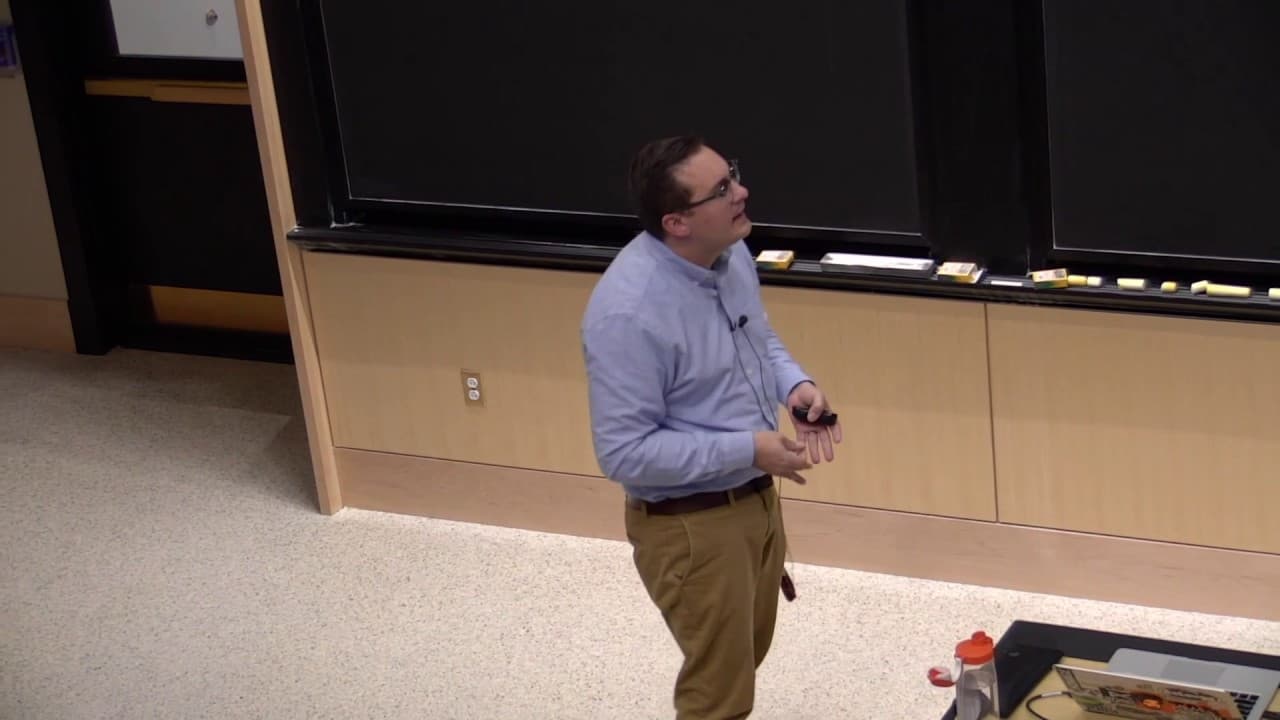
17. Bayesian Statistics
TL;DR
Bayesian statistics is a powerful tool that allows practitioners to incorporate prior knowledge into their analysis, resulting in more accurate inference.
Transcript
The following content is provided under a Creative Commons license. Your support will help MIT OpenCourseWare continue to offer high quality educational resources for free. To make a donation or to view additional materials from hundreds of MIT courses, visit [email protected] PHILIPPE RIGOLLET: So today WE'LL actually just do a brief c... Read More
Key Insights
- 👻 Bayesian statistics allows for the incorporation of prior knowledge into the analysis, resulting in more accurate inference.
- 🚱 There are different types of priors, including informative and non-informative priors, that can be used depending on the context.
- ❓ The choice of prior distribution is important and can influence the results of the analysis.
Install to Summarize YouTube Videos and Get Transcripts
Explore YouTube Video Summarizer or Get YouTube Transcript Extractor
Questions & Answers
Q: What is the main difference between Bayesian and frequentist statistics?
The main difference lies in their approach to inference. Frequentist statistics focuses on estimating parameters based solely on the observed data, while Bayesian statistics incorporates prior knowledge into the analysis to obtain a posterior distribution.
Q: What are some examples of informative and non-informative priors?
An informative prior is one that has specific information about the parameter of interest. For example, if you have historical data about similar experiments, you can use this information to inform the prior. On the other hand, a non-informative prior is one that does not provide any specific information about the parameter. Examples include a uniform prior or a flat prior.
Q: Why is the choice of prior distribution important in Bayesian statistics?
The choice of prior distribution can influence the posterior distribution and, consequently, the results of the analysis. Different prior distributions can lead to different conclusions. Hence, it is crucial to consider the available prior information and its potential impact on the analysis.
Q: How can Bayesian statistics be useful in practice?
Bayesian statistics allows for the incorporation of prior knowledge, which can be particularly valuable in situations where there is limited data or uncertainty. It provides a systematic framework for combining prior beliefs with observed data, resulting in more accurate inference and decision-making.
Summary & Key Takeaways
-
Bayesian statistics is a comprehensive framework that allows practitioners to incorporate prior knowledge into their analysis.
-
The Bayesian approach involves using a prior distribution to represent beliefs about the parameter of interest, updating this prior distribution using the observed data, and obtaining a posterior distribution as a result.
-
The choice of prior distribution can vary depending on the problem at hand, with some priors being informative and others being non-informative.
Read in Other Languages (beta)
Share This Summary 📚
Summarize YouTube Videos and Get Video Transcripts with 1-Click
Try YouTube Summary with ChatGPT & Claude or YouTube Transcript Generator
Explore More Summaries from MIT OpenCourseWare 📚



Summarize YouTube Videos and Get Video Transcripts with 1-Click
Try YouTube Summary with ChatGPT & Claude or YouTube Transcript Generator