M4ML - Multivariate Calculus - 1.3 Rise Over Run
TL;DR
This video explores the relationship between speed and acceleration using calculus concepts.
Transcript
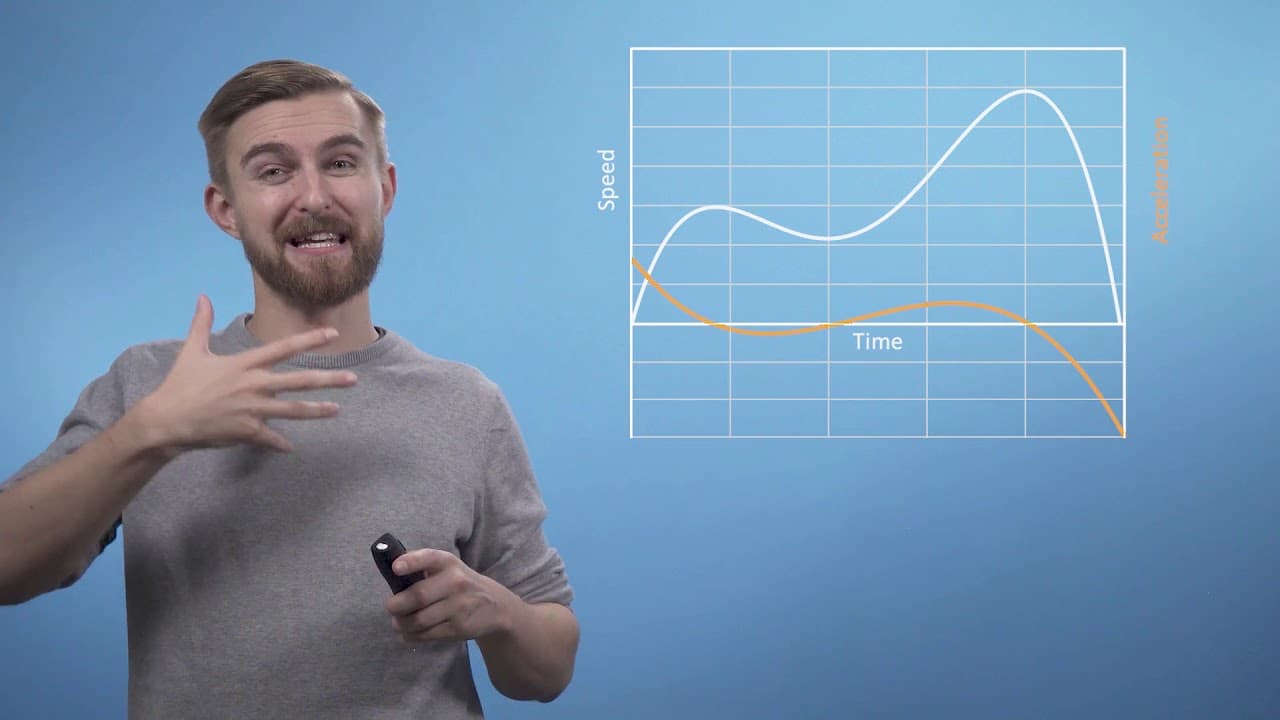
in the last video I told you that cactus is just a set of tools for describing the relationship between a function and the change in its variables and so in this video we're going to explore what this means and how it might be useful let's start by having a look at a classic example a speed versus time graph for a car the most obvious thing this gr... Read More
Key Insights
- 🐎 Speed versus time graphs provide crucial insights into a vehicle’s speed changes and overall motion characteristics.
- 👻 Differentiation allows for the extraction of meaningful information, such as acceleration from speed graphs through local gradients.
- 🛟 The formal definitions of calculus, including derivatives and integrals, serve to enhance our understanding of motion and changes in velocity.
- 🫥 Visualization of tangent lines on curves serves as a fundamental tool in interpreting instantaneous rates of change in motion.
- 🤩 Jerk, while less commonly known, is a key concept that informs us about the comfort of driving experiences based on acceleration changes.
- 👷 The acceleration curve constructed from speed data reveals patterns that are essential for analyzing vehicle performance.
- 🚙 Understanding calculus reinforces the ability to tackle complex motion problems and predict vehicle behavior over time.
Install to Summarize YouTube Videos and Get Transcripts
Explore YouTube Video Summarizer or Get YouTube Transcript Extractor
Questions & Answers
Q: What does a speed versus time graph indicate about a car's motion?
A speed versus time graph indicates whether a car's speed is constant or changing. If the line is horizontal, speed is constant. If it slopes upward, the car accelerates, while a downward slope indicates deceleration. This visual representation helps analyze the car's behavior and speed changes over time.
Q: How is acceleration defined in the context of a speed time graph?
Acceleration is defined as the local gradient of the speed versus time graph. This means that it represents the rate of change of speed at any given moment, with a positive gradient indicating acceleration, a zero gradient indicating constant speed, and a negative gradient indicating deceleration.
Q: What is the significance of tangent lines in analyzing speed time graphs?
Tangent lines are significant as they represent the local gradient at a specific point on the curve of a speed time graph. By drawing tangent lines, one can determine the instantaneous rate of change of speed, which directly indicates acceleration at that moment.
Q: What is the relationship between the acceleration graph and the speed graph?
The acceleration graph directly relates to the speed graph, as the points where the acceleration is zero correspond to flat segments of the speed time graph. This relationship captures the overall behavior of the car’s motion, providing insights into how speed changes over time are linked to its acceleration.
Q: What is 'jerk' in terms of a car's motion?
'Jerk' refers to the rate of change of acceleration, essentially the third derivative of the position function. In practical terms, it describes the car’s variations in acceleration during motion, highlighting how abruptly the vehicle starts and stops, contributing to a smoother driving experience.
Q: How does the concept of integral relate to the car’s distance from the starting position?
The integral concept relates to the car’s distance by representing the antiderivative of the speed function. It shows how distance is accumulated over time and indicates that the slope of the distance time graph indicates the speed of the car at any moment.
Summary & Key Takeaways
-
The video begins by introducing the relationship between speed and acceleration through a speed versus time graph, illustrating that speed is not constant and changes over time.
-
It explains how calculus allows us to interpret the slope of this graph, with acceleration represented as the local gradient and leading to the construction of an acceleration versus time graph.
-
Finally, it delves into derivatives and antiderivatives, emphasizing their role in understanding the change of speed and mapping out concepts like jerk and distance covered by the car.
Read in Other Languages (beta)
Share This Summary 📚
Summarize YouTube Videos and Get Video Transcripts with 1-Click
Try YouTube Summary with ChatGPT & Claude or YouTube Transcript Generator
Explore More Summaries from Digital Learning Hub - Imperial College London 📚
Summarize YouTube Videos and Get Video Transcripts with 1-Click
Try YouTube Summary with ChatGPT & Claude or YouTube Transcript Generator