Transistor switching times | Pulse Digital Circuits ( PDC ) | Lec-40
TL;DR
The video explains transistor switching times and their operational regions.
Transcript
hi everyone in this video I am going to explain about the transistor switching times so transistor switching times previously I have explained how a transistor is acting as a switch so transistor can be acting in three different regions we have seen cutoff region active region and saturation region if you see the characteristics of this transistor ... Read More
Key Insights
- ☢️ Transistor operation involves distinctly defined regions: cutoff, active, and saturation, which determine its functionality.
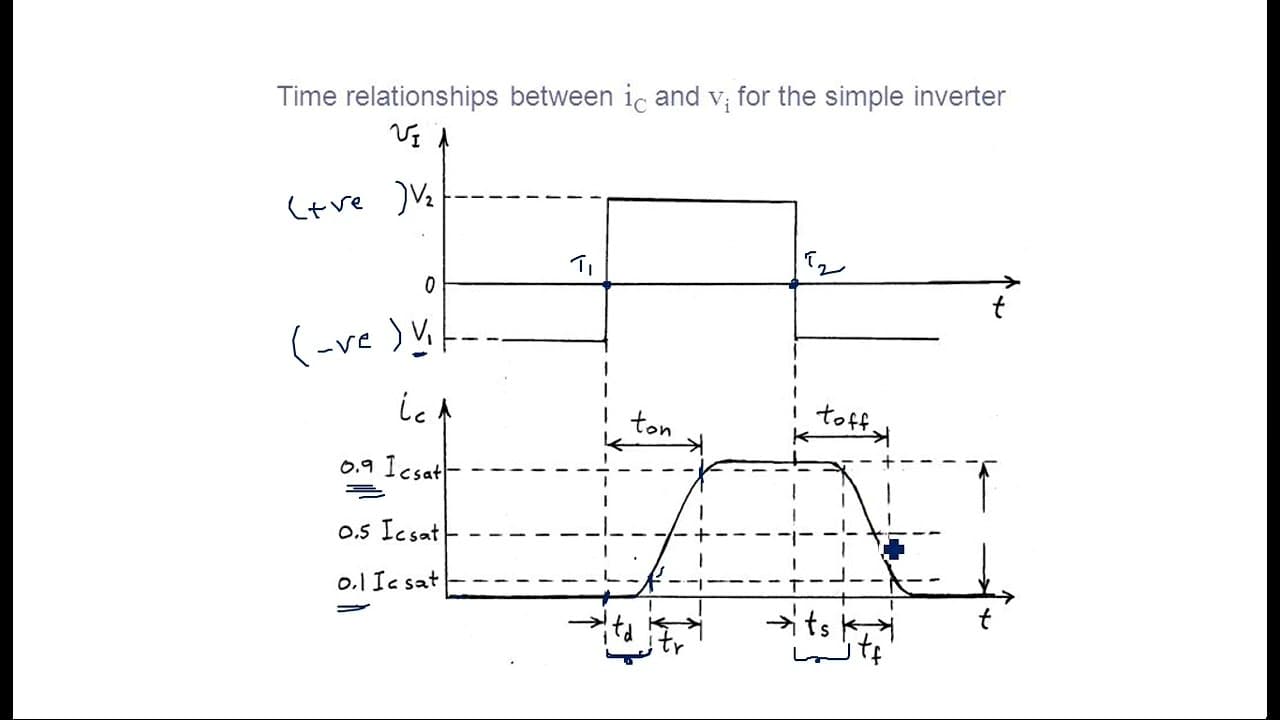
- ⌛ The switching behavior of transistors is characterized by time parameters that must be studied for effective application in electronics.
- 🚄 Delay time reflects how responsive a transistor is to input changes, critical for high-speed applications.
- ⏳ Rise time is significant for understanding how quickly a transistor can turn on from a low state.
- 🍂 Fall time indicates the efficiency of a transistor when switching off, preventing unwanted delays or signals.
- 🥹 Storage time shows how long a transistor can hold onto the charge, influencing the output signal during transitions.
- 🖐️ Each timing parameter plays a critical role in ensuring the reliability and efficiency of electronic circuits.
Install to Summarize YouTube Videos and Get Transcripts
Explore YouTube Video Summarizer or Get YouTube Transcript Extractor
Questions & Answers
Q: What are the three operational regions of a transistor?
A transistor operates in three regions: cutoff, where it acts as an open circuit; active, functioning as an amplifier; and saturation, where it behaves like a short circuit with maximum current flow. Understanding these regions is crucial for applications in digital electronics.
Q: Can you explain the concept of delay time in transistor switching?
Delay time refers to the duration a transistor takes to respond to an input voltage change. For instance, when a 1-volt input is applied to switch on a transistor, the delay time represents how long it takes for the transistor to begin conducting current. This time lapse is critical for designing circuits that require precise switching actions.
Q: What is rise time and how is it measured?
Rise time is the time it takes for a transistor's output to transition from 10% to 90% of its maximum value after being turned on. It indicates the speed of the transistor in reaching its active state. Understanding rise time is essential for assessing performance in high-speed applications.
Q: Describe fall time and its significance in transistor operation.
Fall time measures the period needed for a transistor's output to drop from 90% to 10% of its maximum voltage when transitioning from on to off. This timing parameter is crucial for designers to ensure that the transistor can properly switch off without causing unintended signals or delays in digital circuits.
Q: What is storage time in the context of transistors?
Storage time is the duration a transistor retains a stored charge before it begins to discharge. This time is important because it can affect a transistor's ability to switch efficiently. When input changes from high to low, the stored charge can delay the output response, impacting overall circuit performance.
Q: How do the different timing factors (delay, rise, fall, storage) affect digital circuits?
Each timing factor plays a crucial role in the overall performance of digital circuits. For example, high delay times can slow down the responsiveness of the circuit, while long rise and fall times can lead to signal integrity issues. Thus, understanding and optimizing these parameters is essential for reliable circuit design.
Q: Why is it important to understand the switching characteristics of transistors?
Understanding the switching characteristics of transistors is vital for their application in various electronic devices. These characteristics dictate performance metrics such as speed, efficiency, and reliability, which impact how effectively transistors can function in switching power supplies, amplifiers, and digital logic circuits.
Summary & Key Takeaways
-
The video elaborates on how transistors operate in cutoff, active, and saturation regions, explaining their characteristics and roles as switches and amplifiers.
-
Key timing parameters such as delay time, rise time, fall time, and storage time are defined to understand how transistors switch between on and off states.
-
The transition of a transistor's state from off to on and vice versa is discussed with a focus on the time taken for these transitions to occur, highlighting practical challenges in switching times.
Read in Other Languages (beta)
Share This Summary 📚
Summarize YouTube Videos and Get Video Transcripts with 1-Click
Try YouTube Summary with ChatGPT & Claude or YouTube Transcript Generator