15.3 Worked Example - Bouncing Ball
TL;DR
The content explains how to calculate the average normal force exerted by the ground on a ball during a collision.
Transcript
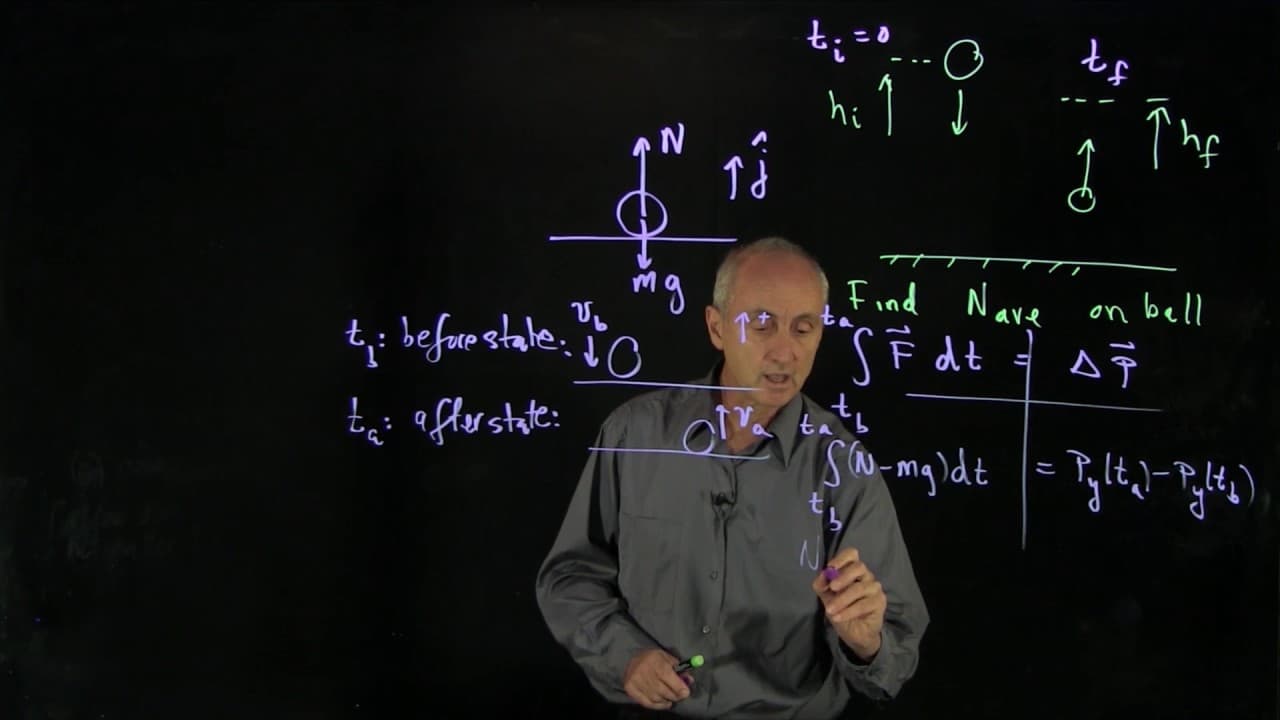
Let's consider a ball that is dropped from a certain height, h i, above the ground and this ball is falling. It hits the ground and it bounces up until it reaches some final height, h final. Now when the ball is colliding with the ground, there are collision forces. And in this problem what we like to do is figure out what the average force of the ... Read More
Key Insights
- 💥 The average normal force exerted by the ground during a collision can be calculated using the momentum principle.
- 😚 Energy is lost during the ball's collision with the ground due to deformation and the subsequent transformation into thermal energy.
- 💥 The collision time affects the magnitude of the average force exerted by the ground.
Install to Summarize YouTube Videos and Get Transcripts
Explore YouTube Video Summarizer or Get YouTube Transcript Extractor
Questions & Answers
Q: Why does the ball lose energy during the collision with the ground?
The ball loses energy due to deformation in its rubber structure, which is not completely elastic, causing the energy to transform into molecular motions and eventually radiate as thermal energy into the environment.
Q: How is the average normal force calculated during a collision?
The average normal force can be calculated using the momentum principle. By considering the difference in momentum before and after the collision, the expression for the average normal force is derived as (m * Va + Vb) / (delta t) + mg, where Va and Vb are the velocities of the ball before and after the collision.
Q: How does the collision time affect the average force exerted by the ground?
If the collision time is very short, the average force will be slightly larger. Conversely, if the collision time is longer, the average force will be slightly smaller.
Q: What are the factors considered when analyzing the average normal force?
The analysis considers the masses of the ball, the gravitational force, the velocities of the ball before and after the collision, the collision time, and the height of the ball during the collision.
Summary & Key Takeaways
-
The video discusses the concept of average normal force during a ball collision and how some energy is lost due to deformation and thermal energy transfer.
-
A free body diagram is used to represent the forces acting on the ball, including the normal force and gravitational force.
-
The momentum principle is applied to analyze the average normal force, with the expression derived using the difference in momentum before and after the collision.
Read in Other Languages (beta)
Share This Summary 📚
Summarize YouTube Videos and Get Video Transcripts with 1-Click
Try YouTube Summary with ChatGPT & Claude or YouTube Transcript Generator
Explore More Summaries from MIT OpenCourseWare 📚



Summarize YouTube Videos and Get Video Transcripts with 1-Click
Try YouTube Summary with ChatGPT & Claude or YouTube Transcript Generator