How to Solve Intermediate Algebra Problems Effectively
TL;DR
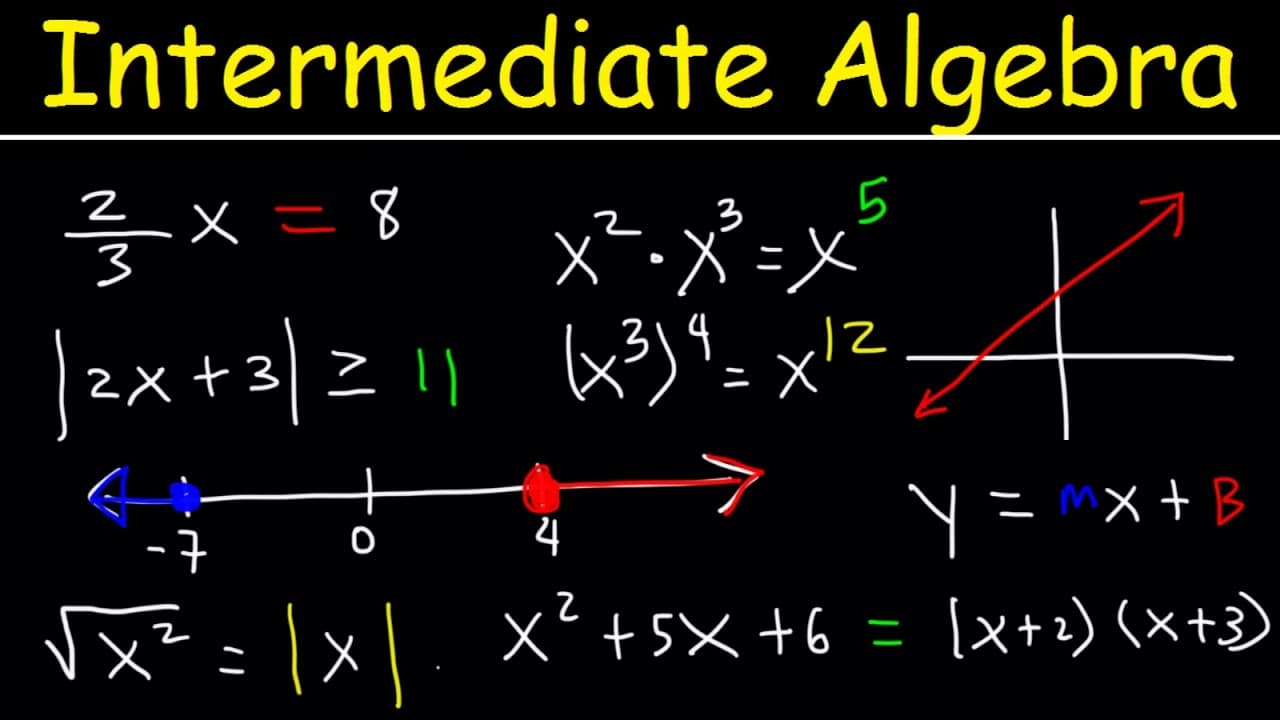
To solve intermediate algebra problems, start by isolating variables using inverse operations for linear equations. For equations with fractions, eliminate them by multiplying by the least common multiple. When graphing, identify the slope and y-intercept, while recognizing that parallel lines have the same slope and perpendicular lines have negative reciprocal slopes. Factor quadratic equations to find their roots, and simplify radicals by identifying perfect square factors.
Transcript
in this video we're going to cover some basic concepts that you might encounter in a typical intermediate algebra course so let's go ahead and begin the first thing that you need to do is you need to be able to solve linear equations so consider this equation x plus 8 is equal to 20. what is the value of x x is basically a number it's a number that... Read More
Key Insights
- ❓ Solving linear equations involves applying inverse operations to isolate the variable.
- 😀 Graphing linear equations requires finding the slope and y-intercept.
- 🧑🏭 Quadratic equations can be factored to find their roots or solutions.
- 😑 Simplifying radicals involves identifying perfect square factors and simplifying the expression.
- ✖️ Fractional equations require eliminating the fractions by multiplying by the least common multiple (LCM) of the denominators.
- 🫥 Parallel lines have the same slope, while perpendicular lines have negative reciprocal slopes.
- ❓ The quadratic formula can be used to find the solutions of any quadratic equation.
Install to Summarize YouTube Videos and Get Transcripts
Explore YouTube Video Summarizer or Get YouTube Transcript Extractor
Questions & Answers
Q: How do you solve linear equations with one variable?
To solve linear equations, isolate the variable by applying inverse operations. Add or subtract to isolate the variable term, then multiply or divide to find its value.
Q: How do you solve equations with fractions?
To solve equations with fractions, eliminate the fractions by multiplying both sides of the equation by the least common multiple (LCM) of the denominators. Simplify and find the value of the variable.
Q: How do you graph linear equations?
Graphing linear equations involves finding the slope and y-intercept. Plot the y-intercept on the y-axis, then use the slope to find additional points. Connect the points to create a straight line.
Q: What is the process of factoring quadratic equations?
To factor quadratic equations, find two numbers that multiply to the constant term and add up to the coefficient of the linear term. Rewrite the equation in factored form and set each factor equal to zero to find the solutions.
Q: How do you simplify radicals?
Simplify radicals by identifying perfect square factors. Divide the number inside the radical by its largest perfect square factor, then rewrite the radical as the square root of the perfect square factor multiplied by the simplified expression.
Summary & Key Takeaways
-
The video explains how to solve linear equations by isolating the variable and applying inverse operations.
-
It demonstrates how to solve equations with fractions by applying multiplication and division rules.
-
The video covers graphing linear equations, finding the slope and y-intercept, and understanding parallel and perpendicular lines.
-
It explains how to factor quadratic equations, finding the roots or solutions.
-
The video demonstrates how to simplify radicals by identifying perfect square factors.
Read in Other Languages (beta)
Share This Summary 📚
Summarize YouTube Videos and Get Video Transcripts with 1-Click
Try YouTube Summary with ChatGPT & Claude or YouTube Transcript Generator
Explore More Summaries from The Organic Chemistry Tutor 📚


Summarize YouTube Videos and Get Video Transcripts with 1-Click
Try YouTube Summary with ChatGPT & Claude or YouTube Transcript Generator