Products
Features
YouTube Video Summarizer
Summarize YouTube videos
Web & PDF Highlighter
Highlight web pages & PDFs
Chat with PDF
Ask any PDF questions with AI
Ask AI Clone
Chat with your highlights & memories
Audio Transcriber
Transcribe audio files to text
Glasp Reader
Read and highlight articles
Kindle Highlight Export
Export your Kindle highlights
Idea Hatch
Hatch ideas from your highlights
Integrations
Obsidian Plugin
Notion Integration
Pocket Integration
Instapaper Integration
Medium Integration
Readwise Integration
Snipd Integration
Hypothesis Integration
Apps & Extensions
Chrome Extension
Safari Extension
Edge Add-ons
Firefox Add-ons
iOS App
Android App
Discover
Discover
Ideas
Discover new ideas and insights
Articles
Curated articles and insights
Books
Book recommendations by great minds
Posts
Essays and notes from readers
Quotes
Inspiring quotes collection
Videos
Curated videos and summaries
Explore Glasp
Glasp Newsletter
Weekly insights and updates
Glasp Talk
Interview series with great minds
Glasp Blog
Latest news and articles
Glasp Use Cases
Learn how others use Glasp
Build & Support
Glasp API
Access Glasp's API for developers
MCP Connector
Connect Glasp to Claude & ChatGPT
Community
Glasp Reddit Community
Students
Student discount and benefits
FAQs
Frequently Asked Questions
AboutPricing
DashboardLog inSign up

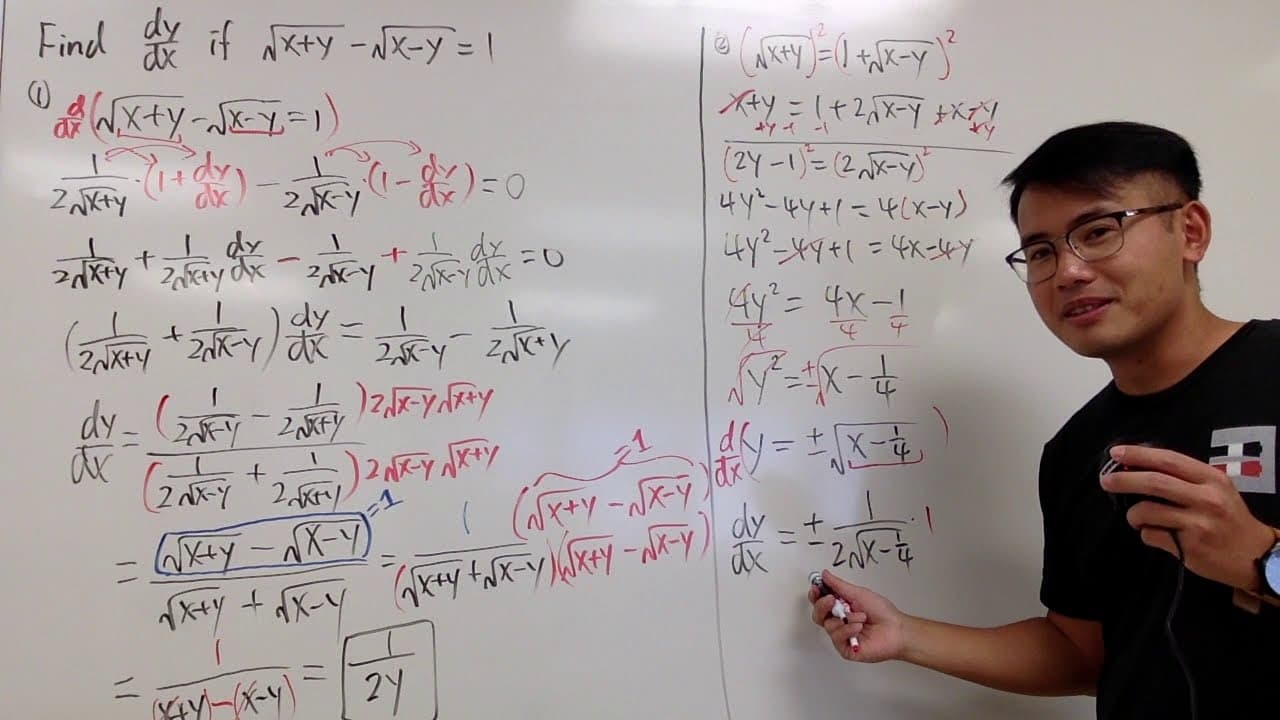
derivative of sqrt(x+y)-sqrt(x-y)=1
72.0K views
•
August 4, 2018
by
blackpenredpen
YouTube video player
derivative of sqrt(x+y)-sqrt(x-y)=1

TL;DR

This video explains two methods for finding dy/dx - implicit differentiation and solving for y first. The answer is simplified using algebraic manipulations.

Transcript

okay this is just a continuation video from last time where we are going to find dy/dx for this equation right here and this video of sugars is two ways to do it the first way is that we are two implicit differentiation just like last time but today we are going to actually simplify the answer more and then the second way is will actually solve for... Read More

Key Insights

  • 😀 Implicit differentiation is a method used when it is difficult to solve for y explicitly.
  • 😀 The chain rule is applied to differentiate terms involving y in implicit differentiation.
  • 😀 Solving for y first simplifies the differentiation process by explicitly expressing y in terms of x.

Install to Summarize YouTube Videos and Get Transcripts

Explore YouTube Video Summarizer or Get YouTube Transcript Extractor

Questions & Answers

Q: What is implicit differentiation and how does it differ from the usual derivative?

Implicit differentiation is used when the equation cannot be solved explicitly for y. It involves differentiating both sides of the equation with respect to x, treating y as an implicit function of x. This is different from the usual derivative where y is explicitly expressed in terms of x.

Q: What is the advantage of using implicit differentiation?

Implicit differentiation is useful when it is difficult or impossible to solve the equation explicitly for y. It allows us to find the derivative without explicitly solving for y.

Q: How is the chain rule used in implicit differentiation?

The chain rule is used in implicit differentiation because y is treated as a function of x. When differentiating terms involving y, the chain rule is applied to account for the derivative of y.

Q: Why is solving for y first an alternative method for finding dy/dx?

Solving for y first allows us to transform the equation into a form where we can explicitly express y in terms of x. This simplifies the differentiation process, as we can then directly apply the derivative to the expression.

Summary & Key Takeaways

  • The video discusses two methods for finding dy/dx: implicit differentiation and solving for y first.

  • Implicit differentiation is used to differentiate the equation. The chain rule is applied to simplify the expression.

  • Solving for y first involves manipulating the equation by squaring both sides and rearranging to isolate y. The expression is then differentiated.


Read in Other Languages (beta)

English

Share This Summary 📚

Summarize YouTube Videos and Get Video Transcripts with 1-Click

Download browser extensions on:

Try YouTube Summary with ChatGPT & Claude or YouTube Transcript Generator

Explore More Summaries from blackpenredpen 📚
Same Derivatives Implies Same Functions? thumbnail
Same Derivatives Implies Same Functions?
blackpenredpen
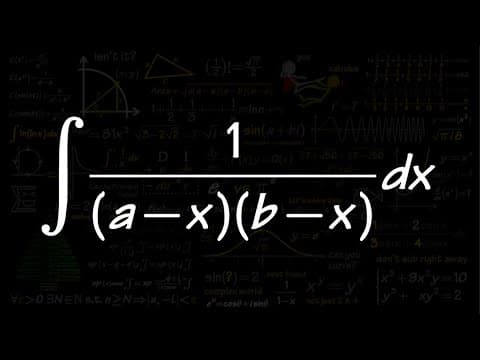
integral of 1/((a-x)(b-x)) thumbnail
integral of 1/((a-x)(b-x))
blackpenredpen
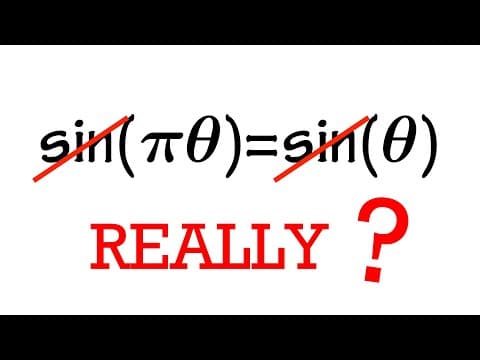
Precalculus challenge: can we just cancel out the sine? thumbnail
Precalculus challenge: can we just cancel out the sine?
blackpenredpen
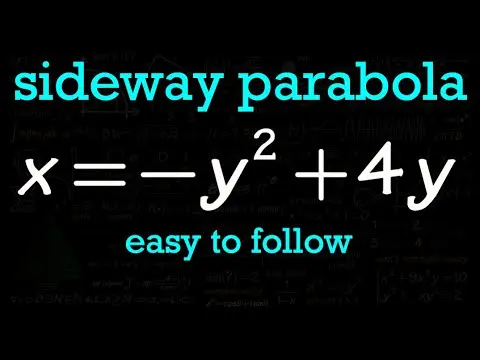
How to graph a side-way parabola thumbnail
How to graph a side-way parabola
blackpenredpen
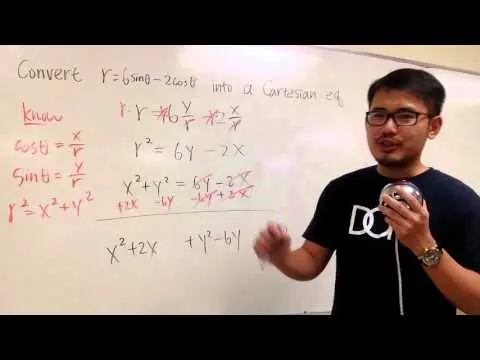
Convert a polar equation to a cartesian equation: circle! thumbnail
Convert a polar equation to a cartesian equation: circle!
blackpenredpen
Calculating Work, pumping water out of a tank, calculus 2 tutorial, application of integration thumbnail
Calculating Work, pumping water out of a tank, calculus 2 tutorial, application of integration
blackpenredpen

Summarize YouTube Videos and Get Video Transcripts with 1-Click

Download browser extensions on:

Try YouTube Summary with ChatGPT & Claude or YouTube Transcript Generator

Apps & Extensions

  • Chrome Extension
  • Safari Extension
  • Edge Add-ons
  • Firefox Add-ons
  • iOS App
  • Android App

Key Features

  • YouTube Video Summarizer
  • Web & PDF Summarizer
  • Web & PDF Highlighter
  • Chat with PDF
  • Ask AI Clone
  • Audio Transcriber
  • Glasp Reader
  • Kindle Highlight Export
  • Idea Hatch

Integrations

  • Obsidian Plugin
  • Notion Integration
  • Pocket Integration
  • Instapaper Integration
  • Medium Integration
  • Readwise Integration
  • Snipd Integration
  • Hypothesis Integration

More Features

  • APIs
  • MCP Connector
  • Blog & Post
  • Embed Links
  • Image Highlight
  • Personality Test
  • Quote Shots

Company

  • About us
  • Blog
  • Community
  • FAQs
  • Job Board
  • Newsletter
  • Pricing
Terms

•

Privacy

•

Guidelines

© 2026 Glasp Inc. All rights reserved.