How Does Corruption Impact Development?
TL;DR
Corruption in developing economies is pervasive and self-reinforcing, often trapping individuals and communities in cycles of exploitation. The case of the Husain family in an Indian slum illustrates how corruption undermines justice and development. To foster growth, societies must ensure individual rights and justice, providing security for life, liberty, and property.
Transcript
welcome everyone alex tabrock here today i want to talk about corruption but i want to do so not through the lens of theory but through the lens of a single searing example this example will show us how all pervasive corruption can be in a developing economy we'll then go on to draw a few general lessons about how corruption breeds corruption corru... Read More
Key Insights
- Corruption in developing economies can be all-encompassing, affecting every aspect of life and governance.
- The Indian criminal justice system can function like a market where innocence and guilt are bought and sold.
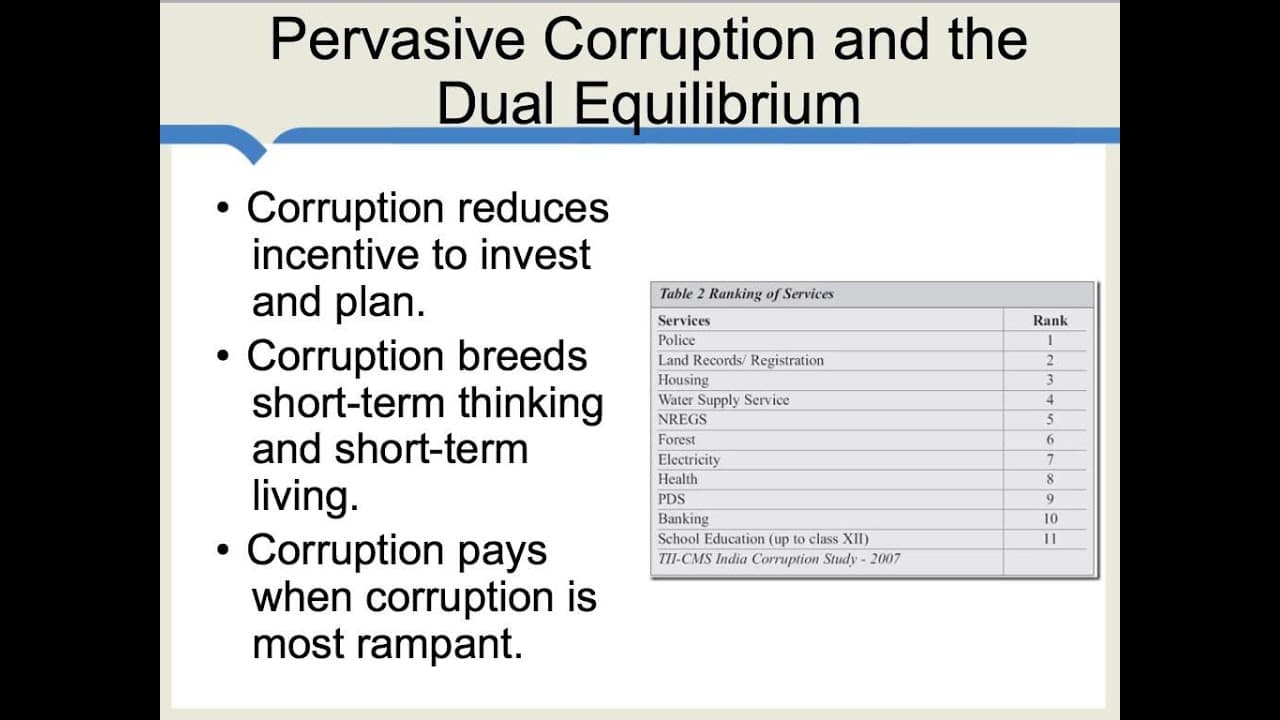
- Corruption reduces incentives to invest and plan for the future due to the uncertainty it creates.
- In highly corrupt environments, short-term thinking prevails because long-term gains can be easily taken away.
- Corruption is self-reinforcing, becoming a way of life where everyone is involved and difficult to punish.
- Justice and individual rights are essential for development, providing security for investment and growth.
- In corrupt systems, even small successes can make individuals targets for exploitation and bribery.
- Liberty, justice, and development are interconnected, with secure rights fostering economic growth.
Install to Summarize YouTube Videos and Get Transcripts
Explore YouTube Video Summarizer or Get YouTube Transcript Extractor
Questions & Answers
Q: How does corruption impact development in economies?
Corruption undermines development by creating environments where short-term thinking prevails and long-term investments are discouraged. It fosters a lack of trust in institutions, making it difficult for individuals to plan for the future. Corruption becomes a self-reinforcing cycle, trapping individuals and communities in exploitation, as seen in the case of the Husain family in an Indian slum.
Q: What role does justice play in economic development?
Justice is crucial for economic development as it provides security for individuals' rights to life, liberty, and property. This security encourages investment and growth by ensuring that individuals can reap the benefits of their investments without fear of arbitrary confiscation. Justice and individual rights are integral to development, fostering environments where economies can thrive.
Q: Why is corruption difficult to eradicate in some societies?
Corruption is difficult to eradicate because it becomes a way of life, involving many individuals who benefit from the system. In highly corrupt environments, everyone is implicated, making it challenging to catch and punish wrongdoers. This pervasiveness creates a self-reinforcing cycle where corruption is normalized, as illustrated by the pervasive bribery and exploitation in the Indian slum example.
Q: How does corruption affect individual rights?
Corruption erodes individual rights by creating an environment where justice can be bought and sold. This undermines the security of life, liberty, and property, discouraging individuals from investing in the future. In such environments, people cannot trust that their rights will be protected, leading to a lack of confidence in institutions and stifling economic growth.
Q: What example illustrates the impact of corruption on justice?
The impact of corruption on justice is illustrated by the story of the Husain family in an Indian slum. When falsely accused of a crime, they faced demands for bribes from the police and other officials. This case shows how corruption can manipulate the justice system for financial gain, with innocence and guilt treated as commodities, undermining trust in legal institutions.
Q: How does corruption influence investment decisions?
Corruption influences investment decisions by creating uncertainty and risk. Investors are hesitant to commit resources in environments where success can be arbitrarily undermined by corrupt practices. This discourages long-term planning and investment, as individuals cannot be sure that their gains will not be seized or exploited by corrupt officials, leading to a focus on short-term gains.
Q: Why is short-term thinking prevalent in corrupt environments?
Short-term thinking is prevalent in corrupt environments because individuals cannot rely on the stability of long-term investments. The pervasive nature of corruption means that any success can be quickly exploited by those in power, discouraging planning for the future. This creates a cycle where individuals focus on immediate gains to avoid potential losses from corrupt practices.
Q: How are liberty, justice, and development interconnected?
Liberty, justice, and development are interconnected as secure rights and justice systems foster environments conducive to economic growth. When individuals have confidence in their rights to life, liberty, and property, they are more likely to invest and plan for the future. This security supports development, as seen in economies with strong civil liberties, where justice and development progress hand in hand.
Summary & Key Takeaways
-
Corruption in developing countries can create a self-fulfilling prophecy, trapping individuals in cycles of bribery and exploitation. The story of the Husain family in an Indian slum highlights how pervasive corruption can undermine justice and development. Ensuring individual rights and justice is crucial for fostering economic growth and providing security for life, liberty, and property.
-
In environments where corruption is rampant, such as the Indian slum described, the criminal justice system can be manipulated for financial gain, with innocence and guilt being commodities. This pervasive corruption discourages investment and long-term planning, as any success can be quickly undermined by corrupt practices, leading to short-term thinking.
-
Justice and individual rights are not separate from development but are integral to it. Societies that ensure security of life, liberty, and property create environments conducive to investment and growth. The interconnectedness of liberty, justice, and development explains why economies with strong civil liberties tend to prosper, highlighting the importance of secure rights for economic advancement.
Read in Other Languages (beta)
Share This Summary 📚
Summarize YouTube Videos and Get Video Transcripts with 1-Click
Try YouTube Summary with ChatGPT & Claude or YouTube Transcript Generator
Explore More Summaries from Marginal Revolution University 📚

Summarize YouTube Videos and Get Video Transcripts with 1-Click
Try YouTube Summary with ChatGPT & Claude or YouTube Transcript Generator