How to Use Universal Differential Equations in Machine Learning
TL;DR
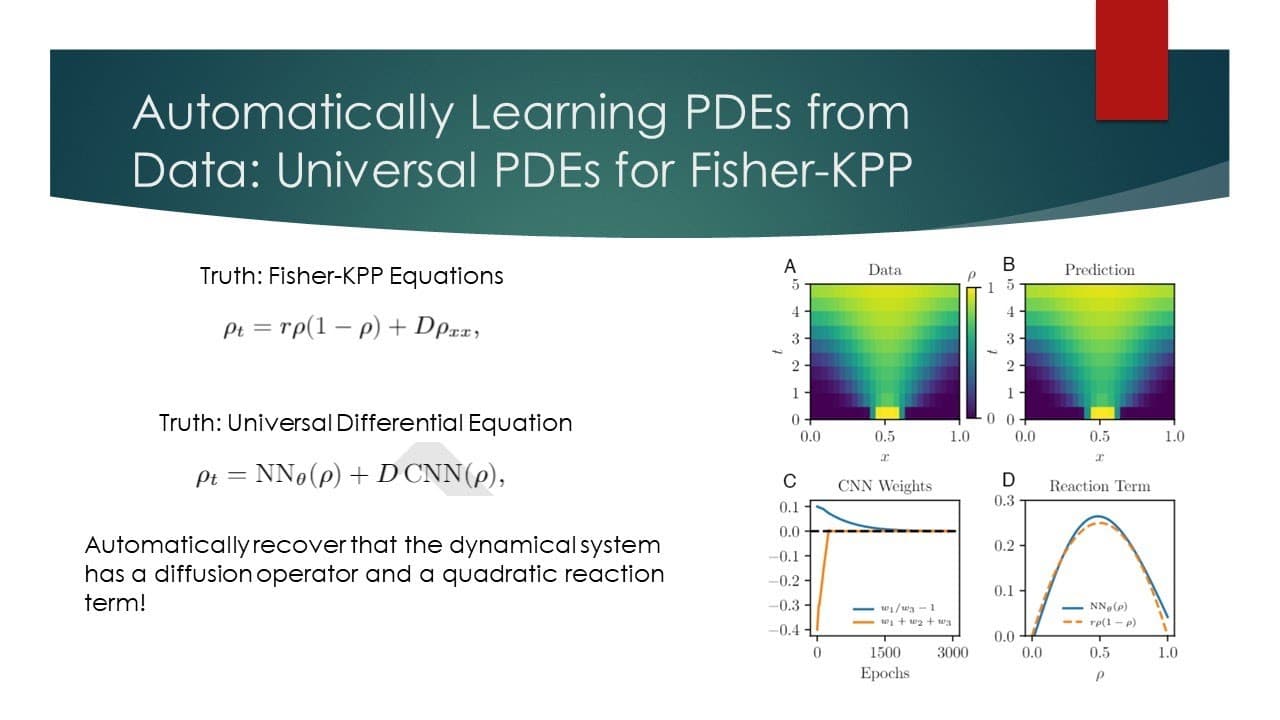
Universal Differential Equations (UDEs) blend scientific models with machine learning to enhance data efficiency and model accuracy. By embedding learnable structures into differential equations, UDEs can discover unknown equations, extrapolate data, and accelerate simulations. This approach, supported by open-source software, addresses modeling challenges across scientific disciplines, offering significant computational improvements.
Transcript
want to thank everyone for coming today's talk is from Chris Rock caucus Chris fairly recently got his PhD and applied mathematics from UC Irvine and he's currently an instructor in the math department MIT and the thing that confused me you also worked at the University of Maryland School of Pharmacy because and when I was in Maryla... Read More
Key Insights
- Universal Differential Equations (UDEs) integrate machine learning with scientific models to improve data efficiency.
- UDEs allow for the discovery of unknown governing equations and accurate extrapolation beyond initial data.
- Scientific models provide structure, while machine learning offers flexibility to handle complex data interactions.
- UDEs can significantly accelerate simulations, demonstrated by a 15,000x speed increase in climate modeling.
- The approach leverages open-source software that incorporates physical constraints and stochasticity.
- Combining scientific models with machine learning reduces the need for large homogeneous datasets.
- UDEs can handle computationally difficult problems across various scientific disciplines.
- The methodology supports the automatic discovery of biological mechanisms and other scientific phenomena.
Install to Summarize YouTube Videos and Get Transcripts
Explore YouTube Video Summarizer or Get YouTube Transcript Extractor
Questions & Answers
Q: How do Universal Differential Equations (UDEs) improve machine learning models?
UDEs enhance machine learning models by integrating scientific structures into the learning process, allowing for more data-efficient training and accurate extrapolation beyond the initial dataset. This approach enables the discovery of unknown governing equations and accelerates simulations, while reducing the reliance on large homogeneous datasets.
Q: What are the benefits of combining scientific models with machine learning?
Combining scientific models with machine learning offers several benefits, including increased data efficiency, the ability to discover unknown equations, and improved model accuracy. This integration allows for better handling of complex data interactions and significantly accelerates simulations, making it applicable to a wide range of scientific disciplines.
Q: How can UDEs accelerate simulations in scientific modeling?
UDEs can accelerate simulations by embedding machine-learnable structures into differential equations, which allows for faster computation while maintaining accuracy. For example, UDEs have been shown to speed up climate simulations by 15,000 times, demonstrating their potential to handle computationally intensive tasks efficiently.
Q: What role do scientific models play in UDEs?
In UDEs, scientific models provide the structural framework that guides the learning process. This structure helps ensure that the machine learning model adheres to known scientific principles, improving its ability to extrapolate accurately and reducing the need for extensive labeled datasets.
Q: How do UDEs handle complex data interactions?
UDEs handle complex data interactions by embedding machine learning capabilities within the framework of differential equations. This allows the model to learn and adapt to nonlinear interactions directly from the data, while still being guided by the underlying scientific structure, leading to more accurate and efficient modeling.
Q: What challenges do UDEs address in scientific modeling?
UDEs address challenges such as the need for large homogeneous datasets, difficulties in discovering unknown equations, and the computational intensity of simulations. By integrating machine learning with scientific models, UDEs provide a more efficient and accurate approach to scientific modeling across various disciplines.
Q: How do UDEs contribute to the discovery of unknown governing equations?
UDEs contribute to the discovery of unknown governing equations by allowing machine learning to fill in gaps within the scientific model. This process involves learning the missing components directly from data, enabling the identification of previously unknown interactions and mechanisms within the modeled system.
Q: What is the significance of open-source software in the context of UDEs?
Open-source software is crucial for UDEs as it provides the tools necessary to integrate machine learning with scientific models. This software supports the training of UDEs by incorporating physical constraints, delayed interactions, and stochasticity, making it accessible for researchers to apply UDEs to a wide range of scientific challenges.
Summary & Key Takeaways
-
Universal Differential Equations (UDEs) combine scientific models with machine learning to enhance data efficiency and model accuracy. By embedding learnable structures into differential equations, UDEs can discover unknown equations, extrapolate data, and accelerate simulations. This approach, supported by open-source software, addresses modeling challenges across scientific disciplines, offering significant computational improvements.
-
UDEs allow for the discovery of unknown governing equations and accurate extrapolation beyond initial data. Scientific models provide structure, while machine learning offers flexibility to handle complex data interactions. The methodology supports the automatic discovery of biological mechanisms and other scientific phenomena.
-
By integrating machine learning with scientific models, UDEs significantly accelerate simulations, demonstrated by a 15,000x speed increase in climate modeling. This approach leverages open-source software that incorporates physical constraints and stochasticity, reducing the need for large homogeneous datasets and handling computationally difficult problems across various scientific disciplines.
Read in Other Languages (beta)
Share This Summary 📚
Summarize YouTube Videos and Get Video Transcripts with 1-Click
Try YouTube Summary with ChatGPT & Claude or YouTube Transcript Generator