Number System | Highest power of Prime number | Aptitude | Part- 22 | Bharath Kumar
TL;DR
This session explains how to find the highest power of a prime in n factorial.
Transcript
hi everyone welcome to the session in this session i will explain a new concept that is highest power of prime number in n factorial next concept is highest power of prime number highest power of prime number in n factorial in n factorial this is the next concept listen carefully here to solve the problems related to this kind of model first of all... Read More
Key Insights
- ✋ The concept of highest power of a prime in n factorial is applicable only to prime numbers; non-primes must be factored.
- 💗 Factorials grow rapidly, necessitating efficient methods to handle their calculations.
- #️⃣ Counting the contributions of a prime directly from each number may involve complex number breakdowns.
- ✊ Calculation entails both understanding prime factorization and devising systematic approaches to compute powers.
- 🧑🦽 The summed quotient method provides a reliable shortcut, yielding consistent results with manual calculations.
- ✋ The general form for calculating the highest prime power can be applied universally across various factorials.
- ✊ Visualizing factorial growth aids in understanding the relationships between primes and their powers.
Install to Summarize YouTube Videos and Get Transcripts
Explore YouTube Video Summarizer or Get YouTube Transcript Extractor
Questions & Answers
Q: Why is it important to confirm if a number is prime before applying the method?
Confirming whether a number is prime is crucial because the method for calculating the highest power relies on using prime numbers. If a non-prime number is used, it must be broken down into its prime factors, altering the calculation process and potentially leading to incorrect results. This step ensures the integrity of the calculation.
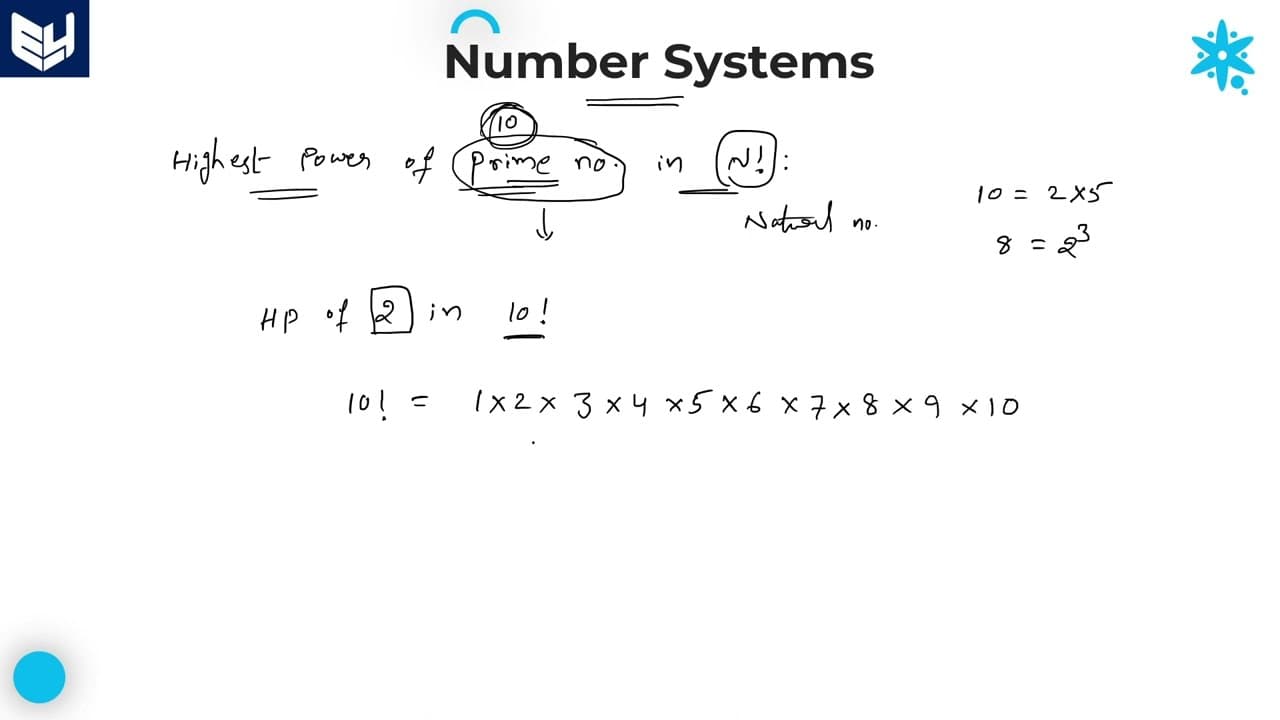
Q: Can you explain the manual method used to find the highest power of 2 in 10 factorial?
To find the highest power of 2 in 10 factorial manually, one counts how many times 2 can be factored from each number in the factorial decomposition. This involves examining each number from 1 to 10, noting that 2 contributes one count, 4 contributes two counts, and so forth, leading to a total of 8 twos in 10 factorial.
Q: How does the shortcut method improve efficiency in calculations?
The shortcut method improves efficiency by allowing calculations to be completed without listing all factorial components. By summing the quotients obtained from dividing the factorial number by the prime, it eliminates the need for tedious manual counting, thereby speeding up the process significantly, especially for larger numbers.
Q: Why can't we use a direct approach for larger numbers like 50 factorial?
Directly calculating larger factorials, such as 50 factorial, becomes unwieldy due to the sheer number of multiplicative components involved. The shortcut method streamlines this process, allowing quick determination of highest prime powers without needing to exhaustively enumerate all terms in the factorial expansion.
Summary & Key Takeaways
-
The highest power of a prime in n factorial is calculated by first confirming the number is prime; if not, it must be factored into primes.
-
A detailed example shows finding the highest power of 2 in 10 factorial, demonstrating both manual counting and a shortcut method.
-
The shortcut method involves summing the quotients of the factorial number divided by the prime repeatedly, confirming results obtained through manual calculations.
Read in Other Languages (beta)
Share This Summary 📚
Summarize YouTube Videos and Get Video Transcripts with 1-Click
Try YouTube Summary with ChatGPT & Claude or YouTube Transcript Generator