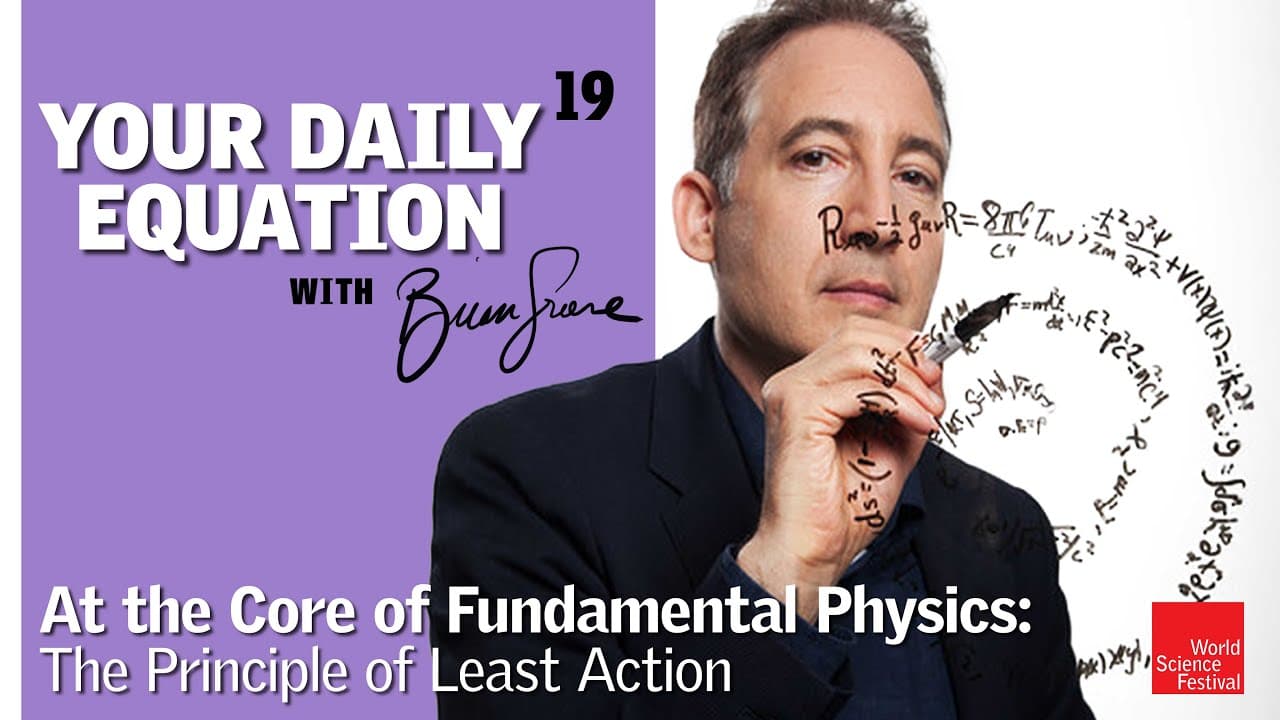
Your Daily Equation #19 : At the Core of Fundamental Physics: The Principle of Least Action
TL;DR
The Euler Lagrange equations are fundamental to modern theoretical physics, central to understanding the motion of particles and the principle of least action.
Transcript
everyone welcome to this next episode of your daily equation today I will focus upon the Euler Lagrange equations yeah it's a bit of a mouthful but the equations that I'm gonna talk about are really absolutely central to all of modern theoretical physics I mean if you go into the office of any physicist a theorist and experimentalist and you look a... Read More
Key Insights
- ❓ The Euler Lagrange equations are essential and widely used equations in modern theoretical physics.
- ❓ The principle of least action provides an alternative approach to understanding motion, considering all possible trajectories and finding the one that minimizes the action value.
- 🌐 The Euler Lagrange equations are equivalent to Newton's equations, but they offer a more global perspective on motion.
- ⛔ The equations are not limited to one-dimensional motion; they can be generalized to describe the behavior of particles in multiple dimensions.
- 🏛️ Quantum mechanics builds upon the principles of classical physics and includes all possible trajectories, not just the ones that minimize the action.
Install to Summarize YouTube Videos and Get Transcripts
Explore YouTube Video Summarizer or Get YouTube Transcript Extractor
Questions & Answers
Q: What are the Euler Lagrange equations, and why are they important in physics?
The Euler Lagrange equations are a set of equations that describe the motion of particles and are crucial to understanding fundamental physics concepts. They allow physicists to study and analyze the behavior of physical systems and predict their future motion.
Q: How do the Euler Lagrange equations differ from Newton's approach to motion?
Newton's approach focused on initial conditions and the use of F = ma to calculate the trajectory of a particle. In contrast, the Euler Lagrange equations consider all possible trajectories and assign an action value to each, aiming to find the trajectory with the minimum action, which corresponds to the actual trajectory.
Q: What is the principle of least action?
The principle of least action, also known as the least action principle, states that the actual trajectory of a particle is the one that minimizes the action, a value assigned to each possible trajectory. This principle provides a different perspective on understanding motion and is central to modern theoretical physics.
Q: How do the Euler Lagrange equations relate to the principle of least action?
The Euler Lagrange equations are derived from the principle of least action. By minimizing the action, physicists can determine the actual trajectory a particle takes. The equations connect the variation of the action with respect to the particle's position, velocity, and time.
Summary & Key Takeaways
-
The Euler Lagrange equations are essential to all of modern theoretical physics, with physicists using them to understand and describe motion in their research and experiments.
-
The equations are also known as the principle of least action, with many physicists throughout history contributing to their development and refinement.
-
Newton's approach to describing the motion of particles involved initial conditions and the famous F = ma equation, while the least action approach considers all possible trajectories and assigns an action value to each, with the aim of finding the trajectory with the minimum action.
Read in Other Languages (beta)
Share This Summary 📚
Summarize YouTube Videos and Get Video Transcripts with 1-Click
Try YouTube Summary with ChatGPT & Claude or YouTube Transcript Generator
Explore More Summaries from World Science Festival 📚



Summarize YouTube Videos and Get Video Transcripts with 1-Click
Try YouTube Summary with ChatGPT & Claude or YouTube Transcript Generator