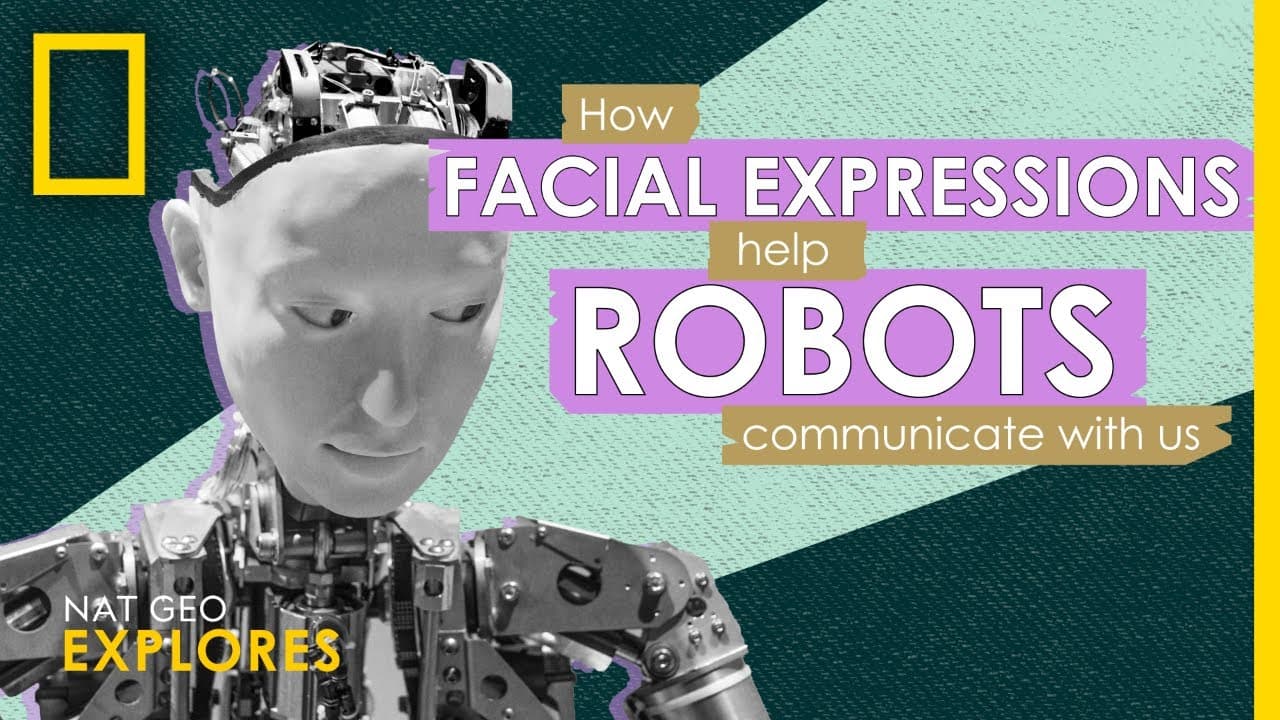
How Facial Expressions Help Robots Communicate with Us | Nat Geo Explores
TL;DR
Facial expressions are a universal language connecting humans and robots through emotions.
Transcript
- [Narrator] There are a lot of us all with different cultures, languages, beliefs. So, yeah. Communication. It's not always easy. - You're crazy - You're crazy - You're crazy (slapping) - [Narrator] But no matter where we come from or the languages we speak by using these, we can still connect with other humans. And now maybe with them too. - Ther... Read More
Key Insights
- 😑 Facial expressions serve dual functions of communication and physical actions.
- 😑 Charles Darwin's theory on universal emotions and expressions influences modern psychology.
- 😑 The universality of seven facial expressions allows global emotional connections.
- 😑 Human-like robots with facial expressions facilitate emotional interactions with humans.
- 😑 Emotional facial expressions are crucial for effective communication, transcending language barriers.
- 😑 Robots with facial expressions have practical applications in various fields.
- 😑 Facial expressions of emotion serve as a universal language fostering human connections.
Install to Summarize YouTube Videos and Get Transcripts
Explore YouTube Video Summarizer or Get YouTube Transcript Extractor
Questions & Answers
Q: How do facial expressions serve purposes beyond communication?
Facial expressions like nose wrinkling not only convey emotions but also serve a physical function by blocking substances from entering the body through the nasal passage.
Q: Why did Charles Darwin believe in the universality of emotions and expressions?
Darwin believed emotions were innate and universal, aiding in immediate reactions and group survival, with expressions further facilitating communication of these reactions.
Q: What are the seven universally recognized facial expressions of emotions?
The seven universally recognized facial expressions are anger, contempt, disgust, fear, happiness, sadness, and surprise, accepted across all demographics worldwide.
Q: How do facial expressions play a role in human-robot interaction?
By developing human-like facial expressions in robots, humans can connect with them on an emotional level, indicating emotions and intelligence beyond verbal language.
Summary & Key Takeaways
-
Facial expressions serve multiple purposes beyond communication, such as preventing substances from entering the body through nose wrinkling.
-
Charles Darwin believed emotions and expressions are universal, aiding in group survival.
-
The universality of seven facial expressions allows humans to connect with each other and potentially human-like technology.
Read in Other Languages (beta)
Share This Summary 📚
Summarize YouTube Videos and Get Video Transcripts with 1-Click
Try YouTube Summary with ChatGPT & Claude or YouTube Transcript Generator
Explore More Summaries from National Geographic 📚



Summarize YouTube Videos and Get Video Transcripts with 1-Click
Try YouTube Summary with ChatGPT & Claude or YouTube Transcript Generator