How Do Imaginary Numbers Work with Fractional Exponents?
TL;DR
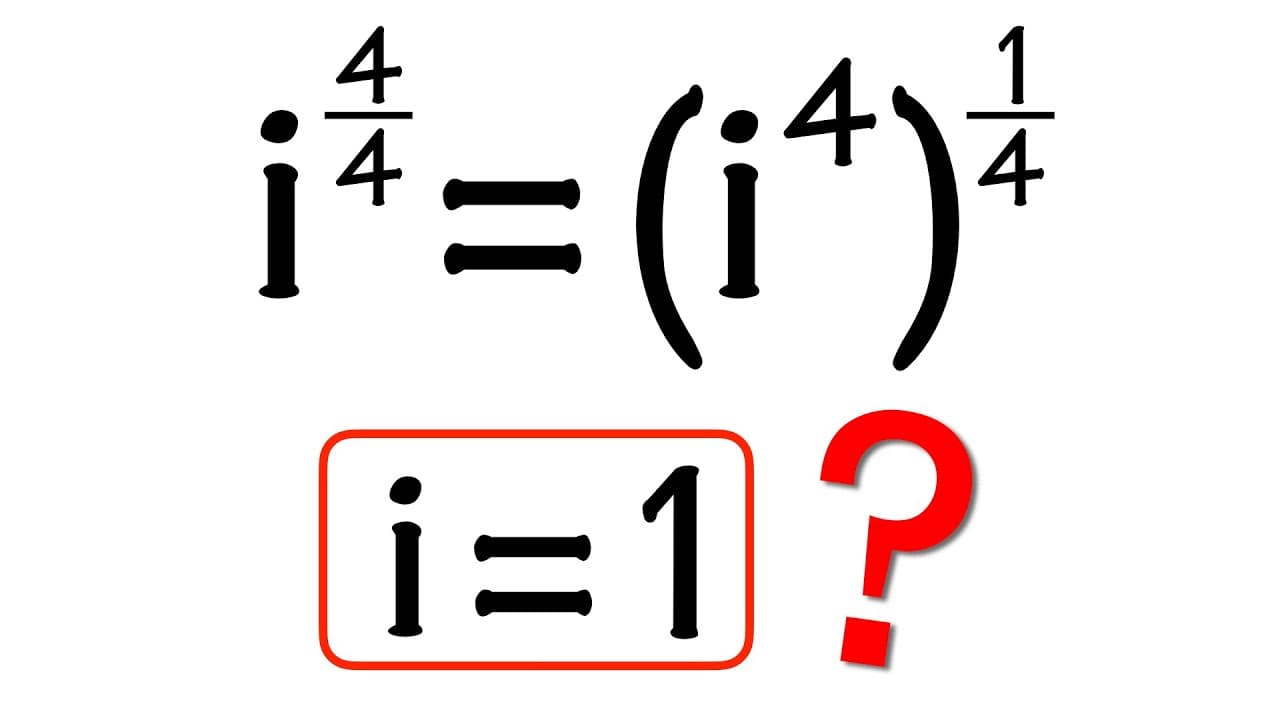
When dealing with imaginary numbers and fractional exponents, it's crucial to note that i can yield multiple values, specifically 1, -1, i, and -i, depending on the order of operations. To achieve accurate results, always reduce the fraction of the exponent if possible; this can simplify calculations and prevent misconceptions like believing i is equal to 1.
Transcript
this is not the time to sing only you but rather we have to sing only i ladies and gentlemen have a look right here starting with i and let's look at this as i to the first power and everybody knows 4 over four is equal to one but i know one is the same as four over four so i'm gonna put this down as i raised to the four over four power w... Read More
Key Insights
- 🤨 Complex numbers have multiple values when raised to fractional exponents.
- 🎭 The order in which operations are performed with complex numbers and fractional exponents can affect the results.
- ❓ Reducing the fraction of the exponent can simplify calculations.
- 🪈 If the greatest common divisor of the numerator and denominator is not 1, the order of operations is crucial.
- 📏 Complex numbers can be confusing, but following the correct rules ensures accurate results.
- 🔬 Brilliant offers interactive courses in math, science, and computer science to enhance problem-solving skills.
- 🎮 The video debunked the misconception that i is equal to 1.
Install to Summarize YouTube Videos and Get Transcripts
Explore YouTube Video Summarizer or Get YouTube Transcript Extractor
Questions & Answers
Q: Why is it incorrect to claim that i is equal to 1?
This is a common misconception that arises when dealing with complex numbers and fractional exponents. In reality, i is not equal to 1; it has multiple values, including 1, -1, i, and -i.
Q: How does the order of operations affect the results when dealing with fractional exponents?
When raising i to the fourth power and then taking the one-fourth power, there are four possible answers. However, when taking i to the one-fourth power and then raising it to the fourth power, there is only one answer.
Q: Why is reducing the fraction important when dealing with fractional exponents?
Reducing the fraction ensures that there are no common factors between the numerator and denominator, simplifying the calculations and avoiding confusion.
Q: What should be done if the greatest common divisor of the numerator and denominator is not 1?
In such cases, it is necessary to perform the operations in the correct order. First, take the one over the root (1 over n), then raise it to the exponent (m). This ensures accurate results.
Summary & Key Takeaways
-
The video discusses the misconception that i (the imaginary unit) is equal to 1 and explores the correct approach to dealing with complex numbers and fractional exponents.
-
When raising i to the fourth power and then taking the one-fourth power, there are four possible answers: 1, -1, i, and -i.
-
When taking i to the one-fourth power and then raising it to the fourth power, there is only one answer: i.
-
The key is to reduce the fraction of the exponent if possible, and if the greatest common divisor of the numerator and denominator is not 1, the order in which the operations are performed matters.
Read in Other Languages (beta)
Share This Summary 📚
Summarize YouTube Videos and Get Video Transcripts with 1-Click
Try YouTube Summary with ChatGPT & Claude or YouTube Transcript Generator
Explore More Summaries from blackpenredpen 📚

Summarize YouTube Videos and Get Video Transcripts with 1-Click
Try YouTube Summary with ChatGPT & Claude or YouTube Transcript Generator