Permutations and Combinations | Digits & Vowels | Aptitude | Part- 18 | Bharath Kumar
TL;DR
This session explores how to solve combinatorial problems involving digit arrangements.
Transcript
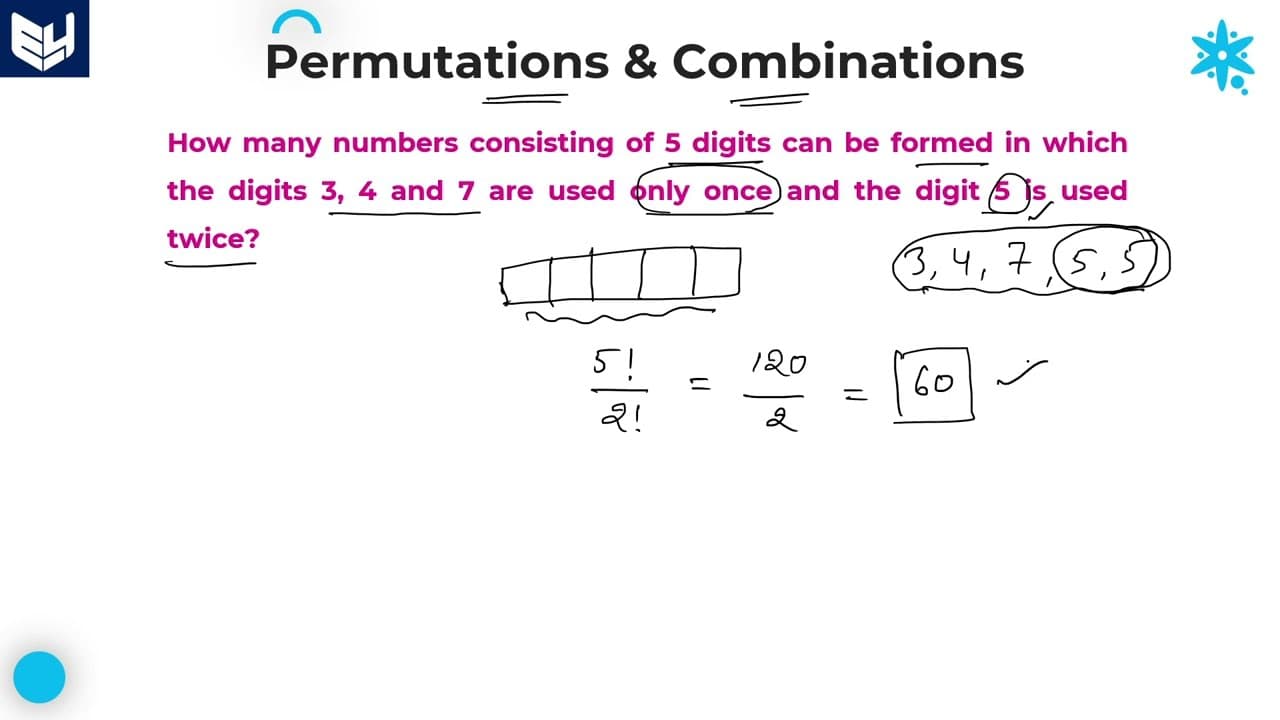
hi everyone welcome to the session in this session i am continuing the problems on permutations and combinations see the first question in this session how many numbers consisting of five digits can be formed in which the digits 3 4 7 are used only once and the digit 5 is used twice and the digit 5 is used twice here the question is we need to form... Read More
Key Insights
- 🔁 Understanding permutations and combinations requires clarity about repeated elements in arrangements.
- #️⃣ In calculating arrangements, conditional placements significantly affect the total number of distinct arrangements.
- 👥 Grouping indistinguishable items, like vowels, simplifies complex arrangements by treating them as a single entity.
- ❓ Factorials are foundational in combinatorial problems but must be used with an understanding of the specific problem context.
- ❓ Clear differentiation between total digits and distinct digits prevents miscalculation in arrangements.
- 👣 Keeping track of conditions while calculating arrangements ensures adherence to the problem requirements.
- ❓ Recognizing the importance of arrangement conditions is crucial for correct problem-solving strategies in combinatorics.
Install to Summarize YouTube Videos and Get Transcripts
Explore YouTube Video Summarizer or Get YouTube Transcript Extractor
Questions & Answers
Q: What is the method for calculating arrangements with repeated digits?
When calculating arrangements, if some digits are repeated, the total arrangements are calculated using factorials while dividing by the factorial of the number of repetitions. For example, if you have 5 digits where 1 digit is repeated twice, the formula used is 5! / 2! to get the distinct arrangements.
Q: How does grouping vowels in a word affect arrangements?
Grouping vowels together requires treating them as a single unit. In the word "software," when grouping the vowels (o, a, e), they are considered as one entity alongside the consonants, leading to a calculation method that combines the arrangements of the consonant unit and the internal arrangements of the vowels.
Q: What is the significance of arranging numbers with specified conditions?
Arranging numbers with specific conditions, like requiring certain digits at the extremes, narrows down possibilities significantly. For instance, if 6 and 5 must be the first and last digits, this restricts the arrangements to those two placements and requires calculating the arrangements of the remaining digits independently.
Q: Why do students often mistakenly calculate arrangements without considering conditions?
Students often directly use the factorial calculation for total arrangements without accounting for specific placement conditions outlined in the problem. It's essential to carefully read and implement conditions to find the correct count of valid arrangements.
Summary & Key Takeaways
-
The session discusses the arrangement of digits where specific digits are used multiple times. The examples illustrate how to calculate total arrangements accounting for repeated digits.
-
Another problem tackled is determining how many ways letters of "software" can be arranged with vowels grouped together, emphasizing treating group letters as single entities.
-
The last example covers arranging digits with conditions about specific digits being placed at the extremes, requiring attention to specific placement rules in the arrangements.
Read in Other Languages (beta)
Share This Summary 📚
Summarize YouTube Videos and Get Video Transcripts with 1-Click
Try YouTube Summary with ChatGPT & Claude or YouTube Transcript Generator