What Is Mahathir Mohamad's View on Democracy and Education?
TL;DR
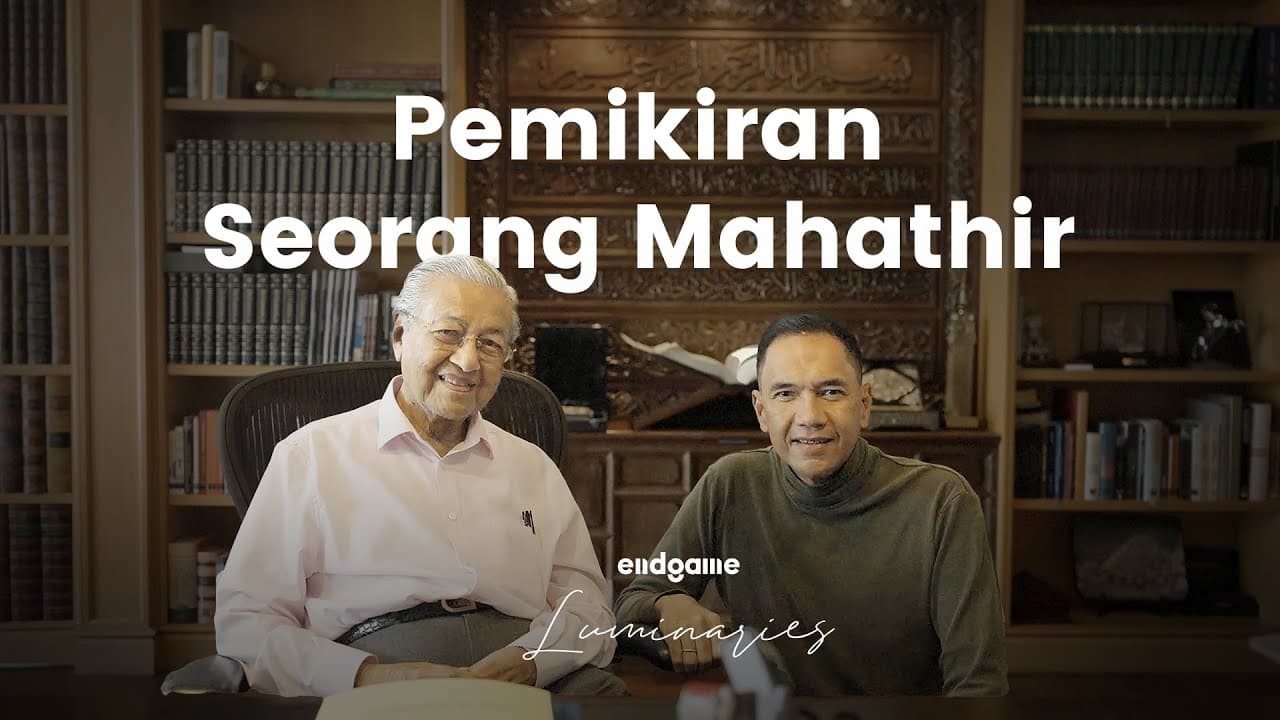
Mahathir Mohamad argues that democracy in Malaysia is challenged by political fragmentation and social media's influence on misinformation. He emphasizes the need for enhanced education, particularly in STEM, and a return to Quranic teachings to address misunderstandings within Islam and promote cultural advancement.
Transcript
GITA WIRJAWAN: Hello friends, today we're having Tun Mahathir Mohammad. The former prime minister of Malaysia who has led Malaysia twice. First, he served as a prime minister for 22 years, until 2003. And the second period, it was for almost two years, from 2018 to 2020. It's a pleasure and an honor for you to be here and for me to be able to sp... Read More
Key Insights
- Mahathir Mohamad transitioned from medicine to politics to gain credibility and influence change in Malaysia, emphasizing the importance of education in political credibility.
- Malaysia's multi-racial dynamics influenced Mahathir's political motivations, aiming to increase Malay participation in business and entrepreneurship.
- Mahathir criticizes the lack of challenge in Malay culture, suggesting it hinders their entrepreneurial spirit compared to other ethnic groups in Malaysia.
- Leadership in Malaysia was historically limited to the ruling class, with ordinary people only participating politically post-British colonial rule.
- Democracy, according to Mahathir, is complex and often destabilized by multiple parties, leading to fragmented political landscapes and unstable governments.
- Mahathir highlights the challenges social media poses to democracy by spreading unchecked information, leading to misinformed electorates.
- Islamic teachings, according to Mahathir, have been misinterpreted over time, leading to divisions among Muslims; he advocates for a return to Quranic teachings.
- Mahathir underscores the importance of STEM education in the Muslim world, citing the lack of scientific achievements as a result of educational shortcomings.
Install to Summarize YouTube Videos and Get Transcripts
Explore YouTube Video Summarizer or Get YouTube Transcript Extractor
Questions & Answers
Q: What motivated Mahathir to switch from medicine to politics?
Mahathir Mohamad was initially motivated to enter politics to gain credibility and influence change in Malaysia. He realized that having a university degree would give him the necessary credibility to be taken seriously in political circles. Although he intended to study law, he was given a scholarship to study medicine, which he accepted as it still provided him with a university education.
Q: How does Mahathir view the role of Malays in business?
Mahathir expresses disappointment with the lack of Malay involvement in business, attributing it to a cultural preference for secure, salaried jobs over entrepreneurship. He notes that in his hometown of Alor Setar, business was dominated by Chinese and Indians, with Malays largely absent. He believes that Malays need to be more proactive in seeking business opportunities to secure their fair share of the country's wealth.
Q: What are Mahathir's views on democracy and its challenges?
Mahathir acknowledges that democracy is a complex system that provides power to the people, but it often leads to instability due to the fragmentation of political parties. He notes that in new democracies, losing parties frequently challenge election results, leading to political instability. He suggests that a two-party system might offer a more stable political environment.
Q: How does Mahathir perceive the impact of social media on democracy?
Mahathir believes that social media poses significant challenges to democracy by spreading unchecked and often false information. Unlike traditional media, which is subject to editorial oversight, social media allows anyone to publish content, leading to misinformation and confusion among the electorate. This undermines informed decision-making and can destabilize democratic processes.
Q: What does Mahathir suggest about the interpretation of Islam?
Mahathir argues that the varied interpretations of Islam have led to divisions among Muslims. He advocates for a return to the teachings of the Quran, which he believes provide clear and positive guidance for life. He criticizes those who rely solely on religious leaders' interpretations without referring directly to the Quran, leading to misunderstandings and conflicts.
Q: Why does Mahathir emphasize STEM education for Muslims?
Mahathir emphasizes the importance of STEM education for Muslims to regain scientific and technological prominence. He highlights the historical achievements of Muslims in science and mathematics and contrasts them with the current lack of representation in fields recognized by Nobel prizes. He believes that a focus on STEM education is crucial for Muslims to contribute meaningfully to global scientific advancements.
Q: What role does Mahathir believe leadership plays in education reform?
Mahathir believes that enlightened leadership is necessary to reform education systems, particularly in the Muslim world. He calls for a curriculum that emphasizes both religious and scientific knowledge, arguing that current educational practices focus too much on the afterlife and not enough on worldly knowledge. He stresses the need for leaders to be knowledgeable and brave enough to initiate these changes.
Q: How does Mahathir view the role of teachers in education?
Mahathir acknowledges the critical role of teachers in education but notes that many teachers are not adequately qualified, often becoming teachers because they couldn't pursue other disciplines. He advocates for the use of technology to broadcast lessons from the best teachers, ensuring quality education across classrooms. He also highlights the need for better recognition and compensation for teachers to attract top talent into the profession.
Summary & Key Takeaways
-
Mahathir Mohamad discusses his journey from medicine to politics, emphasizing the need for education to gain credibility and influence in Malaysia. He highlights the racial dynamics in Malaysia and his desire to increase Malay involvement in business.
-
He critiques the current state of democracy, noting the challenges posed by social media and the fragmentation of political parties. Mahathir suggests that a two-party system might offer more stability and effectiveness in governance.
-
Mahathir reflects on the historical openness of Muslims to learning and science, contrasting it with current educational practices. He calls for a return to Quranic teachings and a focus on STEM education to regain scientific prominence.
Read in Other Languages (beta)
Share This Summary 📚
Summarize YouTube Videos and Get Video Transcripts with 1-Click
Try YouTube Summary with ChatGPT & Claude or YouTube Transcript Generator
Explore More Summaries from Gita Wirjawan 📚



Summarize YouTube Videos and Get Video Transcripts with 1-Click
Try YouTube Summary with ChatGPT & Claude or YouTube Transcript Generator