How to Solve Sudoku Puzzles Efficiently with Code
TL;DR
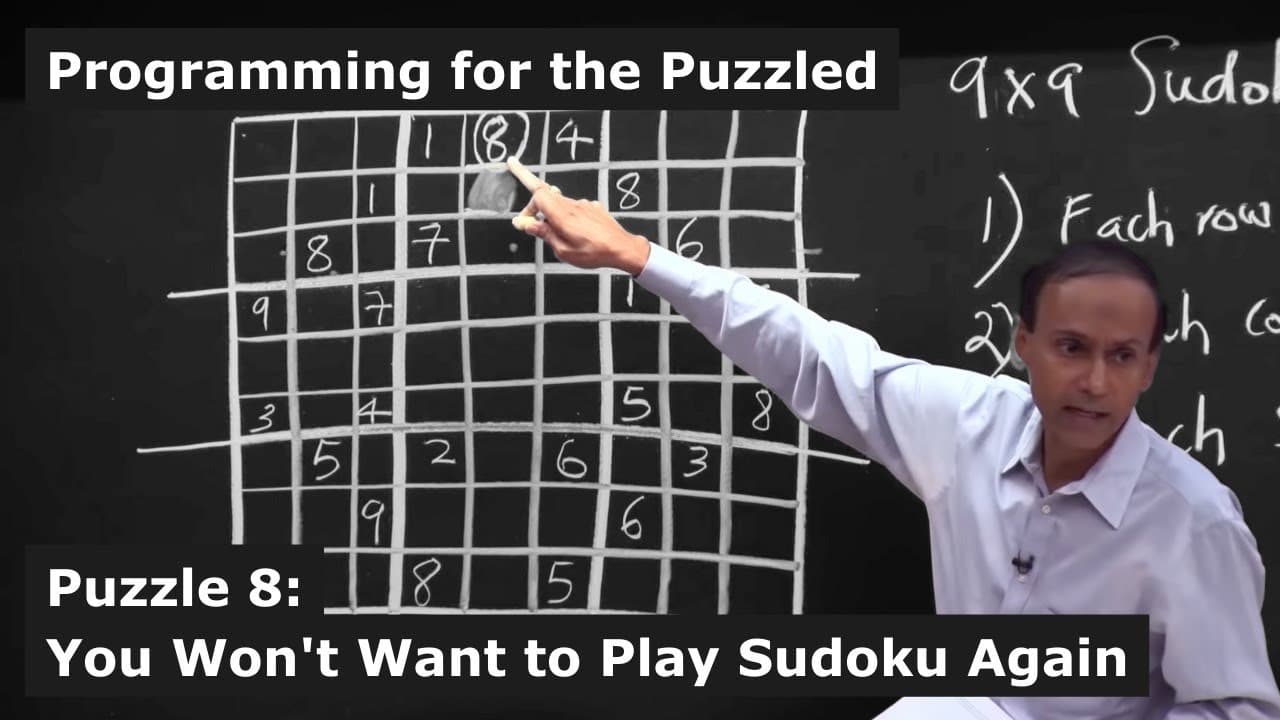
To solve Sudoku puzzles efficiently, combine brute force search with smart implications that deduce placements based on existing numbers. By implementing a computer program that utilizes both methods, you can significantly improve performance and reduce the number of backtracks needed to find a solution.
Transcript
SRINI DEVADAS: All right good morning, everyone. Welcome back. I hope you had a good long weekend. So today's puzzle is, I guess, a classic puzzle. It's Sudoku. I've never actually successfully managed to complete a Sudoku puzzle by myself, because they've fallen into two categories for me. Either they're easy, and I get bored and I stop. Or they'r... Read More
Key Insights
- 🧩 Sudoku puzzles can be challenging to solve manually due to the complexity of possible combinations.
- 🧩 Brute force search can be used to solve Sudoku puzzles, but it may take a long time for complex puzzles.
- 👨🔬 Integrating implications into the search process can significantly improve the solver's performance.
- #️⃣ The number of backtracks made by the program is a proxy for measuring performance.
Install to Summarize YouTube Videos and Get Transcripts
Explore YouTube Video Summarizer or Get YouTube Transcript Extractor
Questions & Answers
Q: What is the author's experience with solving Sudoku puzzles manually?
The author admits that they have never successfully completed a Sudoku puzzle by themselves and prefer to write computer programs to solve them.
Q: How does the author's program solve Sudoku puzzles?
The program uses a combination of brute force search and smart implications. Initially, it generates all possible combinations and then prunes the search by employing deductions and constraints.
Q: How does the author measure the performance of their program?
The author suggests using a metric called "backtracks" to measure performance. Backtracks refer to the number of incorrect guesses made by the program during the search process.
Q: How does the program handle implications?
The program examines each sector, row, and column of the Sudoku puzzle to identify missing numbers. It then checks if there is only one possibility for a certain position based on the existing numbers. This deduction is considered an implication.
Summary & Key Takeaways
-
The content discusses the author's attempt to solve Sudoku puzzles using a computer program.
-
The program is able to solve any Sudoku puzzle by employing brute force search and smart implications.
-
The author introduces the concept of "implications," which are deductions made based on the existing numbers in the puzzle.
Read in Other Languages (beta)
Share This Summary 📚
Summarize YouTube Videos and Get Video Transcripts with 1-Click
Try YouTube Summary with ChatGPT & Claude or YouTube Transcript Generator
Explore More Summaries from MIT OpenCourseWare 📚



Summarize YouTube Videos and Get Video Transcripts with 1-Click
Try YouTube Summary with ChatGPT & Claude or YouTube Transcript Generator