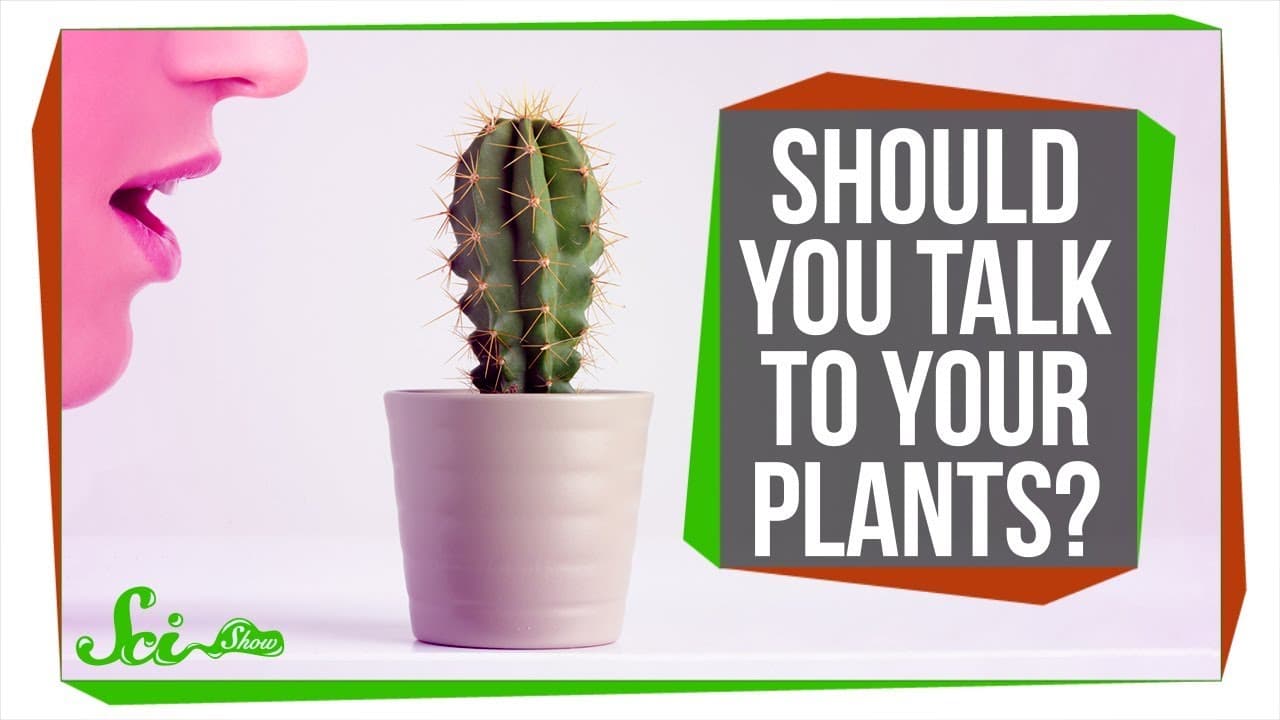
Should You Talk to Your Plants to Help Them Grow?
TL;DR
Talking to plants may have a positive effect on their growth due to the sound waves and carbon dioxide emitted during conversation.
Transcript
♪ INTRO ♪ You might have heard that plants do better with a bit of verbal encouragement. The idea that plants like being talked to is an old one—there’s mention of it in a book published in 1848. And it sort of seems plausible: When you talk, you send both sound waves and carbon dioxide into the air, either of which could affect plants. But althoug... Read More
Key Insights
- 🧡 Plants tend to respond to sound waves with frequencies between 50 and 500 hertz, similar to human vocal range.
- 🌱 Exposing plants to recordings of talking or classical music has shown positive effects on growth and seed germination.
- 💨 Plants may react to sound because they associate it with changes in wind or vibrations caused by animal movement.
- 🎵 Growth hormones and gene expression in plants can be influenced by exposure to music or single-note tones.
- 🌱 The effects of a normal conversation on plant growth are still unknown.
- 🧑🏭 The carbon dioxide in breath may act as a fertilizer for plants, but it is unclear if talking provides enough CO2 to make a difference.
- 💉 Talking to plants may indirectly improve their health by increasing attention towards their needs.
Install to Summarize YouTube Videos and Get Transcripts
Explore YouTube Video Summarizer or Get YouTube Transcript Extractor
Questions & Answers
Q: Does talking to plants directly contribute to their growth?
While there is no direct scientific evidence, experiments with recordings of talking or music suggest that sound waves can influence plant growth. However, the effects of a normal conversation or the carbon dioxide in breath are still unknown.
Q: Why do plants respond to sound waves?
Plants may perceive sound waves as wind or vibrations from animal movement, which can stimulate cellular activity. This can lead to an increase in growth hormones and changes in gene expression, promoting plant growth.
Q: Can talking to plants improve their health?
Paying closer attention to plants while talking to them may improve their health indirectly. By closely observing the plants, one is more likely to notice if they need water, light, or are being attacked by pests.
Q: Are there more effective ways to nourish plants than talking to them?
Yes, providing plants with appropriate lighting, water, and nutrients will have a more significant impact on their growth than talking to them. These are the basic requirements plants need for healthy development.
Summary & Key Takeaways
-
Some plants respond to sound waves with frequencies within the human vocal range, leading to better growth and faster seed germination when exposed to recordings of talking or classical music.
-
Plants may react to noise because they are tuned to detect changes in wind and vibrations caused by animal movement, which can stimulate their cells.
-
Research has shown increases in growth hormones and changes in gene expression in plants exposed to music or single-note tones.
Read in Other Languages (beta)
Share This Summary 📚
Summarize YouTube Videos and Get Video Transcripts with 1-Click
Try YouTube Summary with ChatGPT & Claude or YouTube Transcript Generator
Explore More Summaries from SciShow 📚


Summarize YouTube Videos and Get Video Transcripts with 1-Click
Try YouTube Summary with ChatGPT & Claude or YouTube Transcript Generator