Introduction to Meiosis | Don't Memorise
TL;DR
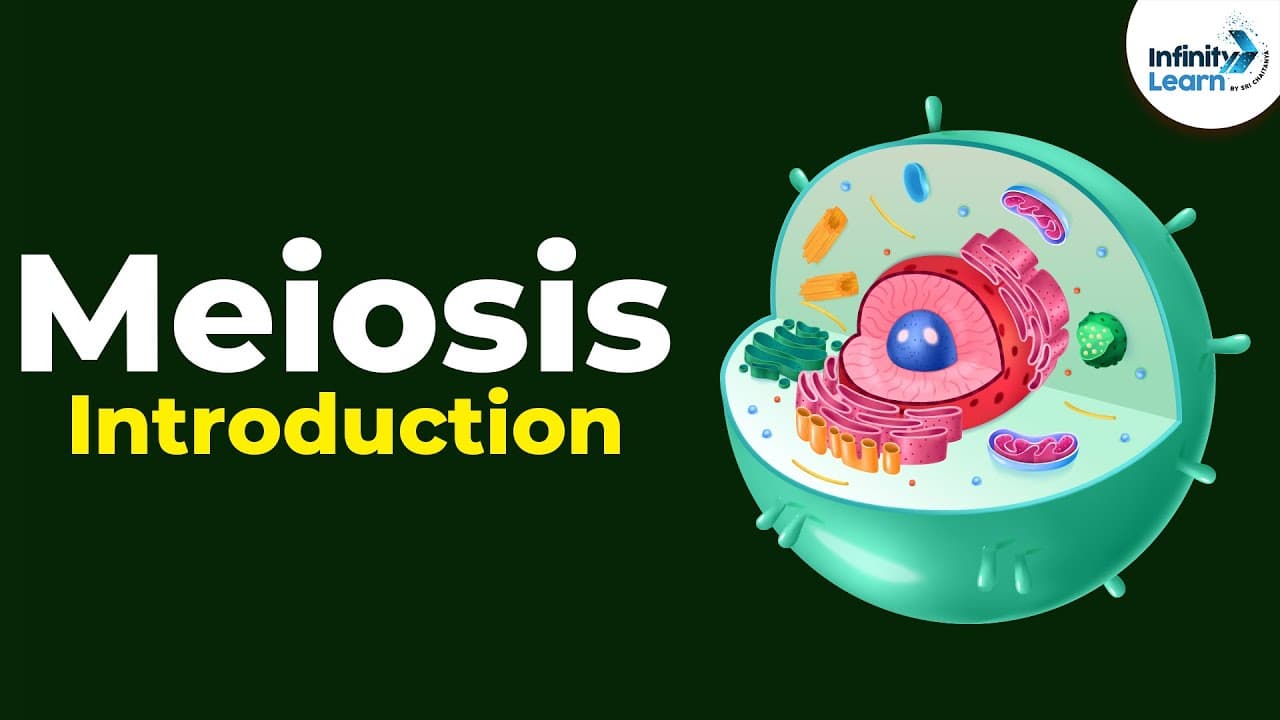
Meiosis is a unique type of cell division that produces four daughter cells with half the number of chromosomes, allowing for sexual reproduction.
Transcript
have you ever thought of cloning yourself or regenerating some of your organs but being humans we can't just divide into two to make an extra copy of ourselves or regenerate any of our parts if we were some other type of organism let's say a starfish or a cactus then cloning or regenerating would have been possible starfish show a startling propert... Read More
Key Insights
- #️⃣ Meiosis is a process specialized for sexual reproduction, producing four daughter cells with half the number of chromosomes to maintain the species' chromosome number.
- ❓ Mitosis is employed by organisms like starfish and cacti for regeneration and asexual reproduction.
- ➗ Meiosis is also known as reduction division due to producing cells with half the chromosome number.
- 😕 Sexual reproduction involves two cells with half the number of chromosomes fusing to form an embryo.
- 😫 Haploid cells have a single set of chromosomes, while diploid cells have two sets.
- #️⃣ The chromosome number in the fusing cells needs to be halved to maintain the correct chromosome number in the zygote.
- ❓ Meiosis increases the chances of fertilization by producing four daughter cells.
Install to Summarize YouTube Videos and Get Transcripts
Explore YouTube Video Summarizer or Get YouTube Transcript Extractor
Questions & Answers
Q: Why do starfish and cacti have the ability to regenerate or clone themselves?
Starfish and cacti can regenerate or clone themselves through processes like regrowing lost limbs or developing new cacti from fragments because they employ the process of mitosis, which aids in asexual reproduction.
Q: How is sexual reproduction different from asexual reproduction?
Sexual reproduction involves two parent cells, one from each parent, combining to form an embryo. This requires the fusion of two cells with half the number of chromosomes to maintain the species' chromosome number. In contrast, asexual reproduction relies on mitosis to produce genetically identical offspring.
Q: What is the significance of meiosis producing four daughter cells?
Meiosis produces four daughter cells with half the number of chromosomes to ensure that when two cells fuse during sexual reproduction, the resulting zygote maintains the correct chromosome number. It also increases the chances of successful fertilization.
Q: What is the difference between a haploid cell and a diploid cell?
A haploid cell has a single set of chromosomes, while a diploid cell has two sets of chromosomes. This means a diploid cell has chromosomes in double doses, while a haploid cell has chromosomes in a single dose. Reproductive cells with half the number of chromosomes, like human egg and sperm cells, are haploid.
Summary & Key Takeaways
-
Meiosis is a process that gives rise to four daughter cells, each with half the number of chromosomes compared to the parent cell.
-
Humans and many other plants and animals rely on sexual reproduction, which requires two cells with half the number of chromosomes to fuse and maintain the species' chromosome number.
-
Meiosis is also known as reduction division because it yields cells with half the chromosome number.
Read in Other Languages (beta)
Share This Summary 📚
Summarize YouTube Videos and Get Video Transcripts with 1-Click
Try YouTube Summary with ChatGPT & Claude or YouTube Transcript Generator
Explore More Summaries from Infinity Learn NEET 📚

Summarize YouTube Videos and Get Video Transcripts with 1-Click
Try YouTube Summary with ChatGPT & Claude or YouTube Transcript Generator