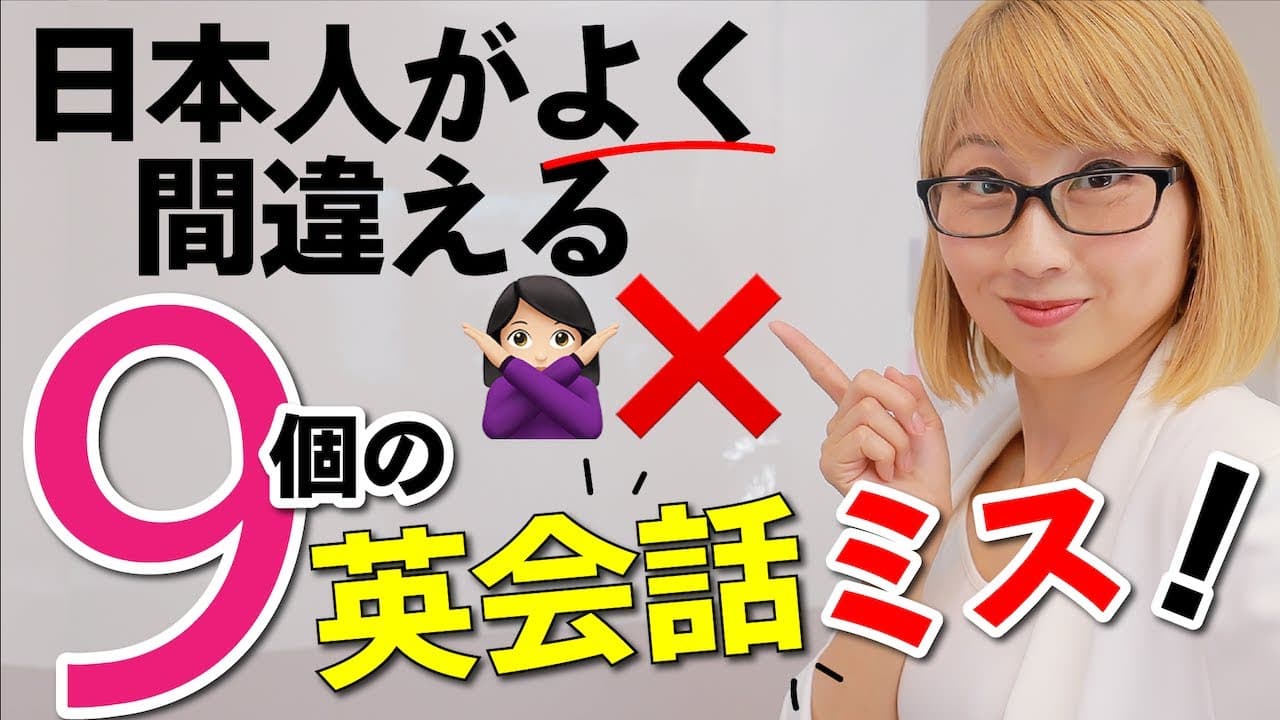
日本人がよく間違える9個の英会話!英語学習中の夫のリアルなミスを解説☆〔#1019〕
TL;DR
The video discusses common English mistakes made by Japanese learners.
Transcript
my wife and i my wife is and i my wife my wife is there something that chica should know aloha do you remember me we met a few years ago of course yes chica told me that you're studying english yes yes did you know that i used to teach english did she tell you that i don't know she asked me to come here and teach you a bit of english oh but i'm goi... Read More
Key Insights
- Japanese learners often confuse 'I'm' and 'I've', leading to incorrect phrases like 'I'm live in Japan' instead of 'I live in Japan'.
- The use of possessive pronouns is essential in English, unlike in Japanese, which can lead to errors such as omitting 'my' or 'our'.
- Understanding time expressions like 'this coming Tuesday' can be confusing for learners and requires explanation.
- Describing occupations or activities, such as 'my work is a Youtuber', can be improved by saying 'I make YouTube videos for a living'.
- Differentiating between 'originality' and 'originally' is crucial, as they have distinct meanings in English.
- Responding to 'do you mind' questions can be tricky, and learners should be careful to respond appropriately.
- Expressing desires or hypothetical situations, such as 'I want to live more in Malaysia', can be refined to 'I wish we could have stayed longer'.
- Communicating multiple purposes for a trip can be simplified by stating 'we're going for both work and vacation'.
Install to Summarize YouTube Videos and Get Transcripts
Explore YouTube Video Summarizer or Get YouTube Transcript Extractor
Questions & Answers
Q: What is a common mistake Japanese learners make with possessive pronouns?
Japanese learners often omit possessive pronouns like 'my' or 'our' because they are not required in Japanese. This leads to phrases like 'daughter is four' instead of 'our daughter is four'. It's important to include these pronouns to convey ownership or relation in English.
Q: How can learners improve their understanding of time expressions?
Learners can improve by familiarizing themselves with common expressions like 'this coming Tuesday', which means the closest Tuesday. Understanding these phrases helps in planning and discussing schedules accurately, especially when communicating with native English speakers.
Q: What is a better way to describe one's occupation as a Youtuber?
Instead of saying 'my work is a Youtuber', learners can say 'I make YouTube videos for a living'. This phrase clearly communicates that creating content on YouTube is their profession and source of income, making it more understandable to native speakers.
Q: What is the difference between 'originality' and 'originally'?
Originality refers to the uniqueness or creativity of something, while originally means 'in the beginning' or 'initially'. Understanding this distinction is crucial for learners to use these words correctly in sentences, as they convey different meanings.
Q: How should learners respond to 'do you mind' questions?
When asked 'do you mind', learners should respond with 'no' if they are okay with the request, as saying 'yes' implies they do mind. This can be confusing, but understanding the context helps in providing the appropriate response.
Q: How can learners express a desire to stay longer in a place?
Instead of saying 'I want to live more in Malaysia', learners can say 'I wish we could have stayed longer'. This phrase conveys a desire to extend the stay and sounds more natural in English, especially in conversations about past experiences.
Q: What is a simple way to communicate multiple purposes for a trip?
Learners can say 'we're going for both work and vacation' to express multiple purposes for a trip. This concise statement is clear and helps avoid confusion, especially when explaining travel plans to others.
Q: Why is it important for learners to practice their English regularly?
Regular practice helps learners internalize corrections and improves fluency. It allows them to become more comfortable with English grammar and vocabulary, reducing the likelihood of repeating common mistakes and enhancing their overall communication skills.
Summary & Key Takeaways
-
The video highlights common English mistakes made by Japanese learners, focusing on grammar and vocabulary usage. It provides examples and corrections to improve fluency.
-
Key areas of improvement include possessive pronouns, time expressions, and correct responses to questions, which are often challenging for learners.
-
The video offers practical advice and examples to help learners sound more fluent and confident in their English conversations.
Read in Other Languages (beta)
Share This Summary 📚
Summarize YouTube Videos and Get Video Transcripts with 1-Click
Try YouTube Summary with ChatGPT & Claude or YouTube Transcript Generator
Explore More Summaries from バイリンガール英会話 | Bilingirl Chika 📚






Summarize YouTube Videos and Get Video Transcripts with 1-Click
Try YouTube Summary with ChatGPT & Claude or YouTube Transcript Generator