Can Math Explain How Animals Get Their Patterns?
TL;DR
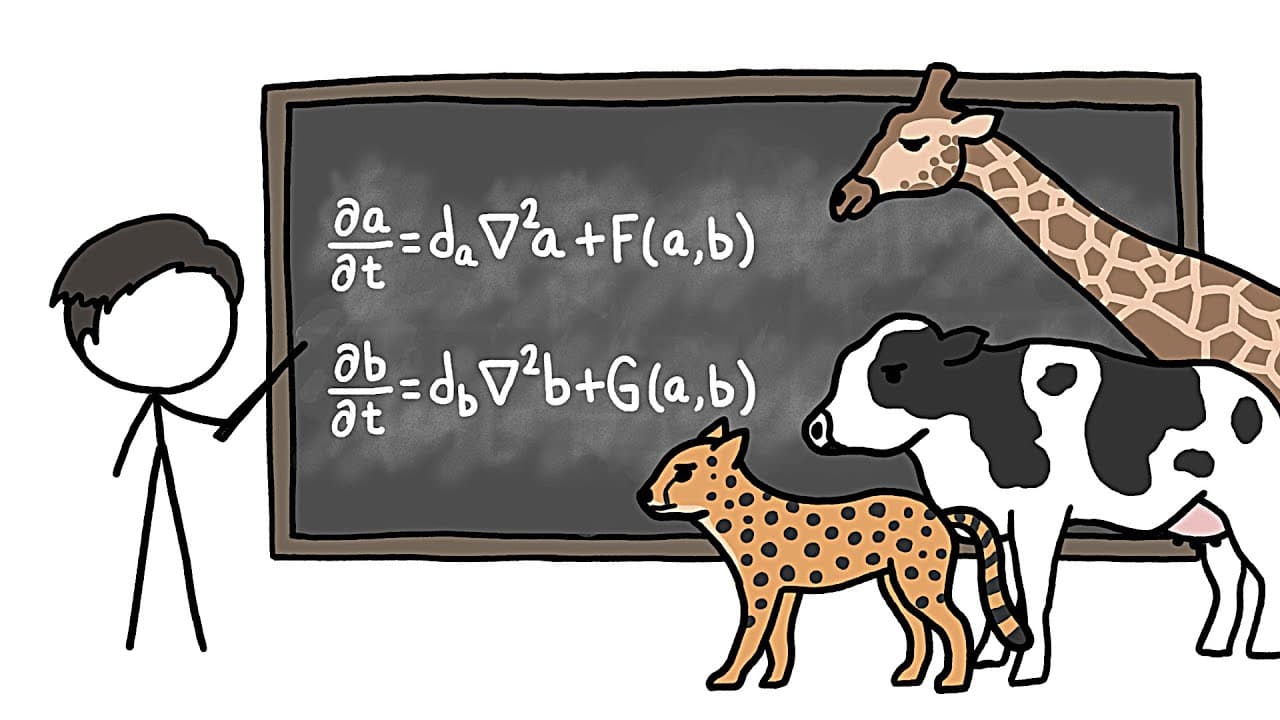
Alan Turing developed a mathematical theory that explains how patterns in nature arise from the interactions between activator and inhibitor substances within organisms.
Transcript
Nature exhibits a seemingly endless array of patterns – from the cow’s spots to the surgeonfish’s stripes to the cheetah’s spots and stripes – but Alan Turing (the guy who invented computers) thought those patterns might not actually be all that different. To show what he meant, he came up with a simple set of mathematical rules that could give ris... Read More
Key Insights
- ❓ Alan Turing's mathematical theory proposed that patterns in nature arise from the interactions between activator and inhibitor substances.
- ❓ Adjusting variables in the theory can generate various patterns, including spots, stripes, and labyrinths.
- 🤟 While some patterns in nature seem to follow Turing-like systems, others are predetermined by genetic factors.
- 🥺 Observations inspired by Turing's theory have led scientists to investigate the role of activator and inhibitor dynamics in living organisms.
Install to Summarize YouTube Videos and Get Transcripts
Explore YouTube Video Summarizer or Get YouTube Transcript Extractor
Questions & Answers
Q: What are Turing's activator and inhibitor substances?
Turing's theory suggests that organisms have two substances, an activator and an inhibitor. The activator stimulates the production of both substances, while the inhibitor slows down production.
Q: How do Turing's rules lead to the formation of patterns?
Turing's rules state that as the populations of predator and prey increase, their ranges expand. The inhibitor (predator) expands faster, dominating the surrounding areas, while the activator (prey) multiplies in the middle, causing changes and patterns wherever it is more abundant.
Q: Can Turing's theory explain real-life patterns in nature?
Scientists are still investigating whether actual activator and inhibitor substances contribute to patterns in nature. Some patterns, like those in fruit fly development, appear predetermined by genetic factors, while others, like the stripey ridges in developing mice, exhibit Turing-like systems involving proteins.
Q: How did Turing's theory influence research in biology?
Turing's theory inspired biologists to search for evidence of activator and inhibitor dynamics in living creatures. Observations and experiments based on his ideas have brought us closer to understanding the origins of patterns in nature.
Summary & Key Takeaways
-
Alan Turing proposed a set of mathematical rules involving activator and inhibitor substances that could generate various patterns in nature.
-
Turing's theory suggests that the population dynamics of predator and prey species can lead to the formation of patterns, with the inhibitor dominating the surrounding areas.
-
Adjusting the variables in Turing's theory can produce different patterns like spots, stripes, and labyrinths.
Read in Other Languages (beta)
Share This Summary 📚
Summarize YouTube Videos and Get Video Transcripts with 1-Click
Try YouTube Summary with ChatGPT & Claude or YouTube Transcript Generator
Explore More Summaries from MinuteEarth 📚




Summarize YouTube Videos and Get Video Transcripts with 1-Click
Try YouTube Summary with ChatGPT & Claude or YouTube Transcript Generator