How Did We Figure Out What Light Is?
TL;DR
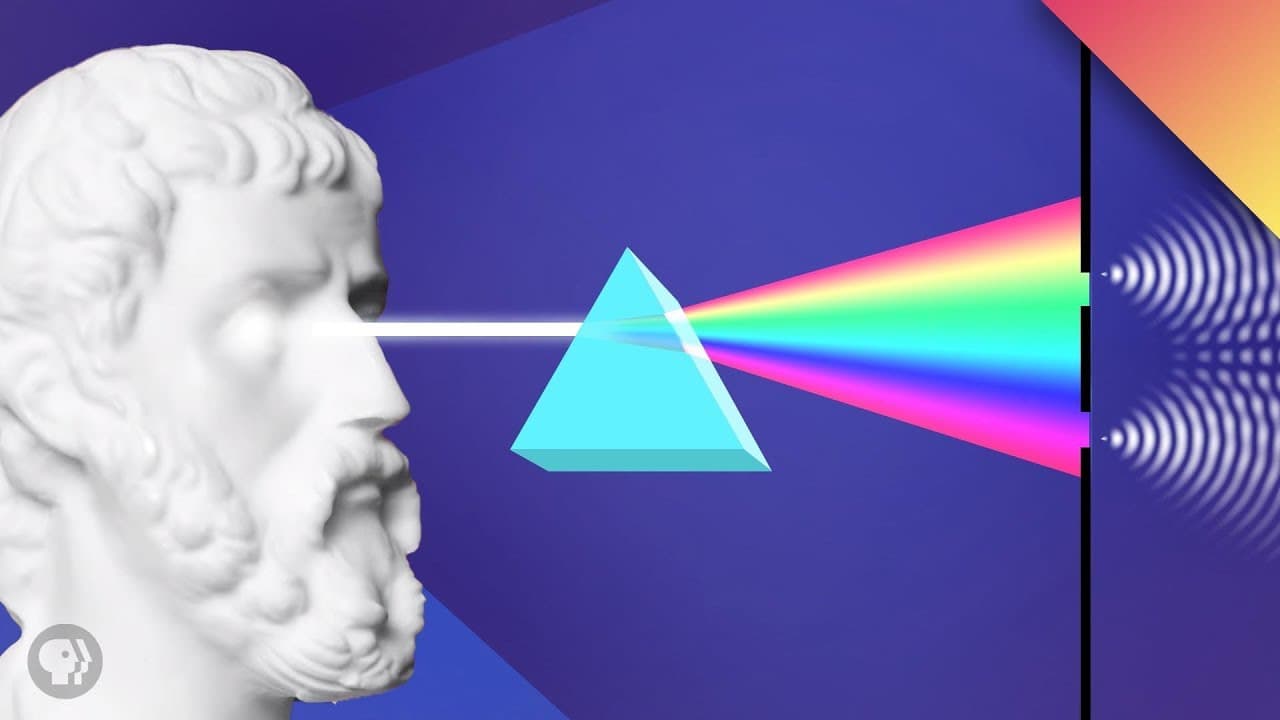
Through scientific discoveries, we have learned that light is not only a wave or a particle, but both simultaneously, leading to the development of modern quantum theory.
Transcript
If a light is on and no one is around to see it, is anything actually lit up? The ancient Greeks didn’t think so. They thought vision was due to rays ‘shot out’ and returned to the eye. That’s… not how it works. Unless your name is Cyclops. It took over 2,000 years, from those Greeks all the way to Einstein, to figure out how we see the world…. And... Read More
Key Insights
- 📺 The ancient Greeks believed in a falsified theory regarding how vision occurs.
- 🙂 Ibn Al-Haytham's experiments proved that light existed outside our bodies.
- ❓ Newton's experiments with prisms provided insight into the nature of color.
- 🙂 Maxwell's unification of electricity and magnetism led to the realization that light is an electromagnetic wave.
- 🙂 The discovery of infrared and ultraviolet light expanded our understanding of the light spectrum.
- ❓ Einstein's theory of photons explained the photoelectric effect.
- 🙂 Light is both a wave and a particle, as revealed by quantum theory.
Install to Summarize YouTube Videos and Get Transcripts
Explore YouTube Video Summarizer or Get YouTube Transcript Extractor
Questions & Answers
Q: How did the ancient Greeks believe vision worked?
The ancient Greeks believed that vision occurred when rays of light were emitted from the eye and returned after interacting with objects.
Q: Who is considered the first true scientist in relation to the study of light?
Ibn Al-Haytham, an Arab Muslim, is considered the first true scientist in relation to the study of light because he conducted experiments to test the previously held beliefs about vision.
Q: How did Newton's experiments with prisms contribute to our understanding of light?
Newton's experiments with prisms showed that white light contains all colors and that objects absorb certain colors and reflect others, leading to the understanding of color as an intrinsic property of light.
Q: What did Max Planck contribute to our understanding of light?
Max Planck developed the theory of energy distribution across the light spectrum and introduced the concept of quanta, which are packets of energy that light consists of.
Key Insights:
- The ancient Greeks believed in a falsified theory regarding how vision occurs.
- Ibn Al-Haytham's experiments proved that light existed outside our bodies.
- Newton's experiments with prisms provided insight into the nature of color.
- Maxwell's unification of electricity and magnetism led to the realization that light is an electromagnetic wave.
- The discovery of infrared and ultraviolet light expanded our understanding of the light spectrum.
- Einstein's theory of photons explained the photoelectric effect.
- Light is both a wave and a particle, as revealed by quantum theory.
- The study of light has continually expanded our knowledge of the universe.
Summary & Key Takeaways
-
The ancient Greeks believed that vision occurred when rays of light were "shot out" and returned to the eye, but this was later proven false.
-
Scientists like Ibn Al-Haytham and Newton conducted experiments and studies that revealed the true nature of light.
-
Further research on light led to the understanding of its wave-particle duality and the development of modern quantum theory.
Read in Other Languages (beta)
Share This Summary 📚
Summarize YouTube Videos and Get Video Transcripts with 1-Click
Try YouTube Summary with ChatGPT & Claude or YouTube Transcript Generator
Explore More Summaries from Be Smart 📚




Summarize YouTube Videos and Get Video Transcripts with 1-Click
Try YouTube Summary with ChatGPT & Claude or YouTube Transcript Generator